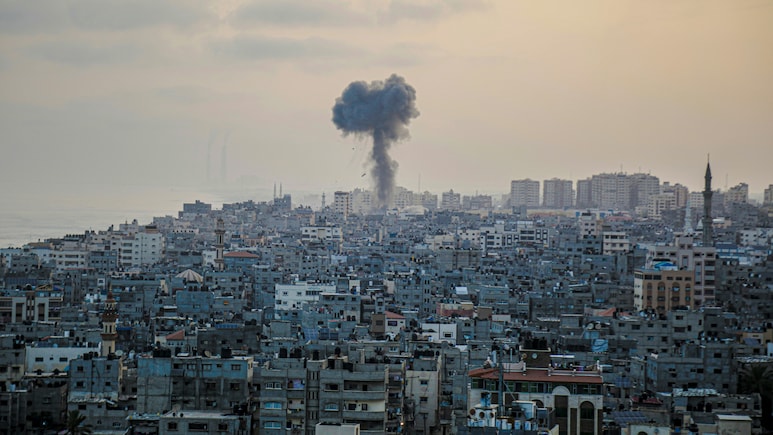
The United States carried out 'self-defence' strikes against targets in Iran on Tuesday after President Donald Trump blamed Tehran for an incident involving a US Army Apache helicopter near the Strait of Hormuz, further straining a fragile ceasefire and complicating ongoing diplomatic efforts between the two countries.
The latest exchange comes at a sensitive moment for negotiations over Iran's nuclear programme and security arrangements in the Gulf. It also raises fresh concerns about stability around the Strait of Hormuz, one of the world's most important energy transit routes.
US Central Command said forces launched what it described as self-defence strikes following the helicopter incident. In a statement posted on social media, the command said the operation was conducted on Trump's orders and represented “a proportional response to unjustified Iranian aggression.”
Also Read | Layoffs Are Rising In Tech, But These Skills Are Helping People Unlock Better Pay
Trump said Iran was responsible for the loss of the aircraft and argued that Washington had no choice but to respond.
“We must, of necessity, respond to this attack,” Trump said in a social media post.
The US president later told ABC News: “I believe the response should be very strong, very powerful, and that's what this one is.”
ALSO READ: 'US Must Respond': Trump Vows Retaliation After Iran Shoots Down Apache Helicopter
Crash Investigation
Questions remain over how the AH-64 Apache came down.
A Reuters report quoted a US official familiar with the investigation and said authorities are examining evidence that the helicopter collided with an Iranian drone while operating near the Strait of Hormuz. The official spoke to Reuters on condition of anonymity because the inquiry remains ongoing.
Officials have not determined whether any collision was deliberate. Public statements from US authorities have so far said only that the circumstances surrounding the crash remain under investigation.
The two crew members survived the incident and were recovered about two hours later, according to US Central Command.
Trump said both service members were “safe and uninjured.”
Capt. Tim Hawkins, a spokesperson for Central Command, said an uncrewed surface vessel located the aviators and moved them to another position at sea before a helicopter completed the recovery, according to a report by Associated Press.
The operation marked the first publicly known rescue of its kind involving a US military drone vessel, AP reported quoting Hawkins as saying.
The vessel used in the mission was a 24-foot craft known as a Corsair. Hawkins said the platform is assigned to Task Force 59, the Navy unit established in 2021 to expand the use of autonomous and artificial intelligence-enabled systems across Middle East waters, including the Strait of Hormuz and the Suez Canal, according to AP report.
Tehran Responds
Iranian state media reported explosions on Qeshm Island and in areas near the Strait of Hormuz after the US strikes.
Iranian Foreign Minister Abbas Araghchi rejected suggestions that Tehran was solely responsible for the helicopter incident and warned foreign militaries operating near Iranian territory faced increasing risks.
“Foreign forces in proximity to our territory are at constant risk on account of their own human errors, plain accidents, or potentially being caught in crossfire,” Araghchi wrote in a post on X.
“To reduce risk, best solution is for them to leave.”
Later, Araghchi vowed that Iran would respond to the latest American military action.
“Iranian forces will leave no attack or threat unanswered,” he said.
ALSO READ: 'Not A Single Drop': Centre Reaffirms Indus Water Stance Against Pakistan
Deal Under Pressure
The military escalation came despite renewed signs of diplomacy only hours earlier.
Before the helicopter incident became public, Trump had suggested negotiations with Tehran were moving closer to a breakthrough.
“We have a good chance” of reaching an agreement within “two or three days,” Trump said late Monday.
He added: “We're very close to having a very, very good, strong, powerful deal.”
Diplomatic efforts involving regional mediators, with Pakistan playing a central role, have continued for weeks. However, major differences remain.
Washington wants Iran to relinquish its stockpile of highly enriched uranium and accept restrictions on its nuclear programme. Tehran has continued to seek sanctions relief and access to frozen assets as part of any agreement.
Iranian Parliament Speaker Mohammad Bagher Ghalibaf criticised Trump's comments earlier this week, saying Washington's public statements conflicted with understandings reached during negotiations.
Lebanon Front
The confrontation also unfolded against a backdrop of continued fighting in Lebanon.
Israel struck the southern port city of Tyre, killing at least eight people, according to reports cited by Reuters. The attack was the deadliest on the city since hostilities resumed in March.
Israeli forces later expanded evacuation warnings to additional areas of Tyre, including neighbourhoods that had largely avoided previous strikes.
Israel has maintained military pressure on Hezbollah despite wider ceasefire discussions involving Iran and the United States.
The continued conflict in Lebanon remains a key issue for Tehran, which has repeatedly linked broader regional stability to developments on that front.
Energy Route In Focus
The latest military exchange has renewed attention on the Strait of Hormuz, a waterway that remains critical to global energy supplies.
Before the conflict, roughly one-fifth of the world's crude oil and liquefied natural gas shipments moved through the route.
Iran has continued to restrict large parts of shipping traffic through the strait, while Washington has maintained pressure on Iranian ports.
US Energy Secretary Chris Wright said vessel movements through Hormuz had improved in recent days, though he cautioned that a full recovery in energy flows would take time.
“It would take many months to get back to normal flows of energy once the war is over,” Wright said.
The confrontation marks the sharpest deterioration in US-Iran relations since the ceasefire took effect two months ago, increasing uncertainty around both diplomatic negotiations and the security of a key global energy corridor.
Essential Business Intelligence, Sharp Market Insights, Practical Personal Finance Advice, Daily Fuel, Gold and Silver Prices and Latest Stories — On NDTV Profit.