- India targets 500 GW non-fossil power capacity by 2030 amid rising coal use
- Coal provides reliable, domestic energy, crucial for grid stability and peak demand
- India produces over 1 billion tonnes of coal annually with large strategic stockpiles
India has one of the world's most ambitious clean energy targets. Renewables already account for more than half of installed power capacity, and the government is pushing toward 500 gigawatts of non‑fossil capacity by 2030. Yet at the same time, India is producing and consuming more coal than ever. According to a recent Morgan Stanley report, this is not a contradiction, but a deliberate recalibration of energy strategy driven by security concerns in an increasingly unstable world.
At the heart of the shift is India's vulnerability to external shocks. The country imports around 85% of its crude oil and about 50% of its natural gas, leaving it highly exposed to geopolitical turmoil in the Middle East. Repeated disruptions have underscored a hard reality for policymakers: energy transitions that compromise reliability can quickly spill over into inflation, fiscal stress and slower growth.
Coal as Insurance, not Ideology
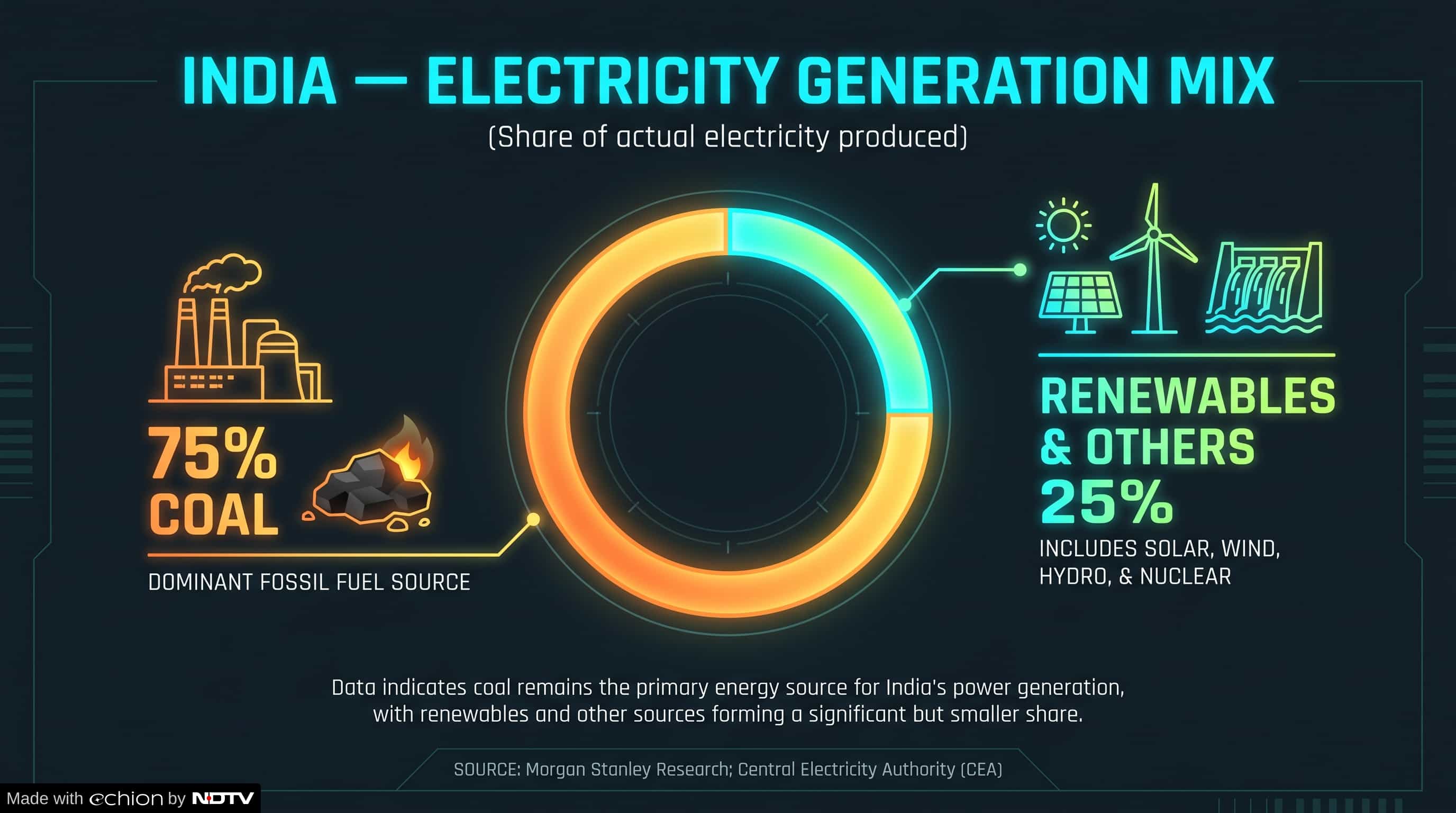
Coal remains India's only scalable, domestically available source of dispatchable energy. While solar and wind capacity has expanded rapidly, coal still generates roughly three‑quarters of India's electricity, making it indispensable for keeping the lights on when renewable output falters. Morgan Stanley notes that coal's role has grown precisely because it is insulated from global fuel markets and shipping chokepoints.
ALSO READ: Peak Power Demand At All-time High Of Over 256 GW On Saturday As Mercury Levels Soar
India now produces more than 1 billion tonnes of coal annually and has built record stockpiles of around 210 million tonnes, equivalent to nearly 90 days of consumption. These inventories function as a shock absorber, helping smooth power supply during demand spikes, monsoon disruptions or fuel import volatility — advantages that intermittent renewables and imported gas cannot yet offer.
At the same time, coal's function within the grid is changing. Rather than operating purely as baseload generation, thermal plants are increasingly used as flexible assets, ramping up during evening peaks when solar output drops sharply. This flexibility has become more valuable as renewables scale faster than transmission and storage infrastructure.
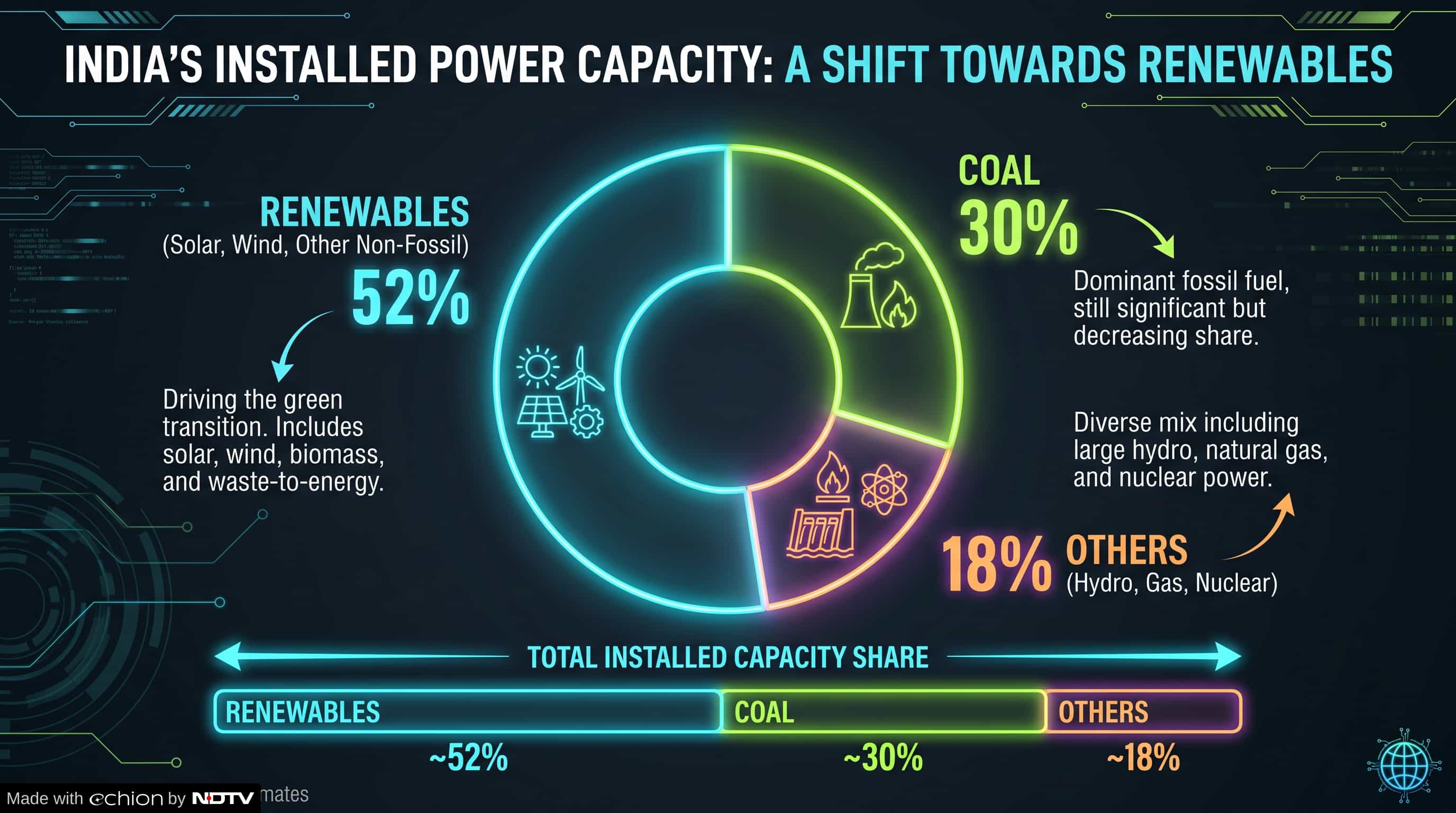
Non‑fossil capacity has crossed 50% of total installed power, and renewable deployment is accelerating. But integration challenges persist. Grid bottlenecks, curtailment, and limited battery storage mean renewables alone cannot yet guarantee round‑the‑clock reliability. Morgan Stanley argues that until storage, transmission and grid digitisation catch up, coal will remain the system's anchor.
This pragmatic sequencing explains why energy policy has evolved from “transition” to “security plus transition.” Rather than replacing coal outright, India is using it to buy time while investing in cleaner infrastructure.
ALSO READ: India Sets More Ambitious Climate Goals: 47% Emissions Cut, 60% Renewable Power By 2035
Nuclear's Quiet Return
Alongside coal, nuclear power is re‑emerging as a strategic solution. Nuclear currently accounts for less than 2% of installed capacity, but policy momentum is building. The government aims to scale capacity to more than 22 gigawatts by the early 2030s, with renewed focus on small modular reactors that can complement renewable-heavy grids.
For policymakers, nuclear offers something renewables and fossil fuels cannot: firm, low‑carbon power without exposure to global fuel price swings. As demand surges from data centres, EVs and industrial electrification, nuclear is increasingly viewed as essential for long‑term energy stability.
Morgan Stanley estimates that India's investment rate will climb to 37.5% of GDP by 2030, with incremental cumulative capex of around $800 billion over the next five years. Nearly 60% of this new investment is expected to flow into energy transition, defence and digital infrastructure, with utilities alone requiring close to $300 billion by 2031.
Essential Business Intelligence, Sharp Market Insights, Practical Personal Finance Advice, Daily Fuel, Gold and Silver Prices and Latest Stories — On NDTV Profit.