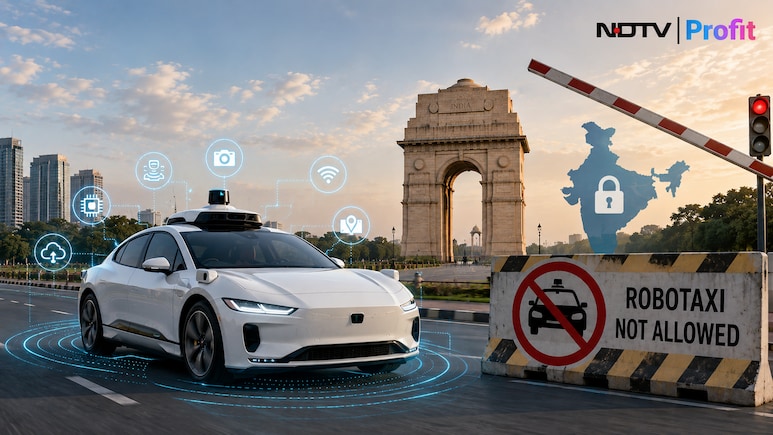
A couple of weeks ago, my uncle in the US booked a Waymo, the leading autonomous cab service and came out impressed. What struck me was the speed at which this idea became a reality. Unfortunately, India's policy stance remains hostile to driverless cars. That may protect some jobs today, but it also leaves India out of an industry that is rapidly growing.
India's Outright Ban Misses The Bigger Point
Road Transport and Highways Minister Nitin Gadkari said, on multiple occasions, "I will not allow driverless cars in India at any cost. This is because in our country, a large number of people are employed as drivers." That means if anyone wants to experience it, they may have to go to countries like the US. India has banned robotaxis completely.
I can understand this reason, but not the stand we have taken. We need to distinguish between allowing research or production and selling on Indian roads. Unfortunately, the policy stance may put India years behind its peers if it doesn't open the sector enough.
Also Read | Layoffs Are Rising In Tech, But These Skills Are Helping People Unlock Better Pay
ALSO READ | Brakes On Chinese Companies Going Global | The Reason Why
The Industry Is Moving Without Us
The most underappreciated part is that AVs are not about a car, the physical product. It is also probably more about the software, sensors, computing systems, and the data infrastructure. Those that control these layers will earn the highest margins and gain strategic influence globally.
Companies like Waymo don't build cars from scratch. They take an existing vehicle platform and add an autonomous stack: lidar, radar, cameras, compute, and sensor-fusion software. Those systems are sourced from specialised suppliers in the US, Europe, Israel, and China.
Waymo adds its hardware and software to Jaguar I-PACE SUVs at its Arizona plant. Baidu's Apollo Go customises the Baidu RT6 EV that is wholly manufactured in China. GM's Cruise modifies its Cruise Origin cars while Motional retrofits Korean-made Kia and Hyundai cars in American plants.
India is a meaningful exporter of conventional auto components, automotive electronics and even software. But it has not entered the AV ecosystem widely. And that is a missed opportunity.
India's R&D Needs More Support
I can understand the challenges of Indian roads for a fully driverless car. But we can use that to our advantage. Companies that can build systems capable of handling Indian traffic conditions may find it easier to deploy them elsewhere. Industrial leaders like former Mercedes CIO, Jan Brecht and Uber's former CEO Travis Kalanick, believe that running AVs in India is the ultimate test.
That's exactly why we need active R&D here.
Indian firms and academia are already heading this way. But they are taking it slow, starting with places where the conditions are conducive to testing this technology.
Wipro, the Indian Institute of Science (IISc), and RV College of Engineering have jointly tested a prototype designed for Indian road conditions. Flux Auto is developing self-driving trucks for mines and industrial zones. Flo Mobility is testing autonomous shuttles within IT parks. Minus Zero has developed India's first end-to-end autopilot system using a vision-based approach rather than the LiDAR-heavy systems common in Western countries. In Bhopal, Swaayatt Robots has tested self-driving Mahindra SUVs.
We are seeing this progress despite active policy support. So, the government must enable R&D in this space by inviting domestic and foreign automobile companies, component manufacturers, engineers, and research institutions.
ALSO READ | AI Boom Rewriting Labour Contract | The Reason Why
The Gains Beyond R&D
If we succeed in testing the full-fledged driverless car, the chances of becoming a global R&D hub increase.
Aggressive R&D in this sector can help us in at least a few aspects:
- It would attract better-quality FDI: not just assembly capital, but engineers, software teams, mapping systems, testing infrastructure, and university partnerships. It's the kind of FDI that compounds.
- It would push India up the value chain from generic components toward high-value, high-margin ones.
- It would create spillovers into logistics, mining, warehousing, defence, agriculture, and industrial automation.
India missed much of the early value creation in semiconductors and EV batteries. Today, it must import all of that. Autonomous systems could become the next major technology breakthrough. Waiting until the technology matures elsewhere risks repeating the same pattern.
A More Sensible Framework
India does not need to legalise robotaxis tomorrow. It needs a phased policy, something like this:
First, allow large-scale R&D, prototyping, and controlled testing by Indian and foreign firms. AVs should be permitted in closed environments such as mines, ports, warehouses, airports, industrial parks, and campuses, while encouraging export-oriented manufacturing of AV vehicles, software and components. This can be implemented right now.
Second, over the next decade, build the supporting ecosystem - safety regulations, quality roads, public awareness, insurance frameworks, cybersecurity standards, digital mapping, and data-reporting requirements. Limited public-road use can be introduced in controlled zones such as freight corridors, ports, and selected highways.
Finally, broader commercial deployment should be considered only after sufficient safety data is available. Any rollout should be gradual, restricted to approved operating conditions, and accompanied by measures to help workers adapt to the transition.
That is how India protects jobs without keeping Indian industry behind its peers.
ALSO READ | The World That Navigates From Constraints To Adaptation | The Week In Whys
Final Take
Waymo, Baidu, and others will keep improving on American and Chinese roads, whether India participates or not.
Every year India delays, the gap widens: in software, in manufacturing know-how, in data, in safety systems, and in supplier capability. By the time India eventually opens, it risks becoming a pure importer.
Whether Indian roads are ready or not is a different question. The policy should ensure that India becomes ready to build the tech that can run elsewhere.
Disclaimer: The views expressed in this article are solely those of the author and do not necessarily reflect the opinion of NDTV Profit or its affiliates. Readers are advised to conduct their own research or consult a qualified professional before making any investment or business decisions. NDTV Profit does not guarantee the accuracy, completeness, or reliability of the information presented in this article.
Essential Business Intelligence, Sharp Market Insights, Practical Personal Finance Advice, Daily Fuel, Gold and Silver Prices and Latest Stories — On NDTV Profit.