- India hosted Myanmar President U Min Aung Hlaing in New Delhi in June for high-level talks
- India and Myanmar agreed to boost cooperation on terror, insurgency, drugs, and border security
- Myanmar is vital to India’s Neighbourhood First, Act East, and Mahasagar foreign policy frameworks
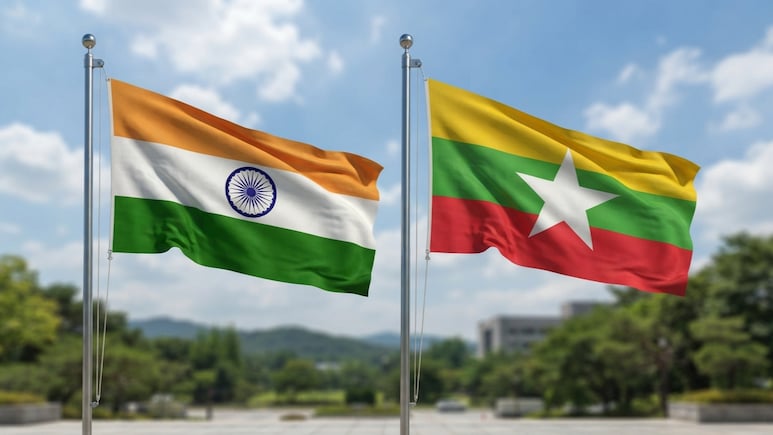
India's engagement with Myanmar has seen high level exchanges in the last few days including a visit by Myanmar President U Min Aung Hlaing to New Delhi in June this year. President U Min Aung Hlaing, who recently transitioned from military chief to civilian president, met Prime Minister Narendra Modi in Delhi. He also met External Affairs Minister S Jaishankar and National Security Adviser Ajit Doval.
The engagement continued at the 23rd National Level Meeting between the two countries held in New Delhi on July 7 and July 8 where the Indian side was led by Govind Mohan (home secretary) and the Myanmar side was led by Min Thu. India and Myanmar have decided to enhance cooperation in tackling terror threats, insurgency, drugs, cross-border crimes, etc. In addition, both nations have reiterated their commitment to ensuring stability in the border area, which remains sensitive.
Strategic Pivot Point
Also Read | Layoffs Are Rising In Tech, But These Skills Are Helping People Unlock Better Pay
Prime Minister Narendra Modi explicitly positioned Myanmar at the intersection of three of India's signature foreign policy doctrines, Neighbourhood First, Act East, and the recently articulated Mahasagar (Mutual and Holistic Advancement for Security and Growth Across Regions) framework — underscoring New Delhi's view that stable ties with Naypyidaw are non-negotiable for its regional ambitions.
Jaishankar and Doval both separately called on the Myanmar president, signalling the breadth of India's engagement and the weight New Delhi attaches to the relationship at this juncture. The level of exchanges is set to grow and continue with New Delhi's sustained engagement with its eastern neighbour despite the country's prolonged political crisis.
"The recent high-level engagements signal a willingness on India's part to adopt a more nuanced, multi-track approach to Myanmar," Cchavi Vasisht, associate fellow at the Centre for Geopolitics and Strategic Studies at the Chintan Research Foundation, said. "However, elevating engagement must be understood not as a blanket endorsement of all actors, but as a pragmatic, interest-driven strategy that balances principled support for democratic norms with pragmatic security imperatives."
"India's Act East Policy has always recognised Myanmar's centrality, but the current geopolitical context is compelling a sharper focus. With Bangladesh's evolving partnership with China, it is essential to recalibrate relations with the new government in Bangladesh and surely the MEA is looking into it.
"Myanmar, offers a more direct and strategically manageable route to Asean, albeit one that is currently complicated by internal instability. The policy response should be to double down on Myanmar as a primary axis of the Act East Policy, while maintaining Bangladesh as a complementary partner," Vasisht added.
ALSO READ: Renewed US-Iran Tensions Cloud India's Iran Oil Import Plans
Why Myanmar Matters
Myanmar sits at strategically important position and shares a 1,643-kilometre-long border with India across four northeastern states of India — Arunachal Pradesh, Nagaland, Manipur and Mizoram. Both countries share a heritage of religious, linguistic and ethnic ties. Myanmar is the only Asean country adjoining India and, therefore, India's gateway to South East Asia. India is seeking to enhance its cooperation with Myanmar in line with our 'Act East' and 'Neighbourhood First' Policies.
Kachin State in Myanmar, which shares a border with Arunachal Pradesh, is the world's largest source of rare earths and while India's trade with Myanmar has grown, there is scope to expand in areas like rare earths, which are critical for India's economic and national security. In 2021, China imported $200 million of rare earths from Myanmar in December 2021, exceeding 20,000 tonnes.
Since the signing of the India-Myanmar trade agreement in 1970, bilateral trade has grown steadily. India is the fourth largest trading partner of Myanmar and there is a lot of scope for expansion of trade relations with Myanmar as India seeks to expand trade partnerships for critical mineral supplies by focussing on nations that have resources, which India can look at for its own needs. India can definitely look at Myanmar if it seeks to diversify its supplies.
Myanmar, with its reserves of heavy rare earth elements is, therefore, very much an option for supplying to India and augmenting the country's diversified sources of rare earths.
Speaking on this possibility, Vasisht said: "This physical reality is compounded by the urgent need for upstream access to heavy rare earth minerals, particularly dysprosium and terbium, concentrated in Kachin and Shan States, which are critical for India's emerging focus on EV policy and defence-industrial programs and for diverting resources from China's near-monopoly over global supply chains."
"At the same time, China's deepening footprint in the China-Myanmar Economic Corridor (CMEC) and its ambition to shape regional connectivity via proposing the BCMC present a structural challenge that India cannot afford to ignore, making Myanmar's alignment a zero-sum question," Vasisht added.
What Are The Challenges?
Even though India has been stepping up engagement with National Unity Government of Myanmar, in border areas adjacent to India, the Ethnic Armed Organisations exert control and, therefore, India also has to factor in the presence and control of non-state actors or Ethnic Armed Organisation in the region. While the Tatmadaw (Myanmar's military ) has had some successes recently in the Chin State, the resultant implications are significant not only for Myanmar but also for neighbouring India and Bangladesh.
"India must engage and the engagement has been there at security agencies level well. Post 2021, work is already under process in this direction. Even Northeast states, such as Chief Minister Lalduhoma has acknowledged 'good relations' with the Arakan Army," Vasisht said.
Along with maintaining state-to-state relations, it is a strategic imperative given the reality on ground has changed with EAOs, particularly those controlling the India-Myanmar borderlands in Rakhine, Chin, and northern Sagaing, according to Vasisht. "They now exercise de facto governance and security functions in areas that directly affect India's border stability, and connectivity projects."
ALSO READ: Japanese Companies Are Going Bankrupt Again | The Reason Why
Essential Business Intelligence, Sharp Market Insights, Practical Personal Finance Advice, Daily Fuel, Gold and Silver Prices and Latest Stories — On NDTV Profit.