Pokémon was my favourite cartoon. I still remember collecting Cheetos Tazos and trading them with friends. That was the thing then. Kids today have anime. There are even anime conventions in India, a concept I was unaware of while growing up.
During both these generations, one thing has not changed. Be it Pokémon or anime, both came from Japan, and the obsession didn't stop at TV units. Japanese electronics became status symbols back then with Sony TVs, Panasonic music systems and Nintendo consoles. Today, it's matcha lattes, sushi, Uniqlo stores and even tourism.
Even economists can't stop talking about the country. Inflation has finally become a regular feature of the economy, after decades of deflation. Its side-effects, however, are hard to ignore. Bond yields are touching levels not seen in decades, and bankruptcies are also growing at the fastest rate in more than a decade.
Also Read | Layoffs Are Rising In Tech, But These Skills Are Helping People Unlock Better Pay
A New Bankruptcy Cycle
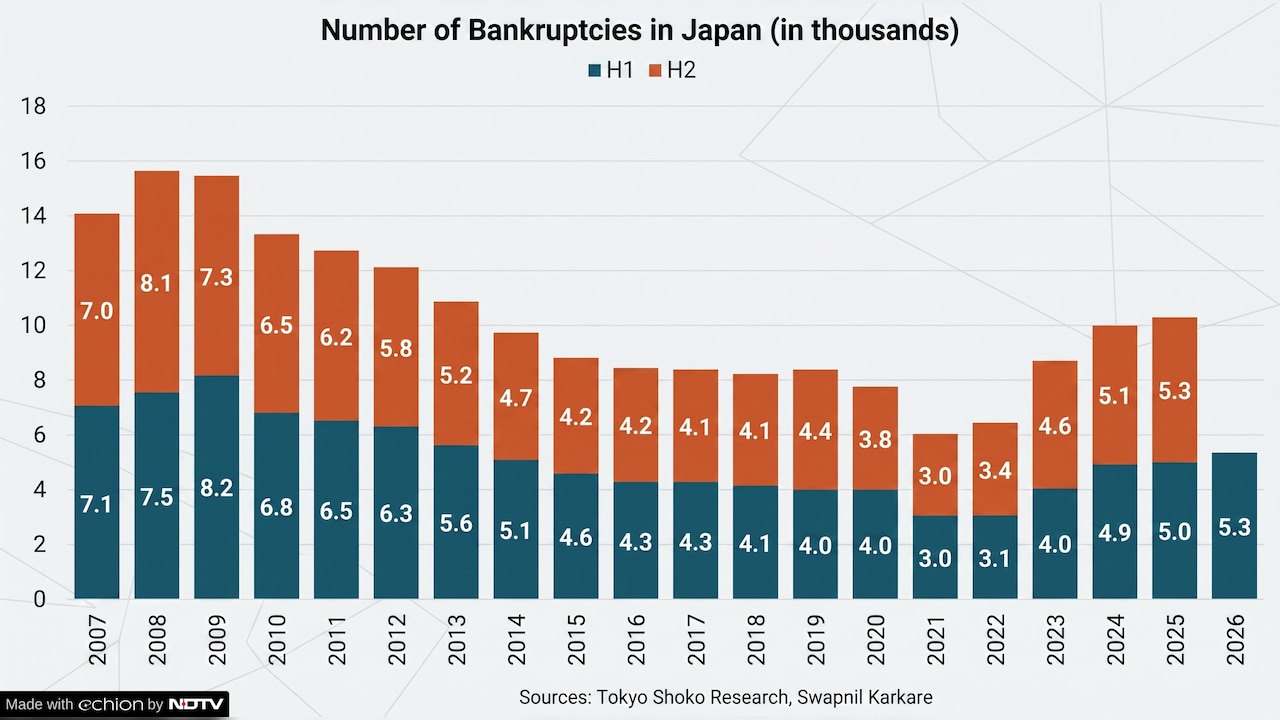
Japan has entered a new bankruptcy cycle. It can be divided into three phases.
- 2007-09: During the global financial crisis (GFC), the number of companies going bankrupt and their debt sizes grew rapidly. Many large firms went bankrupt during that crisis.
- 2010-22: In the next decade, bankruptcies declined. Covid made businesses vulnerable, but monetary and fiscal policies kept many firms alive.
- 2023 onwards: Bankruptcies rose again.
According to Tokyo Shoko Research, the number of bankruptcies has climbed to its highest first-half level in 12 years (5,346 cases in H1 2026). Around 90% of bankrupt firms employed fewer than 10 workers, while most had capital below ¥10 million.
That means this year, bankruptcies are concentrated in small and medium enterprises (SMEs).
Where Is The Stress?
Service sector firms have hit the hardest, accounting for one-third of bankrupt firms in H1 2026, followed by construction and trade sectors. Within services, restaurants, food retailers, accommodation, personal services and other small consumer-facing businesses faced the most liquidations. Within construction, specialised subcontractors such as carpenters, scaffolders, painters, plumbers and electrical contractors suffered the most, while large general contractors were relatively resilient.
The region-wise data shows that the stress is national rather than localised.
ALSO READ: Fertiliser Shortages Haven't Broken Global Farming (Yet) | The Reason Why
Businesses Are Unable To Sell
Coming to the reasons behind rising bankruptcies, nearly three-fourths of all cases in both 2025 and H1 2026 are classified as "Poor Sales." While this has historically been Japan's largest bankruptcy category, the recent deterioration reflects a broader squeeze on consumers and businesses.
Japan imports much of its food, fuel and industrial raw materials. A weaker yen and the West Asian conflict pushed up import and energy costs. During June and July 2026 alone, manufacturers raised prices on thousands of food products, citing higher ingredient, packaging, transportation and energy prices.
Although wages rose by more than 3% (nominal terms) in recent months, inflation-adjusted wages (real terms) remained negative through most of 2025 before turning positive in early 2026. Even then, households stayed cautious. Families cut back on big-ticket purchases and discretionary items like eating out and travel. The official data captures that. Japan recorded six consecutive months of declining real household spending through May 2026, indicating that higher incomes had yet to revive consumer demand. As spending remained weak, revenues of many SMEs came under pressure.
Currency & Labour: Triggers To Bankruptcy
Despite 'poor sales' being the main cause, most headlines focused on one factor: the weak yen. It doesn't even account for 1% of total bankruptcies during H1 2026, yet it is all over the news. However, a lower recorded figure doesn't make the argument irrelevant. Currency pressures usually impact businesses indirectly, like this:
Weak yen → Higher import costs → Higher prices → Weaker consumer demand → Lower business revenues → Bankruptcy recorded as "Poor Sales".
In short, currency pressures may be the trigger, while poor sales or debt burden become the recorded cause.
Labour markets work similarly. H1 2026 saw 237 labour-related bankruptcies, which include labour shortages and higher costs. Again, small firms find it difficult to compete with large players, especially when they raise wages to attract workers. In the construction sector, smaller contractors cannot find skilled labour as easily as large developers, leaving many vulnerable to bankruptcy.
Final Take
Japan's bankruptcy story is much bigger than the weak yen. It reflects an economy transitioning from decades of deflation and ultra-low interest rates to one of inflation, higher wages and rising yields. Large companies are adjusting. But SMEs struggle.
While the rest of the world is falling in love with Japan, many of its smallest businesses are finding it harder than ever to survive.
Disclaimer: The views expressed in this article are solely those of the author and do not necessarily reflect the opinion of NDTV Profit or its affiliates. Readers are advised to conduct their own research or consult a qualified professional before making any investment or business decisions. NDTV Profit does not guarantee the accuracy, completeness, or reliability of the information presented in this article.
ALSO READ: Lithium: China's New Bet For Yuanisation | The Reason Why
Essential Business Intelligence, Sharp Market Insights, Practical Personal Finance Advice, Daily Fuel, Gold and Silver Prices and Latest Stories — On NDTV Profit.