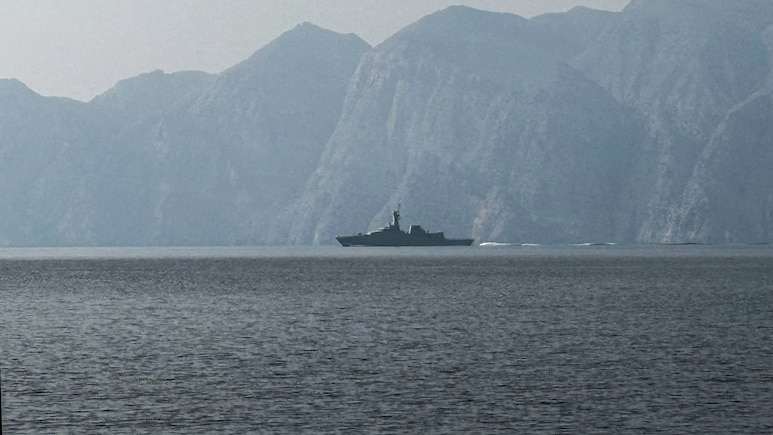
US and Iran tensions grew over the Strait of Hormuz with both sides maintaining their blockades of the critical waterway, creating an uneasy standoff with no sign of peace talks on the horizon.
US President Donald Trump on Thursday ordered the US Navy to shoot any boat putting mines in the strait, while the military said it intercepted two oil supertankers that tried to evade restrictions on traffic to and from Iran's ports. US forces boarded a “sanctioned stateless vessel” transporting oil from Iran in the Indian Ocean overnight, the Pentagon said.
Later, an Iranian ship carrying rice safely passed through the Sea of Oman and reached Iran after being escorted by the Islamic Revolutionary Guard Corps, the country's semi-official Tasnim News Agency reported. It said the US Navy attempted to seize the vessel.
Also Read | Layoffs Are Rising In Tech, But These Skills Are Helping People Unlock Better Pay
US Central Command did not immediately respond to a request for comment.
Trump said Thursday that if Iran is unable to move oil, its infrastructure will explode, while adding that Tehran still wants a deal and that US officials remain in contact with the country.
Iran attacked at least three vessels on Wednesday, helping keep the key oil and gas transit route effectively shut for an eighth straight week.
White House Press Secretary Karoline Leavitt said Trump wants Iran to agree to hand over its stocks of highly enriched uranium, which the Islamic Republic has so far refused to do. The US and Israel started the conflict by bombing Iran in late February, arguing that Tehran could enrich the material further and try to build an atomic bomb.
Trump reiterated his argument that Iran isn't pushing for peace due to infighting among its leaders, saying on social media there's a battle ongoing between hardline and moderate factions. In the meantime, “no ship can enter or leave without the approval of the United States Navy,” he said, referring to Hormuz. “It is “Sealed up Tight,” until such time as Iran is able to make a DEAL!”
Hormuz has now been shut for almost two months due to the conflict, exacerbating fears about the knock-on effect on the global economy. About a fifth of the world's oil and liquefied natural gas supplies are typically shipped through Hormuz, as well as aluminum, fertilizers and other agricultural products.
“The conflict has entered a new phase centered on the Strait of Hormuz,” Bloomberg Economics analysts led by Becca Wasser said in a note. “The US blockade will likely remain in place. But it won't be effective at achieving its strategic objective: economically squeezing Iran into capitulation. Tehran's tolerance to pain is significant when its survival is at stake.”
Trump says that the blockade will only end once Iran agrees to a deal that ends the war, which has killed thousands of people, wreaked havoc across much of the Middle East and led to a surge in fuel prices.
Oil climbed for a fifth day to post its longest string of gains since January, as the standoff worsened the outlook for global supplies. Brent, the global crude benchmark, climbed above $106 a barrel, taking this year's gains to about 75%.
The White House said the blockade is choking off Iran's oil exports. It claims Iran is losing out on $500 million each day, a figure it hasn't provided evidence for.
ALSO READ: Iran War Impact: S&P Global Sharply Reduces 2026 Oil Demand Forecast
“The point of this is the economic leverage that we maintain over Iran now,” Leavitt said. “And the crux of that is this naval blockade. We are strangling their main source of revenue.”
Iran's President Masoud Pezeshkian said Wednesday that Iran welcomes talks, but that the “blockade and threats are main obstacles to genuine negotiations.”
Some Iran-linked vessels appear to have passed the US line of warships in the Gulf of Oman, outside the Strait of Hormuz. At least two fully laden Iranian tankers have sailed out of the Persian Gulf this week, according to data intelligence firm Vortexa.
The US military, however, refuted the report, saying the tankers Hero II and Hedy were intercepted earlier this week and are now anchored in Chabahar, an Iranian port on the Gulf of Oman. The vessel Dorena has been under the escort of a US Navy destroyer in the Indian Ocean, according to a post on X.
Figures from Vortexa suggest at least 34 Iran-linked tankers have made their way through the strait and the US blockade line.
Israel and Hezbollah began a parallel war in March. Trump said on social media that the two would extend their recently brokered ceasefire by three weeks, a move that creates space to work on a long-term deal and removes a roadblock to ending the US war with Iran.
Any return to full-scale fighting in Lebanon would likely worsen the prospects for talks with Iran, which is the main sponsor of Hezbollah and sees the Islamist militant group as a key ally.
(This story has not been edited by NDTV staff and is auto-generated from a syndicated feed.)
Essential Business Intelligence, Sharp Market Insights, Practical Personal Finance Advice, Daily Fuel, Gold and Silver Prices and Latest Stories — On NDTV Profit.