Are you aware that the Indian stock market accounts for roughly 3-3.5% of the world's total stock market capitalisation?
You read that right. The market value of our domestic stock market is roughly $4.84 trillion, compared with the global total of about $ 154 trillion. This share fluctuates dynamically based on relative market performance, exchange rates, and institutional flows.
Which other markets have a dominant share in the global equity markets?
Also Read | Layoffs Are Rising In Tech, But These Skills Are Helping People Unlock Better Pay
Well, the United States represents 48-50% of the global market cap; China, around 9%; Japan, roughly 5-7%; Hong Kong, around 4-5%; South Korea, about 4.6%; and Taiwan, approximately 3.0-3.5%. The Eurozone's stock market capitalisation, as a percentage of the global stock market, is around 7.5%.
From a diversification standpoint, it makes sense to have some exposure to international equities.
However, one needs to tread cautiously and be selective about the markets and themes when investing in global equities.
The global equity markets are navigating a thorny landscape of geopolitical tensions, military conflict, rising oil prices, trade wars, and other factors, which are likely to affect economic growth and corporate earnings. For the stock markets, economic growth and earnings determine the path to wealth creation.
In the last 1 year, the Indian equity market (MSCI India Index USD) has largely underperformed compared with some global markets, posting an absolute return of -9.9% (as of 29 May 2026), according to the MSCI factsheet.
This is due to factors such as lofty valuations relative to global peers, foreign portfolio investors pulling out money, and a maturing earnings cycle.
According to Moody's Ratings, India's corporate sector is likely to see slower earnings growth over the next 12-18 months due to risks such as rising input costs, supply chain disruptions, rupee depreciation, and labour market uncertainty, which are weighing on demand and business investment.
In comparison, South Korea (MSCI Korea Index USD) and Taiwan (MSCI Taiwan Index) have posted absolute returns of 268.9% and 122.7%, respectively, as of 29 May 2026, according to the MSCI fact sheet. This is driven by the semiconductor and High-Bandwidth Memory (HBM) boom, as well as cloud infrastructure.
China (MSCI China Index USD) has also outperformed over the last 1 year, posting 6.3% gains on the back of aggressive government stimulus and valuation re-rating.
The MSCI USA Index posted an absolute return of 29.3% over the last 1 year, driven by booming corporate earnings, resilient consumer spending, and the AI revolution.
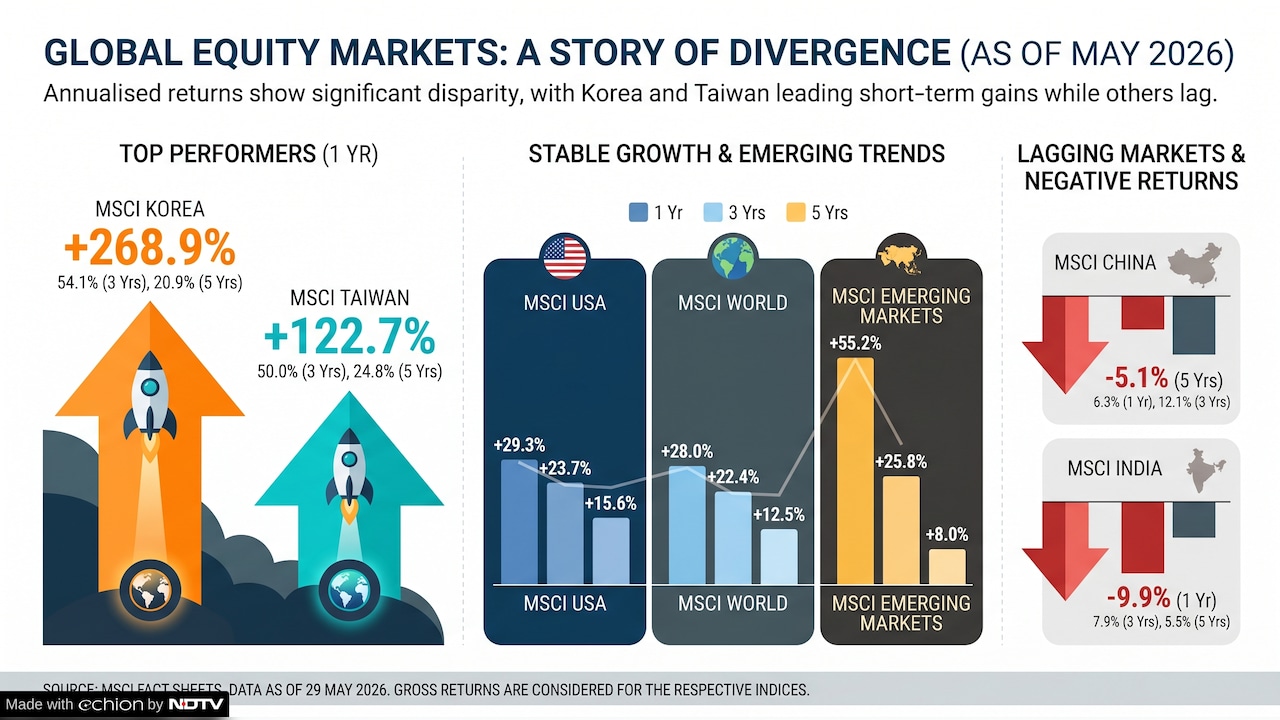
The chart above shows that over longer horizons — three years and five years — Indian equities have underperformed in US dollar terms. This divergence and underperformance in equity market gains further highlight the importance of global diversification.
To gain exposure to the international equity market, international mutual funds are meaningful options.
There are a variety of options. For example, region-specific international mutual funds investing in specific regions or countries; globally diversified funds investing in multiple countries/global indices, as well as thematic & sector funds, such as those investing in tech companies, world mining companies, real estate companies, etc.
So, international mutual funds invest in a variety of stocks across various markets and themes, thereby facilitating diversification, depending on the funds you choose.
The asset management company may offer the fund as a feeder fund, a fund of funds, or one that directly invests in foreign equities, either actively managed or passively via ETFs, in accordance with the investment mandate.
How Have International Mutual Funds Fared?
The returns have been quite attractive. Over the last 1, 3, and 5 years, the category average returns are 45.4% absolute, 26.2% CAGR, and 13.9% CAGR, respectively, as of 5 June 2026.
And out of a total of 72 international mutual funds, 49 international mutual funds have delivered a compounded average growth rate (CAGR) of over 20% in the last 3 years (as of 5 June 2026).
The Nippon India Taiwan Equity Fund has topped the 1-year and 3-year periods, clocking 213.3% absolute returns and 64.5% CAGR, respectively, as of 5 June 2026. Over 5 years, Mirae Asset NYSE FANG+ ETF FoF, with a 33.6% CAGR, tops the list.
Funds | Absolute | CAGR | |
1 Yr Ret (%) | 3 Yr Ret (%) | 5 Yr Ret (%) | |
Nippon India Taiwan Equity Fund | 213.3 | 64.5 | -- |
Mirae Asset NYSE FANG+ ETF FoF | 51.7 | 50.9 | 33.6 |
DSP World Gold Mining Overseas Equity Omni FoF | 69.9 | 45.8 | 22.5 |
Motilal Oswal Nasdaq 100 FOF | 89.0 | 42.7 | 28.0 |
Mirae Asset Global X Artificial Intelligence & Technology ETF FoF | 68.4 | 39.2 | -- |
Mirae Asset S&P 500 Top 50 ETF | 51.4 | 37.8 | -- |
Mirae Asset NYSE FANG+ ETF | 33.5 | 37.7 | 26.5 |
Edelweiss US Technology Equity FoF | 44.8 | 32.9 | 18.5 |
Kotak US Specific Equity Passive FoF | 50.8 | 32.7 | 23.0 |
Invesco India - Invesco EQQQ NASDAQ-100 ETF FoF | 49.7 | 32.5 | -- |
Aditya Birla Sun Life US Equity Passive FoF | 49.7 | 32.3 | -- |
Axis NASDAQ 100 US Specific Equity Passive FoF | 49.9 | 32.1 | -- |
ICICI Prudential NASDAQ 100 Index Fund | 49.2 | 32.1 | -- |
Navi Nasdaq100 US Specific Equity Passive FoF | 48.8 | 31.9 | -- |
Motilal Oswal NASDAQ 100 ETF | 48.6 | 31.9 | 22.7 |
ICICI Prudential Strategic Metal and Energy Equity FoF | 65.8 | 31.3 | -- |
PGIM India Emerging Markets Equity FoF | 51.7 | 30.1 | 6.1 |
HSBC Global Emerging Markets Fund | 73.0 | 29.8 | 12.5 |
DSP Global Innovation Overseas Equity Omni FoF | 45.0 | 29.8 | -- |
Motilal Oswal Nasdaq Q50 ETF | 60.9 | 29.7 | -- |
Invesco India - Invesco Global Consumer Trends FoF | 43.6 | 29.3 | 6.9 |
DSP US Specific Equity Omni FoF - Direct Plan | 56.5 | 29.2 | 19.8 |
DSP World Mining Overseas Equity Omni FoF | 89.4 | 28.7 | 17.1 |
Mirae Asset S&P 500 Top 50 ETF | 39.6 | 28.7 | -- |
SBI US Specific Equity Active FoF | 41.5 | 28.4 | 18.0 |
Kotak Global Emerging Market Overseas Equity Omni FoF | 65.7 | 28.2 | 11.7 |
Edelweiss Emerging Markets Opportunities Equity Offshore Fund | 70.8 | 28.1 | 10.0 |
HSBC Asia Pacific (Ex Japan) Dividend Yield Fund | 58.3 | 27.7 | 14.3 |
Bandhan US specific Equity Active FoF | 30.5 | 27.3 | -- |
HDFC Developed World Overseas Equity Passive FoF | 39.7 | 27.3 | -- |
Navi Total Stock Market US Specific Equity Passive FoF | 38.5 | 26.2 | -- |
Motilal Oswal S&P 500 Index Fund | 37.9 | 25.9 | 18.4 |
Axis Global Innovation FoF | 37.0 | 25.1 | 14.7 |
Kotak Global Innovation Overseas Equity Omni FoF | 44.2 | 24.8 | -- |
Edelweiss Europe Dynamic Equity Offshore Fund | 27.6 | 24.6 | 15.1 |
Aditya Birla Sun Life Global Excellence Equity FoF | 32.7 | 23.6 | 16.2 |
Franklin U.S. Opportunities Equity Active FoF | 23.8 | 23.4 | 12.8 |
Invesco India - Invesco Global Equity Income FoF | 27.8 | 23.2 | 17.3 |
Aditya Birla Sun Life Global Emerging Opportunities Fund | 33.9 | 23.2 | 13.2 |
Axis Global Equity Alpha FoF | 27.8 | 23.1 | 15.3 |
DSP World Gold Mining Overseas Equity Omni FoF has also delivered an impressive 45.8% CAGR over the last 3 years, supported by aggressive central bank gold buying and rising gold prices, which have augured well for the underlying gold mining companies.
Amidst the AI and semiconductor boom, international mutual funds investing in these tech companies have also posted luring returns.
Which Ones to Consider?
At present, not all international mutual funds are open for subscription. This is because the Indian mutual fund industry is required to comply with the aggregate investment limit of US$7 billion, as set by the Securities and Exchange Board of India (SEBI).
At the individual fund house level, though, the overseas investment limit is $1 billion. In line with this limit, certain international mutual funds are accepting fresh investments. A total of 12 international mutual fund schemes are accepting investments.
Three funds, namely Franklin U.S. Opportunities Equity Active FoF, Franklin Asian Equity Fund, and Baroda BNP Paribas Aqua FoF, are accepting both lump and SIP investments.
Nine others, such as PGIM India Emerging Markets Equity FoF, Edelweiss Emerging Markets Opportunities Equity Offshore Fund, Edelweiss Europe Dynamic Equity Offshore Fund, Franklin U.S. Opportunities Equity Active FoF, and Edelweiss Greater China Equity Offshore Fund, are accepting only SIP investments.
So, there is limited choice, even though there is a plethora of international mutual fund schemes out there.
What's important is making a wise choice that considers the investment mandate or investment universe, the outlook for those markets/themes (as the case may be), the risks associated, and the currency impact.
Currency movement is one of the most important and inescapable aspects of investing in international mutual funds. When the Indian rupee seems vulnerable against the U.S. dollar, it could potentially augment your return if the international mutual fund fares well.
However, you need to allocate sensibly, not more than 5-10% of the total mutual fund portfolio. Moreover, international mutual funds should be held in your satellite portfolio, provided you have a high-risk appetite and an investment horizon of at least 5 years.
A prudently made investment in international mutual funds may potentially offer a hedge against domestic events such as political instability, policy changes, economic uncertainty, and currency fluctuations.
Consider a range of quantitative and qualitative parameters when choosing the best international mutual funds to invest in. Don't just go by past returns, which may not be indicative of future returns.
Happy investing!
ALSO READ: The Approach Senior Citizens Should Follow When Considering Small Finance Bank Fixed Deposits
Essential Business Intelligence, Sharp Market Insights, Practical Personal Finance Advice, Daily Fuel, Gold and Silver Prices and Latest Stories — On NDTV Profit.