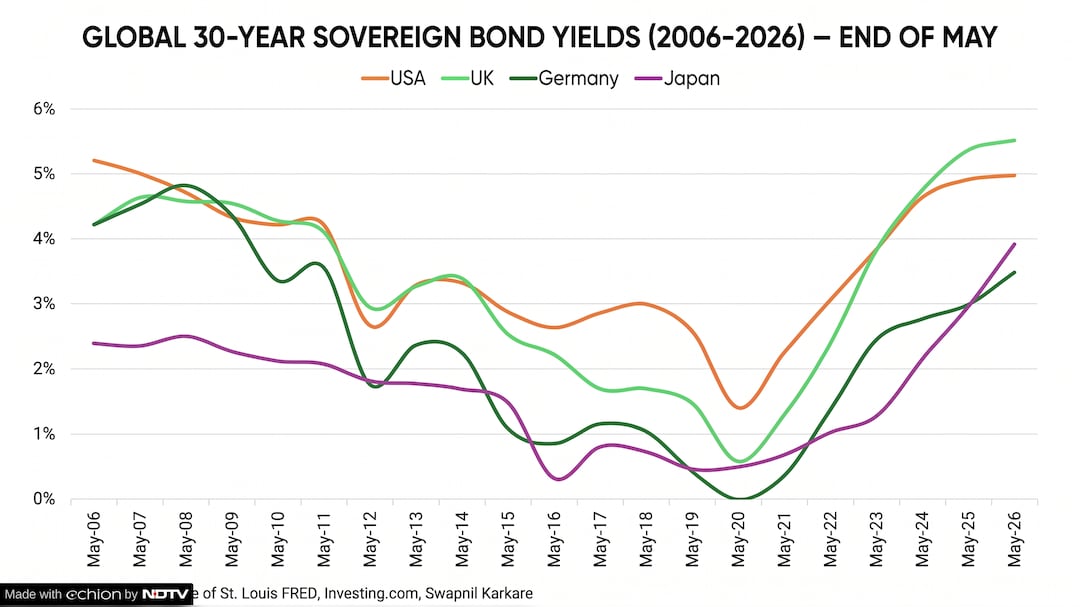
Long-term bonds in the US, UK, Germany and Japan are all trading at yields unseen since the 2000s. That has raised alarms in various corners of the world. Higher yields also raise government borrowing costs at a time when debt levels in many developed economies have already crossed twice the size of their GDPs.
Meanwhile, the AI boom is fuelling equity valuations and capex announcements just as interest rates rise. Analysts fear that if that optimism fades or earnings disappoint, it could be the second dot-com bubble. However, not everyone is pressing the alarm button. Let's decode.
Inflation Expectations Are Rising
Also Read | Layoffs Are Rising In Tech, But These Skills Are Helping People Unlock Better Pay
The US-Iran war and the closure of the Strait of Hormuz have pushed oil prices above $100 per barrel, reviving fears of another energy-driven inflation shock.
The evidence is clear.
In the Euro area, inflation expectations for the next 12 months jumped from 2.5% to 4% within a month. It had seen these levels for over a year after the Russia-Ukraine war. The latest jump reflects fear of another round of inflation due to supply shock.
Japan tells a different story. From 2022 onwards, it has seen inflation expectations over 2% after years of fighting deflation. Rising Japanese bond yields are, therefore, partly a sign that the country is finally emerging from its ultra-low inflation era.
The US is different again. Not only are inflation expectations up, but real yields have risen, too. Real yields are inflation-adjusted interest rates. When they rise, it usually means investors are demanding higher post-inflation returns. This also means that borrowing is becoming more expensive.
In the UK, political instability has become another factor behind rising yields, while in South Korea, they are rising due to inflation and AI-driven higher growth.
Thus, even though most developed economies see rising bond yields and higher inflation expectations, there's more to the story than what headlines suggest.
End of Low Rate Regime
Many analysts now believe the world may be entering a structurally higher interest-rate regime.
For almost two decades after the 2008 global financial crisis, the central banks kept interest rates as low as possible by buying massive amounts of government bonds, known as quantitative easing. In 2005, the Chair of the Fed, Ben Bernanke, argued that the world had too many savers and not enough were willing to spend. The result was fewer investment opportunities and narrower returns.
Today, the situation is changing. Companies and governments around the world want to spend, some in reaction to geopolitical turmoil, while others due to AI advancements. Capital expenditure on AI infrastructure, data centres, semiconductor manufacturing, defence spending and energy-transition projects has increased in the last couple of years. That means more capital is demanded, which will raise the price of the capital, aka interest rates.
The combination of increasing investments, rising inflation and higher government debt has pushed yields upwards.
Isn't This Just Normalisation?
We should not make the mistake of comparing today's yields with those in the post-GFC period. That's a 'recency bias', according to Fisher Investments of the UK.
It argues that US 30-year yields of about 5% are similar to early-to-mid 2000s levels. So, from a wider time horizon, the low-interest-rate period during the QE is an aberration, not today's yields.
Contrary to the perception, higher yields do not necessarily mean higher inflation and lower growth. A decade before the crisis, consumer price inflation and real GDP growth in the US were around 3% both.
Therefore, it believes that the world of higher yields is mean-reverting to the pre-GFC era, and that was not particularly alarming.
Higher Yields Can Be Better For Banks, Investments
Steno Larsen of Real Vision/NowcastIQ adds more insights to this argument. He believes that we are misapplying the macro frameworks built during a 40-year bond bull market in today's world. He believes that higher long-term yields can instead improve the private credit cycle.
Long-term bonds offer higher yields than short-term bonds because investors demand more compensation for locking in for longer periods. If plotted on a chart, it creates an upward-sloping yield curve, an ideal one. During the ultra-low interest-rate era after 2008, the yield curve was flatter, sometimes even inverted.
For banks, an upward-sloping yield curve is beneficial because they borrow short-term through deposits and lend long-term through home loans, business loans and other credit products. Higher long-term yields will improve banks' profitability and help in credit creation.
He cites Japan's example. After the Bank of Japan started normalising monetary policy and long-term yields rose, banks' profitability improved. During the same period, equity markets performed strongly.
Risks Have Not Disappeared
However, the current environment still reminisces of the 1970s stagflation scenario. We are not there yet, but the ingredients exist: high oil prices, large fiscal deficit and elevated inflation volatility.
If AI-driven productivity fails to materialise, or if the AI investment boom collapses, the world could end up with slower growth. That's stagflation. And some economies already look vulnerable. Canada, for example, has entered a technical recession without any large-scale AI investments.
Also, AI is driving most stock market gains. In May 2026, the S&P 500 rose even as 8 of 11 sectors fell. So the claimed end of the stock-bond inverse correlation may be overstated once a few sectors are excluded.
Final Take
The era of high yields raises three questions.
First, will high government borrowing lead to crowding out of the private sector? Most private sector borrowing is tied to AI. If governments absorb much of global savings, private sector borrowing costs could increase, impacting the AI capex.
Second, will the reopening of the Strait of Hormuz lead to lower yields? ING's Padhraic Garvey argues that inflation expectations may ease, but real yields could still stay elevated because the deeper drivers — fiscal deficits, higher investment demand and structurally higher term premiums — are unlikely to disappear quickly.
Third, should we raise alarms? I think the world has changed, and we cannot rely entirely on frameworks built during the ultra-low interest-rate era. But there is also a danger in believing that "this time is different".
So the right approach is probably somewhere in the middle. Not reckless optimism. Not panic either.
Disclaimer: The views expressed in this article are solely those of the author and do not necessarily reflect the opinion of NDTV Profit or its affiliates. Readers are advised to conduct their own research or consult a qualified professional before making any investment or business decisions. NDTV Profit does not guarantee the accuracy, completeness, or reliability of the information presented in this article.
ALSO READ: India's Productivity Journey Is More Complicated Than We Think | The Reason Why
Essential Business Intelligence, Sharp Market Insights, Practical Personal Finance Advice, Daily Fuel, Gold and Silver Prices and Latest Stories — On NDTV Profit.