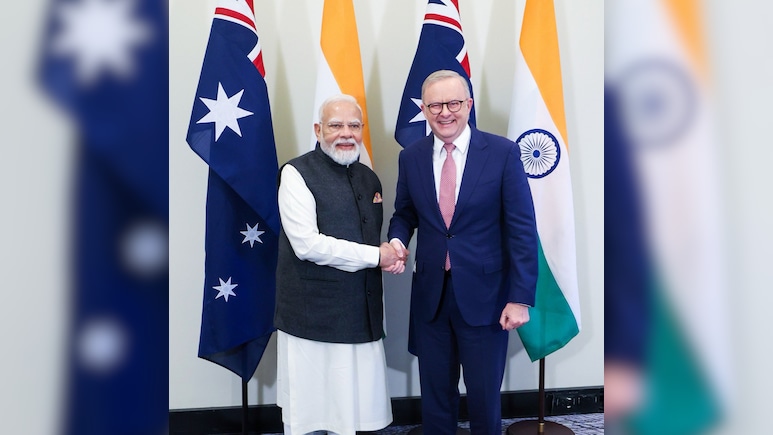
Prime Minister Narendra Modi and his Australian counterpart Anthony Albanese concluded summit-level talks in Melbourne on Thursday, unveiling a raft of agreements spanning defence, energy security, critical minerals, trade and education, according to a joint statement issued by the two governments following the Third Australia-India Annual Summit.
Modi landed in Melbourne on Wednesday to a red-carpet welcome, the second leg of a six-day tour that began in Indonesia and will conclude in New Zealand..
Witnessed a truly exceptional musical performance featuring Australia's ancient Didgeridoo and India's Tabla. The harmony between these two timeless instruments beautifully reflected the deep cultural connect between our two nations.
Compliments to Mr. Ron Murray and Dr. Sam… pic.twitter.com/GTZtym4qurAlso Read | Layoffs Are Rising In Tech, But These Skills Are Helping People Unlock Better Pay
— Narendra Modi (@narendramodi) July 8, 2026
Here are the major announcement made during the summit:
Uranium Trade
India and Australia signed agreement that will facilitate exports of uranium from Australia.
Australia reiterated its strong support for India's membership of the Nuclear Suppliers' Group, and building on the Australia-India Nuclear Cooperation Agreement.
Both Prime Ministers welcomed finalisation and signature of the Administrative Arrangement, which will enable long-term Australian uranium exports to India for exclusively peaceful purposes and under IAEA safeguards, said PMO.
Defence Partnership
The two leaders announced a Joint Declaration on Defence and Security Cooperation, alongside the establishment of an Annual Defence Ministers' Dialogue.
They agreed to enhance maritime cooperation through the India-Australia Maritime Security Collaboration Roadmap, and welcomed a Memorandum of Understanding between Australia's Maritime Border Command and the Indian Coast Guard.
An Indian military instructor is set to be placed at the Australian Defence College in 2028-29, building on the Mutual Logistics Support Arrangement signed in 2021.
Energy Security
In the centrepiece outcome of the visit, the two Prime Ministers welcomed the finalisation and signing of an Administrative Arrangement under the existing Australia-India Nuclear Cooperation Agreement, enabling long-term Australian uranium exports to India for peaceful purposes under IAEA safeguards.
Australia, which holds close to a third of the world's known uranium reserves, also reiterated its support for India's membership of the Nuclear Suppliers' Group.
The deal follows India's new SHANTI Act overhauling its nuclear sector and an earlier uranium supply agreement with Canada's Cameco.
Critical Minerals And Technology
The two sides reaffirmed cooperation on critical minerals supply chains and signed the Australia-India Partnership on Cyber, Critical Technologies and Supply Chains (PACTS), alongside a trilateral Australia-Canada-India Technology and Innovation Partnership MOU.
Trade And Investment
Addressing the India-Australia CEO Forum, Modi said the Economic Cooperation and Trade Agreement (ECTA), concluded in 2022, had boosted bilateral trade by 25 per cent to nearly A$54 billion, though he noted this remained "way below the potential" given the size of both economies.
Indian High Commissioner to Australia Nagesh Singh said talks were continuing on a more comprehensive Economic Cooperation Agreement, with both sides hoping to conclude it "sooner rather than later."
ALSO READ: India Retains IMF Tag As Fastest-Growing Major Economy, Set To Outpace China, US By Wide Margin
Education And People-To-People Ties
The two leaders welcomed expanding education collaboration, including the University Grants Commission's Letter of Intent to Flinders University to establish a campus in Bengaluru, and its Letter of Approval to Victoria University to operationalise a campus in Gurugram.
They also welcomed an agreement between the Western Australian Government and India to set up a National Centre of Excellence for Skilling in Mining at Bhubaneswar's National Skill Training Institute.
Regional Security
The leaders reaffirmed commitment to an open, rules-based Indo-Pacific anchored in UNCLOS, and voiced support for the Quad, IORA under India's chairship, and ASEAN centrality.
They also expressed concern over escalating tensions in the Middle East, calling for restraint and protection of energy supplies and commerce amid the Hormuz crisis.
Essential Business Intelligence, Sharp Market Insights, Practical Personal Finance Advice, Daily Fuel, Gold and Silver Prices and Latest Stories — On NDTV Profit.