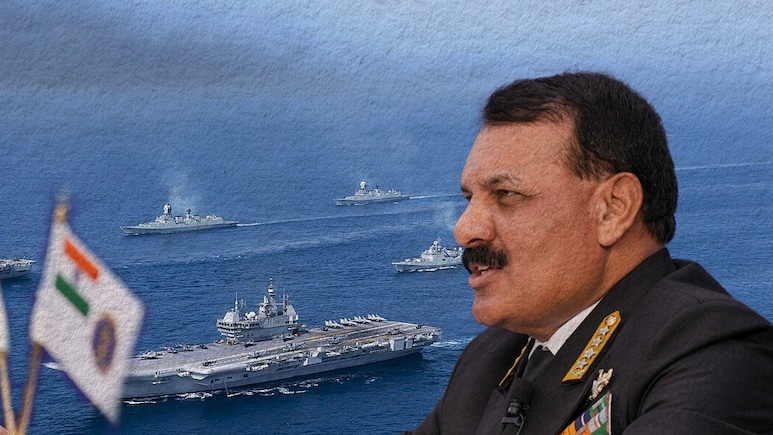
Disruptions in the Strait of Hormuz have led to serious economic effects and instability in energy supply across the region, Indian Navy Chief DK Tripathi said on Thursday, amid the ongoing conflict in West Asia.
Speaking at an event in Mumbai where INS Sunayna, an offshore patrol vessel, departed as Indian Ocean Ship (IOS) Sagar, the Navy chief said that competition at sea is no longer limited to oil and energy resources.
He noted that it is now expanding into areas that will influence future growth, including rare earth elements, critical minerals, new fishing grounds, and data, reported PTI.
Referring to the middle-east conflict, he said, "with the conflict in West Asia well into its fifth week, the disruptions in the Strait of Hormuz have caused severe economic impact and energy instability in the region."
ALSO READ: Mumbai Metro Line 9, 2B Inauguration Postponed As Politics Leaders Busy With Poll Campaigns
The crisis in West Asia began on February 28 following a joint attack by the United States and Israel on Iran. Iran's subsequent strikes on neighbouring regions, along with its control over the Strait of Hormuz, have disrupted global energy supplies, with effects extending beyond West Asia.
Also Read | Layoffs Are Rising In Tech, But These Skills Are Helping People Unlock Better Pay
The Navy chief also highlighted increasing challenges in maritime activity. He said there has been a significant rise in marine surveys, deep-sea research operations, and Illegal, Unreported and Unregulated (IUU) fishing.
These activities, he noted, often encroach on the sovereign rights of coastal nations and take advantage of gaps in monitoring and enforcement systems.
He further pointed out that threats such as piracy, armed robbery, and narco-trafficking have become more complex. These challenges are being intensified by the access of advanced technology to non-state actors, making them harder to counter.
ALSO READ: NCERT Granted 'Deemed University' Status: Gains Research, Doctoral Programmes Under UGC Oversight
Providing data on maritime security, the Navy chief said that the Indian Ocean Region recorded around 3,700 maritime incidents of different types in the past year. He also noted that narcotics seizures in the region crossed USD 1 billion in 2025, indicating the continuing spread of such activities.
Largest supply disruption in the history of the global oil market: WEF
In a separate report, the World Economic Forum, citing the head of the International Energy Agency, Fatih Birol, said in a report that the shipping crisis in the Strait of Hormuz is now "the largest supply disruption in the history of the global oil market.”
The report added that as the conflict involving Iran continues, the disruption has also exposed deeper vulnerabilities in the Middle East's role as a key supplier of non-oil commodities. It noted that shortages are affecting supply chains in real time.
ALSO READ: Maharashtra Rain Alert: IMD Issues Orange Alert For Pune, Nashik — Check Warning For Other Cities
Among the affected commodities are fertilizers such as urea and ammonia, sulfur, methanol, graphite feedstocks, aluminium, helium, glycol (MEG), iron ore and steel pellets, as well as infrastructure related to green hydrogen, the report added.
Essential Business Intelligence, Sharp Market Insights, Practical Personal Finance Advice, Daily Fuel, Gold and Silver Prices and Latest Stories — On NDTV Profit.