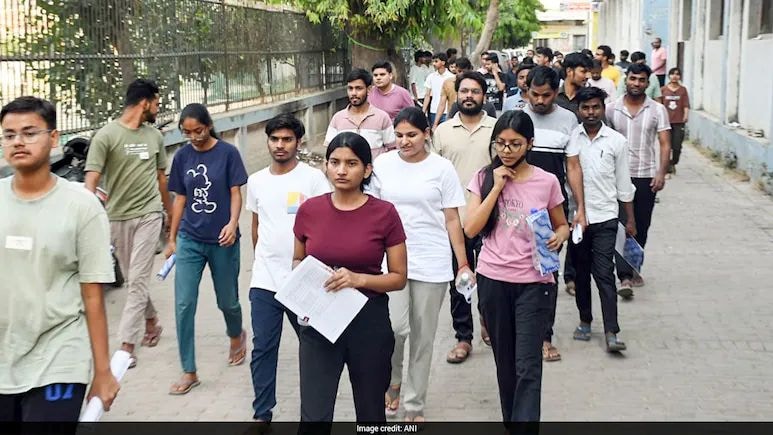
The second slot of CAT 2026 concluded with candidates describing the paper as moderate overall, though Data Interpretation and Logical Reasoning (DILR) proved to be the toughest section. The exam was held from 12:30 pm to 2:30 pm.
The paper had 68 questions across three sections: 24 in Verbal Ability and Reading Comprehension (VARC), and 22 each in DILR and Quantitative Aptitude (QA). Candidates had 40 minutes to complete each section. Every correct answer carried three marks, while an incorrect multiple-choice answer attracted a penalty of one mark. There was no negative marking for TITA questions, in which candidates had to enter their answers instead of choosing from the options.
DILR takes the spotlight
Also Read | Layoffs Are Rising In Tech, But These Skills Are Helping People Unlock Better Pay
What set DILR apart was its format. Eleven of its 22 questions were TITA, leaving no options to eliminate and no room for back-solving. Ravi Prakash, founder of Rodha, said the section amounted to a pure test of whether a set had actually been cracked. He added that the lack of negative marking on TITA questions favoured those who kept their composure.
ALSO READ | Maharashtra Asks Schools Not to Stop ST Students From Appearing For Exams Over Delayed Payments
The sets in this section varied widely. They covered flight routes linking seven cities across six legs, a funding proposal involving six students, a four-stage tournament, and a company's five business units shown in two bar graphs. A puzzle on swapping digits in telephone numbers also appeared, as did a bar-graph set carrying four TITA questions of its own.
VARC and QA
VARC was rated moderate. Reading Comprehension followed the structure of CAT 2025, while Verbal Ability had three questions each on para summary, para jumbles and fill in the blanks. Candidates who attempted 15 or more questions with good accuracy should be comfortably placed.
QA, rated moderate, drew mainly on core arithmetic: percentages, mixtures and alligations, time-speed-distance, and time and work. Algebra included at least one question on inequalities. Clear concepts and clean calculations counted for more than shortcuts.
ALSO READ | Last-Minute CAT Exam Preparation? Here's How To Decide What To Solve, Skip And Revisit
Set against the first slot, the two papers were broadly similar in difficulty, and neither featured Odd One Out questions. The morning shift's new four-set fill-in-the-blanks format was not reported in slot 2, whose DILR leaned far more on TITA.
Advice for slot 3
For slot 3, candidates can expect a familiar VARC and should prioritise accuracy in Reading Comprehension. In DILR, attempt the TITA questions already worked through, since there is no penalty, and in QA solve clean arithmetic questions first. Prakash urged aspirants to slow down in DILR and trust their working.
ALSO READ | CTET December 2026 City Slip Out: Check Exam Date And Exact Venue To Follow
Essential Business Intelligence, Sharp Market Insights, Practical Personal Finance Advice, Daily Fuel, Gold and Silver Prices, Watch Business News Live and Latest Stories — On NDTV Profit.