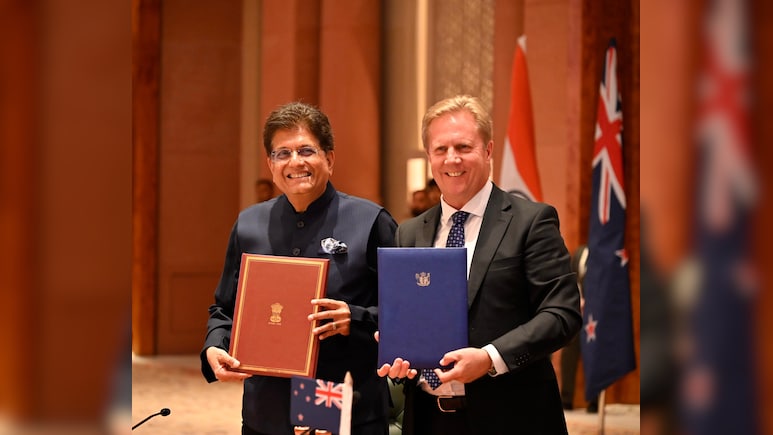
India and New Zealand clinched a historic free trade agreement on Monday, expanding market access, supporting export growth and enabling collaboration in areas like agriculture, education and employment.
In a first, the New Zealand government has agreed to do away with numerical caps on Indian students for post-study work visas, guaranteeing more security and certainty.

-
 Indian Markets Turning Corner After Two Tough Years, Says Sandeep Tandon
-
 NDTV Profit Ignite 2026: Experts See Opportunity In Equities, Stay Bullish For Long-Term
-
 Buy Right, Sit Tight Does Not Work for Individual Stocks, Says Dinshaw Irani
-
 'Worst Is Behind': Quant MF Sees Market Bottom, Flags 'Extreme Euphoria' In Midcaps
-
 India's Mutual Fund Industry Could Become A $1 Trillion Opportunity, Say Fund Managers
-
 'Foreign Investors Are Baraatis': Raamdeo Agrawal's Take On LTCG Tax
-
 Stay Invested Through Market Cycles: Raamdeo Agrawal at NDTV Profit Ignite
-
 Ramesh Damani Remains Bullish On India For Next 20-30 Years, Sees Bargains Amid Market Weakness
-
 CAS Came After A Long Consultation Process: SEBI Chairman Tuhin Kanta Pandey AT NDTV PROFIT IGNITE
-
 Aim To Cut FPI Onboarding Time From Mth To Five Days: SEBI Chairman Tuhin Kanta Pandey AT NDTV PROFI
The agreement also guarantees a minimum of 20 hours per week work during study, and provides extended post-study work opportunities of up to three years for STEM Bachelor's and Master's graduates, and up to four years for Doctorate holders-creating clear pathways for skills development and global careers.
Also Read | Layoffs Are Rising In Tech, But These Skills Are Helping People Unlock Better Pay
Numerical caps on these visas refer to strict limits on the number of permits issued for them, often implemented to control immigration.
In the past, such student provisions were determined by temporary, flexible immigration policies, which brewed uncertainty. They were also subject to being changed by NZ immigration authorities.
ALSO READ: India-New Zealand Ink Free Trade Agreement, Piyush Goyal Says, 'World Economy Is Being Re-Casted'
The immigration authorities of New Zeland have, time and again, tightened the norms surrounding to student immigration and post-study work visas taking into account the quantum of international influx of students.
In 2018, the eligibility criteria for post-study work visas was tightened by giving more generous (that is, longer duration) work rights to students with higher qualifications. These visas, which are classified under 'temporary entry class', are viewed as a gateway to residency.
Further, the FTA also enhances youth mobility through multiple-entry 'Working Holiday Visas' for 1,000 young Indians annually, valid for 12 months, promoting global exposure, skills acquisition, and people to-people linkages.
New provisions for Indian professionals in skilled occupations have also been introduced under the FTA, with a quota of 5,000 visas at any given time and a stay of up to three years categorised as Temporary Employment Entry (TEE) Visa pathway.
This pathway covers Indian professions such as AYUSH practitioners, yoga instructors, Indian chefs, and music teachers, as well as high-demand sectors including IT, engineering, healthcare, education, and construction, strengthening skilled workforce mobility and services trade.
Essential Business Intelligence, Sharp Market Insights, Practical Personal Finance Advice, Daily Fuel, Gold and Silver Prices and Latest Stories — On NDTV Profit.