President Donald Trump said a deal with Iran to end the seven-week war may be imminent though disagreements remain, with Tehran pushing back against US claims that it had agreed to give up its enriched uranium.
Trump said he would work with Iran to recover the country's “nuclear dust.” Reuters and CBS reported that the material could be brought to the US.
“Enriched uranium is as sacred to us as Iran's soil, and it won't be transferred anywhere under any circumstances,” Iran's Foreign Ministry spokesman, Esmail Baghaei, said on state television late Friday.
Also Read | Layoffs Are Rising In Tech, But These Skills Are Helping People Unlock Better Pay
The material — which the US says was buried deep underground after its bombing of Iran's nuclear facilities during last year's 12-day war — lies at the core of efforts to end the conflict, which has left thousands dead and disrupted energy exports from the Persian Gulf. Its fate is central to any broader deal that would allow vessel traffic to flow through the Strait of Hormuz, where about a fifth of the world's oil and liquefied natural gas transited before the conflict began in February.
Momentum for a lasting peace has been building, with Tehran saying Friday that Hormuz is open for commercial shipping after Israel agreed to a ceasefire in Lebanon.
Several oil tankers made a U-turn Saturday after appearing to try to transit the narrow waterway. It wasn't immediately clear why they changed course. Iran said Hormuz would shut again if the US continues a naval blockade that Trump said would stay in place until a deal is signed.
“While a deal appears to be in sight that may bring an end to the current round of US-Iran hostilities and relief to energy markets, it's unlikely to result in a full or lasting peace,” Bloomberg Economics analysts including Jennifer Welch wrote in a report. “We assess any deal will be limited and fragile.”
Trump told Bloomberg in a phone interview on Friday that Iran has agreed to suspend its nuclear program indefinitely, and “most of the main points” in discussions with the country are finalized. He denied that the US would release any frozen funds to the Islamic Republic — a key demand of Tehran that he has long decried.
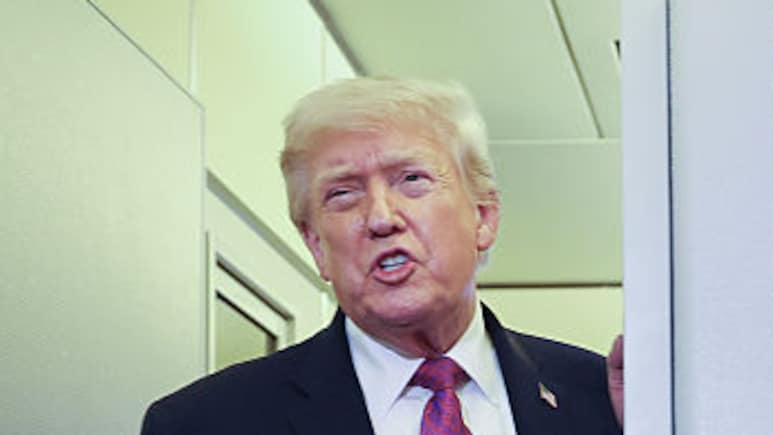
“I just think it's something that should happen. It's something that only makes sense to happen. And I think it will. We'll see what happens,” Trump said separately on the prospect of reaching a deal with Iran, as he was returning to Washington from a Phoenix event. “I think that is going to be very beneficial. And the main thing is that Iran will not have a nuclear weapon.”
ALSO READ: 'Enough Is Enough': Trump Says Ally Israel Prohibited From Bombing Lebanon Any Longer
The president also floated the threat of resuming strikes on Iran once the current ceasefire expires next week. “Maybe I won't extend it, so you have a blockade, and unfortunately we have to start dropping bombs again,” he said.
Trump's comments and Tehran's declaration on Hormuz are the latest signs the two sides are working behind the scenes on a deal after their first round of direct talks in Pakistan last week failed to yield an agreement.
The war saw Iran retaliate against US bases across the region and strike oil and gas infrastructure belonging to American allies in the Gulf, triggering a global energy crisis.
Oil, fuel and natural gas prices plunged on hopes that the latest developments would mean an end to the war and more energy supplies could transit safely through Hormuz. Brent crude dropped 9% on Friday to around $90 a barrel, wiping out most of the gains it posted since the onset of the war. Diesel prices in the US and Europe were also lower.
In a notable shift, real-world oil prices also eased significantly alongside headline futures prices. On Friday, dated Brent, the world's most important physical price, fell below $100 a barrel for the first time since March 11. Stocks extended their rally on speculation the war would soon end.
Iran's Parliament Speaker Mohammad Bagher Ghalibaf, who led the Iranian delegation in the Pakistan talks, said the strait won't remain open if the US continued its naval blockade aimed at preventing Iranian oil exports.
One proposal under discussion is for the US to release $20 billion in frozen Iranian funds in return for Tehran giving up its stockpile of enriched uranium, Axios reported, citing two US officials and two additional sources briefed on the talks whom it didn't identify.
Trump pushed back on that idea in the phone interview, repeatedly saying “no” when asked if he would release the $20 billion.
Pakistani and US officials suggested another round of talks were in the works. Asked if he would travel to Pakistan to sign an agreement, Trump said, “I may.”
Many traders and analysts remain skeptical that meaningful crude flows can resume quickly. The US has said the blockade imposed earlier this week on ships traveling to and from Iranian ports remains in place. Iran's foreign ministry said Tehran would take action if it persists.
Five Greek and Indian tankers have made U-turns in the Gulf after appearing to try to transit the Strait of Hormuz. Shipowners and oil traders remain in a state of disarray as they try to figure out whether Iran would stick to its promise to keep the chokepoint open for all.
The halted journeys early Saturday paint the first picture of how traffic is navigating through the energy artery. Not long after the crude tankers' U-turn, three liquefied petroleum gas carriers and an oil product tanker were seen taking the same way east and are now turning into the Gulf of Oman.
In the phone interview, Trump said the US-Iran discussions are a “totally separate deal” from the Lebanon ceasefire. Still, Israel's military campaign in southern Lebanon against Hezbollah, an Iranian proxy, had been a major impediment to a broader deal. That ceasefire was holding on Saturday.
Israeli Prime Minister Benjamin Netanyahu's office on Friday said the military had “not yet finished the job” against Hezbollah. The goal is to dismantle the group and “this will not be achieved tomorrow,” it added.
The Israeli military has occupied large parts of southern Lebanon during the campaign, which local authorities say has killed more than 2,000 people and displaced a million more.
“We're going to get along hopefully with everybody, and we're going to straighten out Lebanon,” Trump said. “We're not going to be bombing the hell out of Lebanon, not going to let anybody do that.”
ALSO READ: Donald Trump: Xi Pleased By Strait Of Hormuz Reopening, Predicts 'Historic' China Meeting
(This story has not been edited by NDTV staff and is auto-generated from a syndicated feed.)
Essential Business Intelligence, Sharp Market Insights, Practical Personal Finance Advice, Daily Fuel, Gold and Silver Prices and Latest Stories — On NDTV Profit.