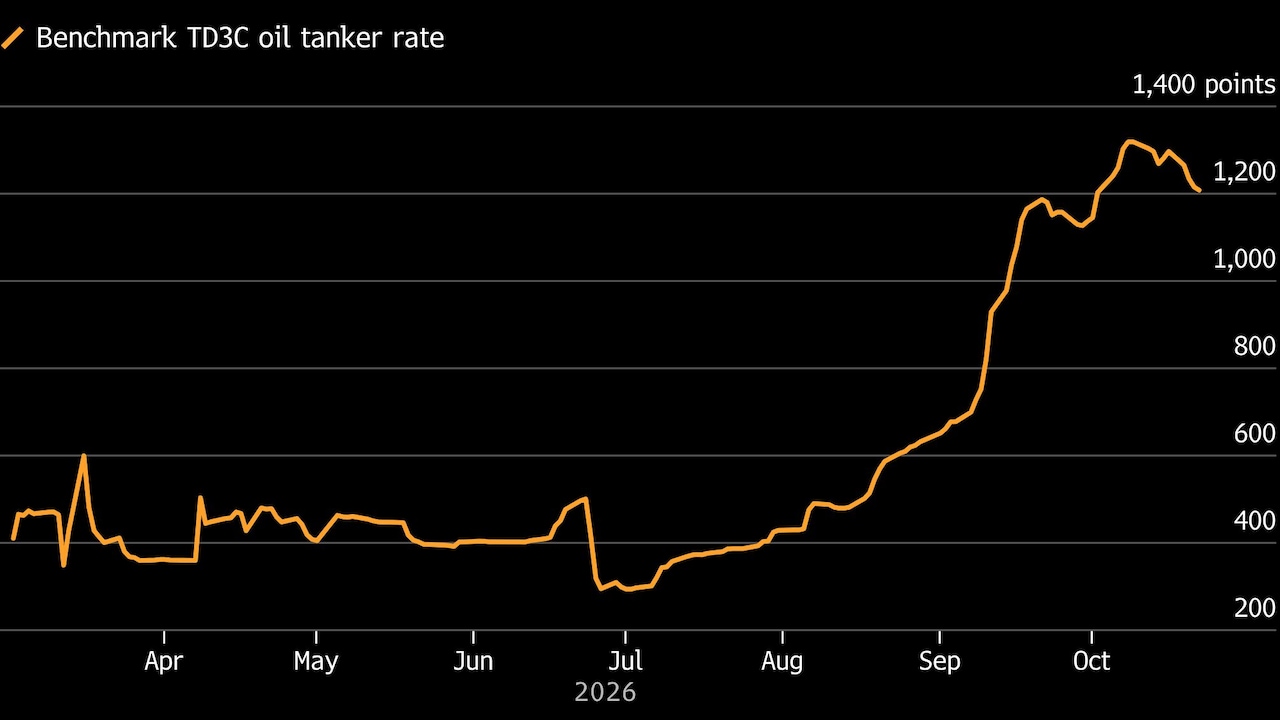
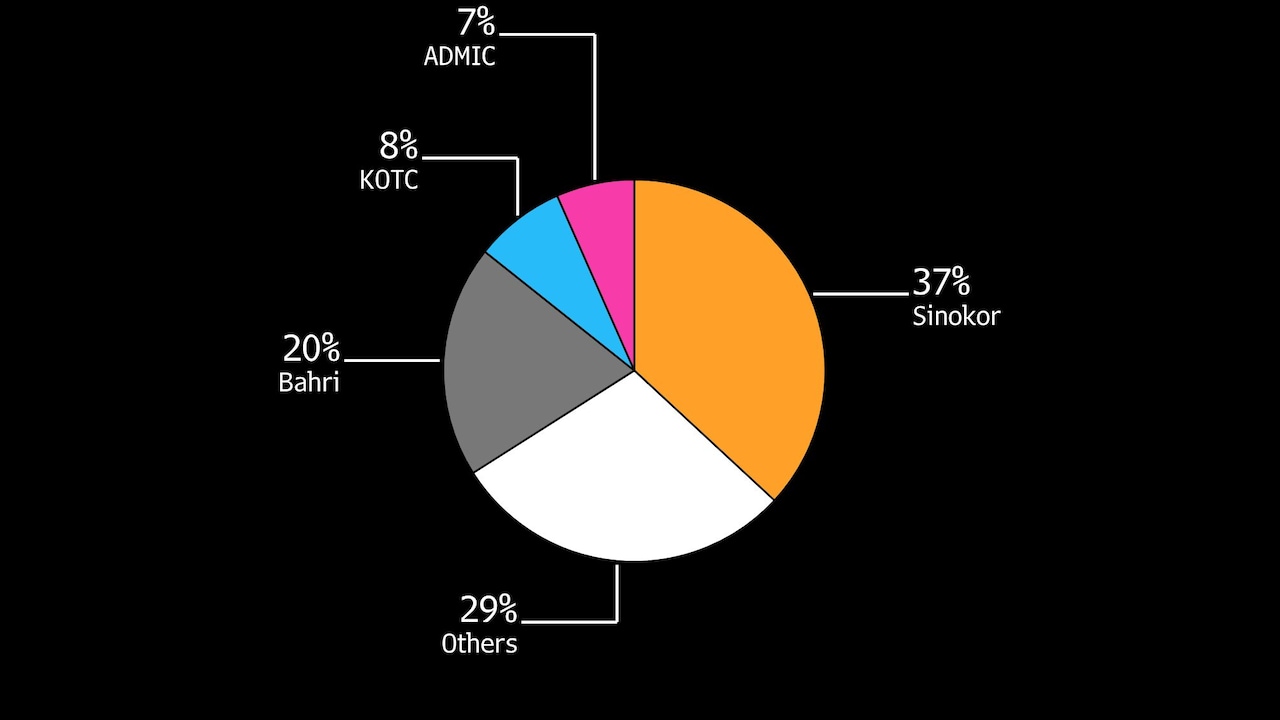
March MessageIt was barely two weeks into the Iran war, on March 12, when brokers received a notification from Sinokor that it had hired out a ship to sail from the United Arab Emirates port of Zirku to Asia at a rate of at least 700 Worldscale points - far above the Baltic's assessment for that day of 348.89. The Worldscale system is a standardized way of comparing tanker freight rates across different routes. At the time, prices had already been soaring for months after Sinokor, until then a relatively smaller player, suddenly embarked on a massive supertanker buying spree with backing from container shipping giant MSC Mediterreanean Shipping Co. The aggressive move gave Chung - the deeply private scion of a Korean shipping family - a level of influence in the tanker market that insiders say is unprecedented, and meant that Sinokor was positioned to reap huge profits when the war started. By the time of Sinokor's March WhatsApp, the Baltic Exchange was facing turmoil of its own, as shipbrokers grappled with how to calculate the cost of shipping from a Saudi Arabian port that was effectively inaccessible due to the war. Some began using a still-functioning Saudi port on the Red Sea for their TD3C assessments, but the exchange intervened and insisted that the benchmark price must continue to reflect loadings from inside the Persian Gulf. By March 16, the Baltic's rate jumped to almost 600 Worldscale points, equivalent to $602,000 a day, as traders struggled to assess a trade that appeared to have stalled, and with barely any visibility of deals being done other than Sinokor's notice. Prices continued to swing wildly in the coming weeks, and in late April Mercuria filed a lawsuit alleging that it had suffered losses in the hundreds of millions of dollars as a result of distortions in the benchmark, though its lawyers said in May that it was not looking to "extract money from an exchange." The company since removed the figure from its claim. Mercuria argues that the index should be suspended immediately, and that since the Iran war began the route no longer serves its intended function. For its part, the Baltic's argues that would be an unprecedented move and that if that request were granted there would be "chaotic market-wide consequences," including for the multibillion-dollar derivatives market linked to TD3C. ALSO READ | Instagram Sextortion Scams On The Rise? KnotDating CEO Shares Screenshots To Warn Others For decades, the Baltic Exchange's Middle East to Asia benchmark has stood at the heart of the oil tanker market, used as a reference point in long-term contracts for supertanker deals - including for vessels sailing elsewhere in the world - and underpinning a large derivatives market. The original TD3 route measured the cost of traveling to Japan, but was replaced about a decade ago with TD3C, to reflect China's growing dominance as an oil importer. The rate is published just after 4 p.m. London time every day, based on the average of assessments provided by nine brokers. The individual brokers submit their estimates shortly before the price is issued, although the Baltic Exchange can occasionally ask for justification for the figures, one of the people said. Mercuria's lawsuit alleged that TD3C was being distorted, and its lawyers argued that the handful of ships transiting Hormuz in the early months of the war should not qualify as fixtures for setting the benchmark rate. Shuttle SystemBy the summer, however, the flow of oil out of the Persian Gulf was becoming a steady stream, as producers and traders settled into a new "dark shuttle" system - using dedicated tankers making return journeys under cover of night before offloading oil onto ships waiting empty just outside the gulf. Bloomberg reported in early July that Sinokor had emerged as a major owner of supertankers moving crude through the strait of Hormuz. But the level of information about ships and cargoes operating in the region for the most part remained extremely limited. It was around that time that the Sinokor messages - referred to among industry insiders as "blasts" - began to accelerate. Sinokor owner Chung already had a reputation in shipping circles for creating sprawling WhatsApp groups with representatives from individual brokerage firms or counterparties, usually including large numbers of Sinokor employees as well. In late July, when TD3C had begun to retreat following the interim peace deal between the US and Iran that notionally lowered the risk of attack in Hormuz, Sinokor "blasted" out that it had hired out a ship at 465 Worldscale points, about 60 points higher than where the market was assessed that day. The difference is the equivalent to just over $60,000 a day in earnings. Sinokor sent out at least five missives in August, each announcing progressively higher rates. By Aug. 21, the company told the market that it hired a ship out at 1,350 Worldscale points, almost three times the level of just under a month earlier. In the months to come, the market went parabolic, surging from around 400 points in late July, to almost 1,320 points in October. Supertankers in the Persian Gulf - and any deals still tied to TD3C- were now earning more than $1.4 million a day. The potential payoff for Sinokor and its partner MSC is huge. Sinokor is listed as the manager of 83 supertankers on the Equasis maritime database, many of which are operating in or around the Middle East. Most industry figures see the company controlling more vessels than that in reality when charter deals are added in too. Using a gauge of average supertanker earnings across the world, a fleet of 83 ships would have pulled in on average of about $143 million a month last year. That jumped to $509 million by July this year, $1.4 billion in September, and $2.1 billion in October, based on the average for the month so far. In reality, it depends where the vessels are sailing, and those figures don't account for costs and days where ships aren't hired. (Some of the company's ships have been hit in Hormuz recently, potentially reducing the number of days its tankers can earn money while they undergo repairs.) By comparison, Sinokor's revenue for the whole of 2025, which also includes a container shipping arm, was $5.5 billion, according to accounts published in South Korea. While the financial rewards for companies like Sinokor willing to take the risk of crossing Hormuz are significant, the journeys also ultimately provided a vital lifeline to global energy markets. Worst case-scenario forecasts of $200 a barrel crude oil prices never materialized, partly as a result of the ships that continued to cross Hormuz. Sinokor itself carried an estimated 37% of the oil that passed through the Strait of Hormuz last month, Bloomberg reported last week. Opaque MarketFor many in the industry, the crucial question is how literally to take the Sinokor messages, which have become less frequent since the summer. Several people involved in tanker markets said Sinokor's WhatsApps can leave room for interpretation around parts of the rate being publicized, like who pays for insurance, or the ship's destination. And the already opaque shipping market has become even harder to track as a result of the Iran war, as most ships in the Middle East have stopped broadcasting satellite signals that make their movements easy to follow. Tracking and satellite images show that while some of the bookings the company broadcast went exactly as advertised, others are less clear. At least one ship that Sinokor said would sail from the Middle East to Asia in early August hasn't left the Indian Ocean and Persian Gulf since then. To be sure, charterers and shipowners will sometimes privately agree to change the route they're due to sail, while bookings can also fall through. The Baltic Exchange's policies say that panelists should use discretion over the relative value they attribute to data they gather and - in cases where there is little or no activity on a route for a period of time - must apply their "expert judgement of the wider market" to provide an assessment. Of 130 published days between early March and early September, the Baltic Exchange said in its defense that there were 12 instances where one broker didn't provide the Baltic with an assessment for the route, citing difficulties in assessing the market. Last month, a different broker said that it would no longer input data for the route on an indefinite, but temporary basis, the exchange added in its defense for the court case. "There is an element of trust when you are determining the price of shipping oil," said Halvor Ellefsen, a London-based director at Fearnleys Shipbrokers UK Ltd. "With such a dominant player making bullish uncorroborated proclamations, although lacking underlying contractual details, it has never been more difficult to figure out where in reality TD3C sits. TD34 has by and large taken over from TD3C as a reliable benchmark." |