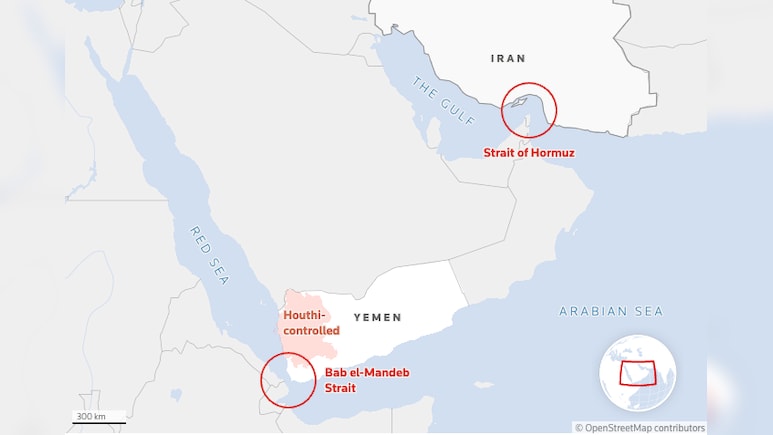
Tensions across two of the world's most vital shipping corridors escalated sharply after Iran-backed Houthi rebels claimed responsibility for striking two Saudi oil tankers in the Red Sea, even as an oil tanker in the Strait of Hormuz was hit by a separate explosion, deepening fears over global energy supply routes.
The Houthi military's spokesman, Yahya Sarea, said in a broadcast on the group's Al-Masirah television that fighters had used a combination of ballistic and cruise missiles along with drones to strike the vessels, named ENCELIA and LAYLA.
The group alleged the tankers had breached maritime restrictions it had recently declared, part of a broader threat by the Houthis to blockade Saudi ports altogether.
Also Read | Layoffs Are Rising In Tech, But These Skills Are Helping People Unlock Better Pay
The Red Sea strikes come on top of an already volatile standoff in the Strait of Hormuz, the narrow passage through which a large share of the world's oil trade moves, where Iran has been targeting vessels attempting to transit despite an earlier understanding with Washington.
Meanwhile, Iran's Islamic Revolutionary Guard Corps (IRGC) said early Thursday that an oil tanker was hit by an explosion in the Strait of Hormuz, forcing two other vessels to turn back after attempting to transit a mine-laden southern route in the strategic waterway, IRIB reported.
The IRGC said the three tankers had attempted to use the southern route through the Strait of Hormuz, which it said had been encouraged by the US military.
It said one tanker was struck by an explosion and caught fire, while the two remaining vessels reversed course.
The IRGC said the Strait of Hormuz would remain “completely closed” for the duration of ongoing US military operations, adding that no tanker would be allowed to enter or leave the waterway during that period.
That preliminary arrangement between the US and Iran has effectively broken down, with Tehran reinstating its blockade of the strait.
US President Donald Trump has responded with direct threat, warning that any Iranian strike on a ship in Hormuz — by missile, rocket, drone or any other means — would prompt the US to destroy an Iranian bridge or power plant in retaliation.
ALSO READ: Two Chokepoints, One Crisis: The Risk Of Hormuz And Bab el-Mandeb Disruption
He posted the warning on social media, framing it as a fixed rule of engagement going forward.
Meanwhile, Iran's Foreign Minister, Abbas Araghchi, pushed back just as forcefully, saying Tehran's approach was built on reciprocity.
Writing on X, Araghchi said Iran's defence doctrine operated on an "eye for an eye" basis and warned that any strike on Iranian infrastructure, including from the US, would draw a strong and decisive response.
Our defense doctrine is clear: eye for an eye.
— Seyed Abbas Araghchi (@araghchi) July 22, 2026
Any aggression against Iran, including our infrastructure, will compel a powerful and decisive response.
Those who contribute to such aggression, whatever the kind of support, will also be considered as legitimate targets.
The overlapping crises in the Red Sea and Hormuz threaten to squeeze two of the busiest arteries for global oil shipments simultaneously, at a time when Washington's military commitment to the region is already being tested by its wider war against Iran. Neither side has shown signs of de-escalating.
ALSO READ: Another Hormuz: How Iran's Houthi Card In Red Sea May Torch Oil Markets
Essential Business Intelligence, Sharp Market Insights, Practical Personal Finance Advice, Daily Fuel, Gold and Silver Prices and Latest Stories — On NDTV Profit.