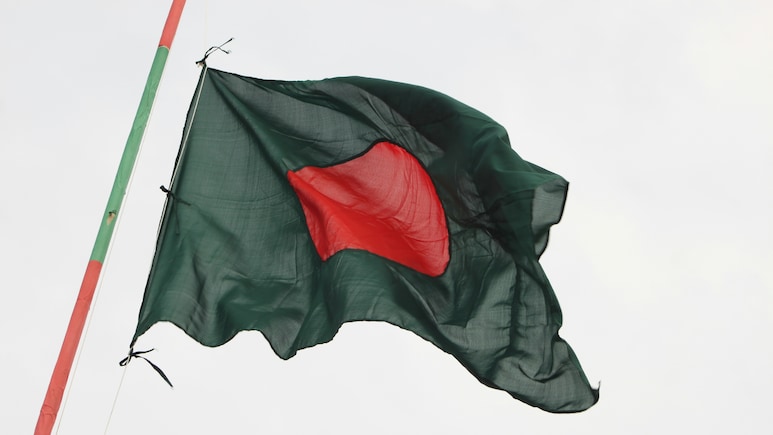
The Indian high commissioner to Bangladesh, Pranay Verma, has met Prime Minister Tarique Rahman in Dhaka on Monday morning and comes right before Foreign Minister Khalilur Rahman's visit to India this week.
Khalilur Rahman will be in India before attending the Indian Ocean Conference in Port Louis, Mauritius, later this month.
In a statement on micro-blogging platform X, the Indian High Commission in Dhaka said: "High Commissioner Pranay Verma paid a courtesy call on Hon'ble Prime Minister H.E. Tarique Rahman on 6 April 2026. They discussed bilateral engagement with focus on people-centric cooperation in multiple domains aligned with the national development priorities of the two countries."
"High Commissioner conveyed India's intent to work together with the Government and people of Bangladesh by adopting a positive, constructive and forward-looking approach based on mutual interest and mutual benefit," the statement added.
Sources in Bangladesh have told NDTV that the visit is being positioned as building the foundation for a sustainable political relationship and mutually beneficial bilateral relationship between the countries at a time when the world order is in a state of flux with the West Asia war.
High Commissioner Pranay Verma paid a courtesy call on Hon'ble Prime Minister H.E. Tarique Rahman on 6 April 2026. They discussed bilateral engagement with focus on people-centric cooperation in multiple domains aligned with the national development priorities of the two… pic.twitter.com/tZh9lovI0r
— India in Bangladesh (@ihcdhaka) April 6, 2026
Khalilur Rahman will be accompanied in Delhi by the Bangladesh PM's adviser on foreign affairs, Humayun Kabir. This will be the first visit to Delhi by a cabinet minister since the BNP Government led by Tarique Rahman assumed office in February this year.
In India, Khalilur Rahman will meet with National Security Adviser Ajit Doval and External Affairs Minister S Jaishankar.
Rahman will pay courtesy calls to Commerce Minister Piyush Goyal and Petroleum & Natural Gas Minister Hardeep Singh Puri as India steps up emergency supplies to neighbours affected by the West Asia war.
"I am going to India before attending the Indian Ocean Conference. During the Delhi visit, I will meet India's external affairs minister S Jaishankar and several other important government representatives," Khalilur Rahman told Bangladesh daily Prothom Alo. "The discussions will focus on the future of relations between the two countries. We want a normal relationship with India based on mutual respect, dignity, and interests."
The India-Bangladesh relationship has undergone a major shift since the fall of the Sheikh Hasina government in 2024. Following the taking over of the interim government under Muhammad Yunus, India-Bangladesh ties nosedived as there were many confrontations between the two countries as Yunus pivoted towards Pakistan at the cost of ties with India and encouraged anti-India rhetoric in Bangladesh. He also made provocative statements regarding India's northeast, for which there were sharp rebukes from India.
After the current BNP Government assumed charge, there has been an effort to normalise ties under Tarique Rahman's Bangladesh First policy, which puts Bangladesh's interests above everything else.
Sources in Bangladesh have told NDTV that the current reality must be acknowledged, and relations between the two countries need to be viewed from the perspective of long-term sustainability and that will be the message that Khalilur Rahman will be bringing to India.
An issue that is also likely to come up for discussions during the visit is the renewal of the Farakka water agreement, which was signed for a duration of 30 years in 1996. India and Bangladesh have repeatedly sparred over the release of water and the holding of water through the Farakka Barrage.
Why is it important to renew the Farakka Water Agreement? Read here
The 1996 Ganga Water Sharing Treaty, a 30-year agreement between India and Bangladesh expiring in 2026, governs the sharing of Ganges water at the Farakka Barrage during the dry season (January 1–May 31). The treaty is up for renewal this year and it is believed to be a major issue in India-Bangladesh ties.
Bangladesh has expressed concerns over reduced water levels and environmental impacts on the Sundarbans due to changing climate and reduced flow, claiming the treaty has not completely resolved issues, specifically during peak dry seasons.
Essential Business Intelligence, Sharp Market Insights, Practical Personal Finance Advice, Daily Fuel, Gold and Silver Prices and Latest Stories — On NDTV Profit.