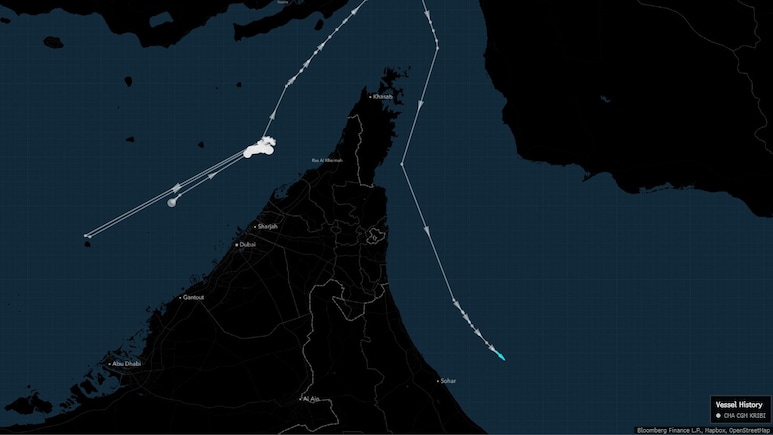
A container ship signaling French ownership has exited the Strait of Hormuz, in what appears to be the first known transit by a vessel linked to Western Europe since the war all but shuttered the vital waterway.
The CMA CGM Kribi sailed from waters off Dubai toward Iran on Thursday afternoon local time, signaling that its owner was French, according to ship-tracking data. It stuck close to the Iranian coast, moving through a channel between the islands of Qeshm and Larak, openly broadcasting its journey. On Friday morning, it signaled that it was off Muscat. Two people familiar with the situation also said the ship had crossed.
Iran has tightened its grip over Hormuz since the US and Israel attacked the country on Feb. 28, reducing shipping to a trickle through a chokepoint that normally handles about a fifth of the world's oil and liquefied natural gas. Tehran has allowed some ships from friendly nations to transit a pre-approved route while threatening to strike vessels allied to the US or Israel. US allies including France are making initial diplomatic efforts to ease the crisis, but so far no progress has been reported.
Also Read | Layoffs Are Rising In Tech, But These Skills Are Helping People Unlock Better Pay
The Maltese-flagged vessel belongs to CMA CGM SA, the world's third-largest container line, which is majority-owned by the billionaire Saadé family. The founder immigrated to France from war-torn Lebanon and started the line in 1978, in Marseille, with one leased vessel.
The company and the French ministry of foreign affairs declined to comment. France's ministry of finance didn't respond to a request for comment.
Tracking ships entering and exiting Hormuz is not an exact science and has been complicated by the intense signal jamming in the area, as well as spoofing of signals. Three other ships also appeared to have exited the Gulf through the strait on Thursday, but further south along the coastline of Oman while broadcasting Omani ownership.
The CMA CGM Kribi can carry about 5,000 twenty-foot equivalent units, or TEUs, and draft readings show it's sitting low in the water, indicating that it's filled with cargo. It's smaller than the near-19,000 TEU ships from China's state-owned Cosco Shipping Corp. that recently exited the Persian Gulf via Hormuz. Both companies are key members of a container-shipping alliance — an agreement that allows them to share routes and space on vessels.
ALSO READ: US Allies Work On Plan B For Hormuz Strait If Trump Walks AwayEssential Business Intelligence, Sharp Market Insights, Practical Personal Finance Advice, Daily Fuel, Gold and Silver Prices and Latest Stories — On NDTV Profit.