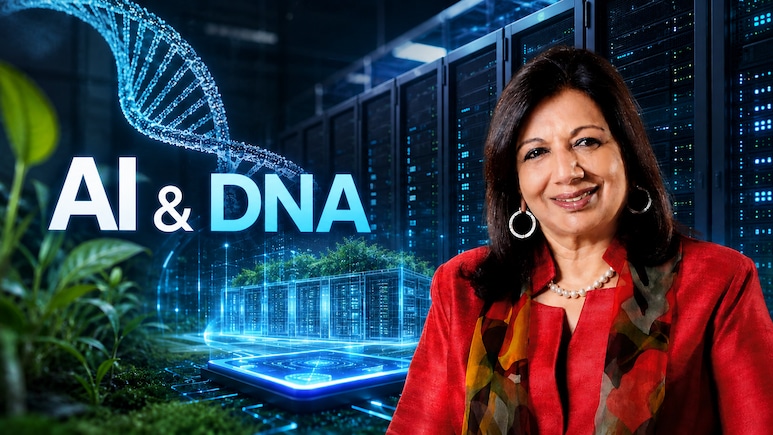
- Kiran Mazumdar-Shaw has highlighted DNA-based data storage as an eco-friendly alternative to data centers
- She acknowledged DNA storage is currently in early research phases but emphasized its potential impact
- Mazumdar-Shaw stated biology will play a crucial role in future AI and computing beyond current technologies
Biocon founder Kiran Mazumdar-Shaw said DNA-based data storage could offer a way out of the energy, water and rare mineral demands straining conventional data centres, in an exclusive interview to NDTV Profit, while acknowledging the idea remains at an early stage.
Asked about the backlash against data centres over their resource consumption, Mazumdar-Shaw said the answer could lie in biology rather than conventional computing. "DNA based data centres could solve some of these problems," she said. Pressed on how close this is to reality, she was candid: "It's blue skies thinking at the moment. But we should never shy away from blue skies thinking. These things can happen much faster than ever."
Also Read | Layoffs Are Rising In Tech, But These Skills Are Helping People Unlock Better Pay
She also argued that biology, not just artificial intelligence in its current form, will shape the next wave of computing. "I believe that biology is going to play a very important role in AI. It's not going to be artificial intelligence, it's going to be biological," she said, adding that computational biology could eventually offer more powerful models than large language models.
Why Scientists Are Looking At DNA To Store Data
The science backs up the direction of Mazumdar-Shaw's comments. Researchers have described DNA as an attractive alternative for dense and durable information storage, capable of addressing the growing gap between the volume of data being produced and the world's capacity to store it, according to a review in Nature Reviews Genetics.
Separate research published in Nature noted that DNA can store up to a billion times more information in the same volume compared with traditional silicon-based storage, with encoded sequences capable of lasting for centuries under the right conditions.
A 2025 study in Nature Communications also pointed to DNA's high storage density, longevity and energy efficiency as reasons it could offer a timely technological leap over conventional storage systems. Large-scale demonstrations remain confined to laboratory settings, with data density and read-write speed still key hurdles before commercial deployment.
ALSO READ: Syngene 'Lost Its Way' But Kiran Mazumdar-Shaw Promises Turnaround by Next Fiscal
Essential Business Intelligence, Sharp Market Insights, Practical Personal Finance Advice, Daily Fuel, Gold and Silver Prices and Latest Stories — On NDTV Profit.