The 8th Pay Commission is all set to potentially elevate the salaries of mid- and senior-level central government employees, with the revised basic pay likely to depend significantly on the fitment factor recommended by the panel. Salary revision calculations will depend on factors including the dearness allowance (DA), while the final figures will only be known after the commission's report is approved.
The Commission is scheduled to hold discussions with employee and pensioner groups and other stakeholders in Bengaluru on October 7 and 8, 2026, and in Mumbai on October 22 and 23, 2026. It has already completed its September discussions in Chandigarh, Chennai, Puducherry and Jaipur.
Employee bodies have prominently raised issues related to salary revision and the fitment factor, which will be important components of the revision of basic salaries. The final salary revision will depend on several factors, including the dearness allowance (prevailing when the commission's recommendations are implemented.
Also Read | Layoffs Are Rising In Tech, But These Skills Are Helping People Unlock Better Pay
The commission's deadline to submit its report is May 2027, bringing its consultations into focus as central government employees await clarity on their revised salaries.
6th, 7th Pay Commission: How DA Affected Salary Hike
The difference is mainly linked to the prevailing DA rate when a new Pay Commission's recommendations are implemented. A higher DA at the time of revision can result in a lower increase in gross salary compared with the increase in basic pay.
When the 6th Pay Commission was notified, the DA under the 5th CPC was 47%, effectively giving employees a 1.47 factor. The government then set the 6th CPC fitment factor at 1.86, resulting in an approximately 54% increase in gross salary.
The calculation also takes into account allowances such as House Rent Allowance (HRA) and Transport Allowance (TPTA).
For the 7th Pay Commission, the fitment factor was higher at 2.57. However, when the recommendations were notified in June 2016, the DA was 125%. This meant employees were effectively already receiving a 2.25 factor under the 6th CPC. Consequently, the average gross salary increase was only around 14.29%, despite the 2.57 fitment factor.
What could happen under the 8th Pay Commission?
The outcome will depend on the DA rate when the 8th CPC report is approved.
The current DA rate is 60% and could rise to around 66% if the recommendations are approved in the second half of 2027. The actual salary increase, however, will depend on the DA applicable at the time of implementation.
Can a Level 8 employee get Rs 1.51 lakh monthly gross salary?
An illustrative calculation shows how the gross salary of a Level 8 central government employee could change under different fitment factors.
For the 8th Pay Commission, the calculation assumes a current basic pay of Rs 47,600, a gross salary of Rs 90,440, and a DA rate of 60% as of January 1, 2026. It also assumes an HRA rate of 30% for an X-category city. For the 8th Pay Commission, the calculation assumes DA will reset to zero and the HRA base rate for an X-category city will be 24%.
Based on these assumptions, three fitment factors — 2.00, 2.38 and 2.57 — have been considered.
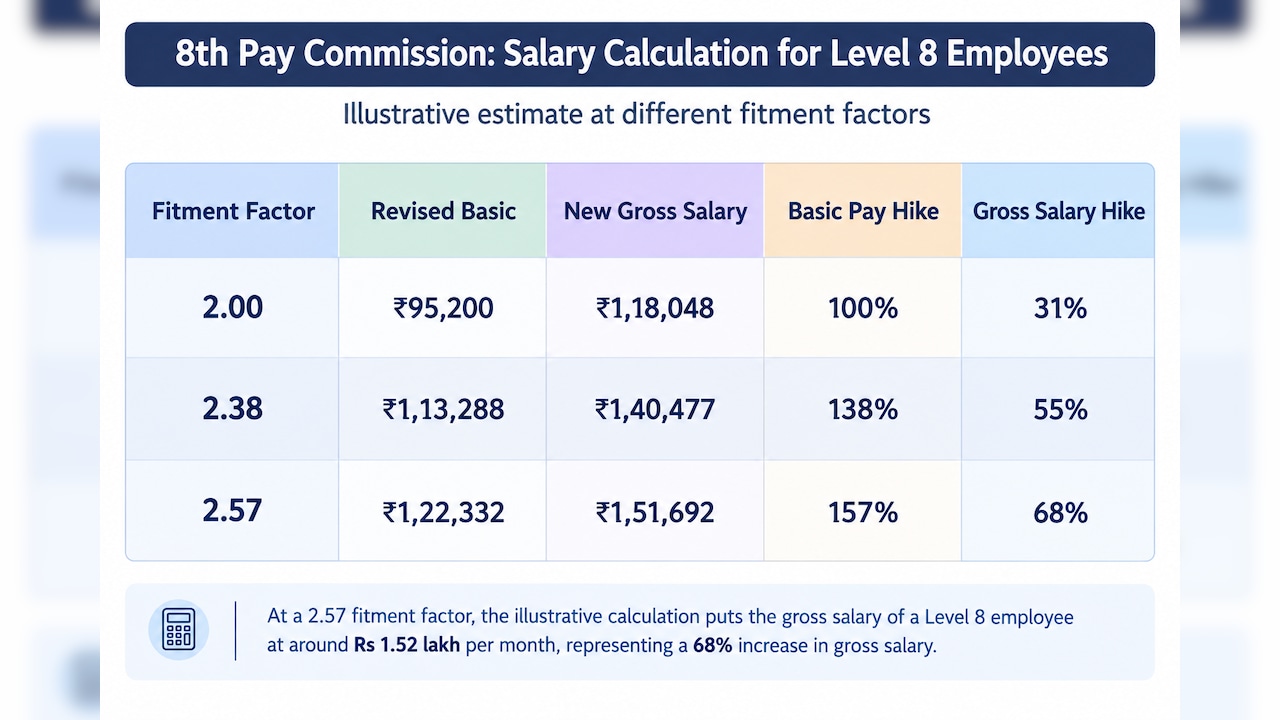
Photo Credit: ChatGPT
At a 2.57 fitment factor, the illustrative calculation puts the gross salary of a Level 8 employee at around Rs 1.52 lakh per month, representing a 68% increase in gross salary.
The figures are illustrative estimates based on assumed fitment factors. The calculations are sourced to BankBazaar.com. The final basic pay, allowances and gross salary will depend on the recommendations of the 8th Pay Commission and the government's final decision.
Essential Business Intelligence, Sharp Market Insights, Practical Personal Finance Advice, Daily Fuel, Gold and Silver Prices and Latest Stories — On NDTV Profit.