- The 8th Central Pay Commission is reviewing pay and pensions for central government employees in India
- Unions demand a fitment factor between 3.83 and 4.0 to revise basic pay and pensions significantly
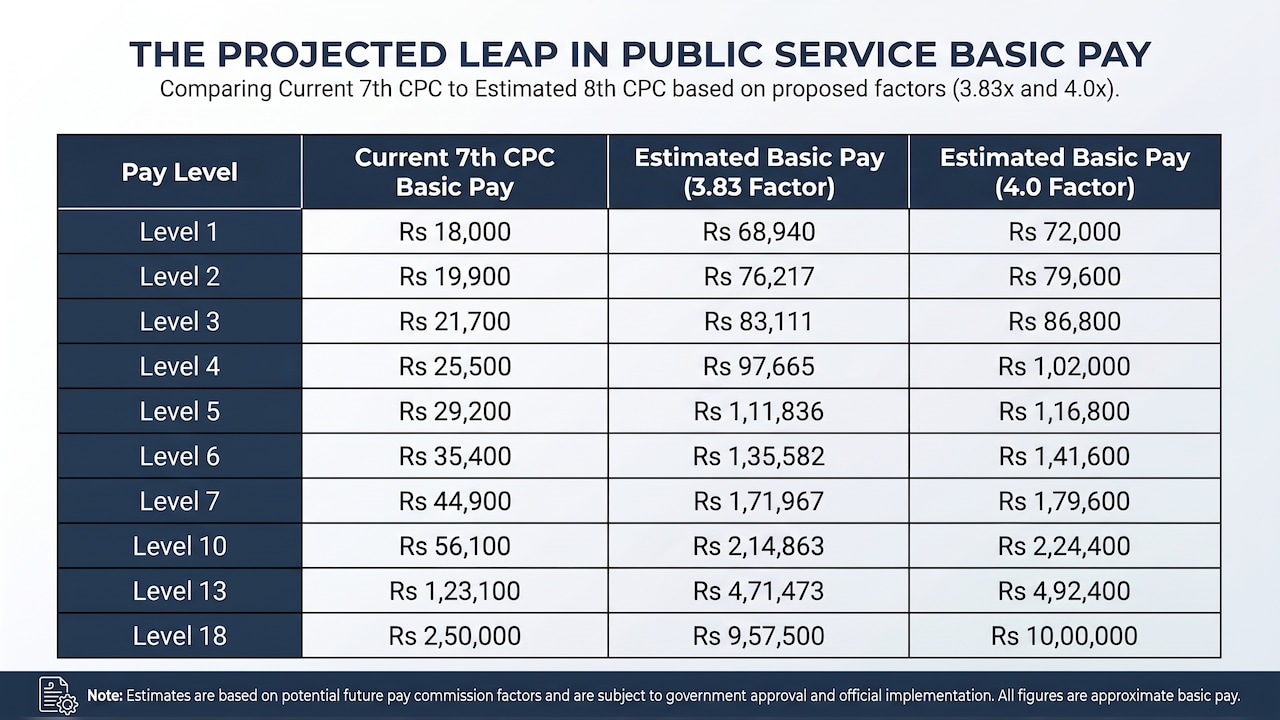
- A fitment factor of 4.0 could raise entry-level basic pay from Rs 18,000 to Rs 72,000 monthly
The 8th Central Pay Commission has become a key focus for central government employees and pensioners in India, who are waiting for clarity on the panel's recommendations.
The commission is collecting opinions from staff federations, trade unions and pensioner bodies through consultations held across the country. At the heart of these discussions is the fitment factor, the multiplier that will determine how existing basic pay and pensions are recalculated.
The 8th Pay Commission is chaired by former Supreme Court judge Justice Ranjana Prakash Desai. Its other key members include IIM Bangalore professor Pulak Ghosh, who serves as a part-time member, and Pankaj Jain, the panel's Member-Secretary. Set up in November 2025, the commission has been given 18 months to complete its work and is expected to submit its report to the Centre by around mid-2027.
Also Read | Layoffs Are Rising In Tech, But These Skills Are Helping People Unlock Better Pay
Employee unions have called for the 8th Pay Commission to consider a fitment factor of between 3.83 and 4.0. A factor of 4.0, if approved by the Union Cabinet, would take the basic monthly pay of entry-level central government employees from Rs 18,000 to Rs 72,000.
ALSO READ: EPFO Form 10C: What Is It, Who Can Apply And How To Claim Pension Benefits Online?
The fitment factor is the multiplier used to convert an employee's existing basic pay under the 7th CPC pay matrix into the revised basic salary. For comparison, the 6th Pay Commission had fixed the factor at 1.86, while the 7th CPC raised it to 2.57.
With inflation continuing to erode the value of wages, employee organisations have put forward higher fitment factors as part of their pay revision demands. The Bharatiya Pratiraksha Mazdoor Sangh (BPMS) has sought a multiplier of 4.0, while the All India Federation of Pensioners' Associations (AIFPA) has proposed 3.83.
Some employee bodies have also called for the Aykroyd formula to be considered, linking wage calculations to basic living costs, nutritional needs and essential household expenses.
The impact of these proposed multipliers can be seen across the various levels of the pay matrix. The calculations point to a sizeable rise in basic pay before allowances are added:
Pensioners would also see their basic pension recalculated under the proposed revision. A monthly minimum basic pension of Rs 9,000 could increase to Rs 34,470 with a 3.83 fitment factor, while a 4.0 multiplier would take it to Rs 36,000.
The implementation of the revised pay structure would also involve resetting the existing DA and DR rates to zero. Employees and pensioners would then receive allowances calculated under the new framework, with components such as HRA and TA added to the revised basic pay to determine the overall monthly amount.
ALSO READ: EPFO Wage Ceiling Raised: Could Your Rs 7 Lakh Insurance Cover Rise To Rs 10.5 Lakh?
Essential Business Intelligence, Sharp Market Insights, Practical Personal Finance Advice, Daily Fuel, Gold and Silver Prices and Latest Stories — On NDTV Profit.