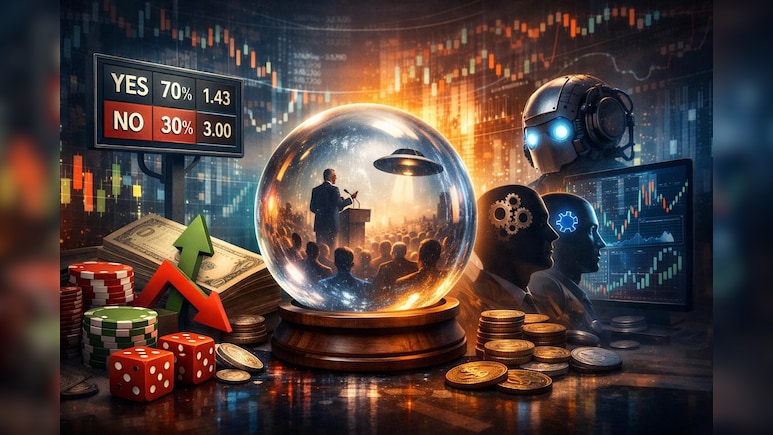
- Prediction markets allow betting on various events, reflecting collective probability estimates
- Prices range from $0 to $1, indicating the likelihood of an event occurring
- Markets aggregate dispersed private information into a public signal or consensus
"I bet she will say yes," or "I bet he will arrive on time." How many times in a day do we offer a wager, just casually? In some sense, we attach money when our conviction is strong. If many people get involved in that argument with differing opinions, we get a market.
In a broad prediction market, people can bet on almost anything - from sports outcomes to central bank decisions. The range can get quirky: users even wagered nearly $200,000 on whether Donald Trump would smoke marijuana on Joe Rogan's podcast (he didn't). "Whether the US will officially confirm the existence of aliens" has seen over $1.6 million in trading volume, becoming one of the more unusual highlights in recent years.
In prediction markets, speculation does not just track sports, economics or politics - it spills into the improbable.
Also Read | Layoffs Are Rising In Tech, But These Skills Are Helping People Unlock Better Pay
How Does Prediction Market Work?
Most prediction markets use a simple binary structure: an event either happens or it does not. Shares trade between $0 and $1. So a "Yes" price of $0.65 implies a 65% probability of the event occurring. If you buy at $0.65 and the event occurs, you receive $1, a gain of $0.35. But you do not have to wait. As new information emerges, prices adjust. If odds rise to $0.85, you can exit early and lock in a $0.20 profit.
The core idea is aggregation: individuals hold dispersed, private information, which markets convert into a public signal.
By 2025, total notional trading volume across major platforms crossed $44 billion, with Kalshi and Polymarket leading the segment.
Crowd Wisdom In Prediction Markets
In an earlier piece, I wrote about the wisdom of crowds with respect to the listing of a stock. Prediction markets apply the same logic. When thousands of financially incentivised participants bet on outcomes, the fragmented knowledge combines to form a collective view.
Kalshi co-founder Tarek Mansour said that these markets move debates "from the realm of subjective emotion to the realm of objective math." Proponents argue that it moves from holding opinions to having "skin in the game". For some, this has changed behaviour and actions. They are reading more on history, economics, politics, and other domains. In this maximalist view, markets act as truth machines.
But that claim runs into a deeper critique. As George Soros argues, markets are not passive thermometers measuring reality; they are active thermostats that shape it. In prediction markets, this feedback loop is immediate. If a candidate's odds surge to 80% on Polymarket, donors, media, and volunteers respond to that signal, improving the candidate's chances of winning. In such cases, the market did not just measure probability; it altered it.
This creates a subtle but important problem. If you use markets to discover truth, you might end up buying it. Imagine if world leaders acted solely on market signals - like attacking a country, arresting an opposition leader, or implementing policies - it could lead to serious problems. Markets show what people think others will believe - not necessarily what is true or best for society. In trying to legitimise themselves through the promise of crowd wisdom, prediction markets risk manufacturing the reality they claim to predict.
Risks From Insider Trading & AI
Some of the predictions have raised more eyebrows, such as the removal of Venezuelan President Nicolas Maduro, the attack on Iran, and even the death of Ayatollah Khamenei. The accuracy has raised red flags about potential insider trading, with suspicions that those close to power may have profited.
The increasing use of AI agents - around 30% of Polymarket wallets use them - has become another problem. This shift challenges the idea of "wisdom of crowds" as AIs, not humans, drive market predictions. If these agents identify patterns before major events, they could influence decisions.
ALSO READ: Economics Of AI Depends On Nuclear Power | The Reason Why
Final Take
If these markets become a shortcut to make money, tomorrow, everything can be wagered. You will no longer listen to the new Taylor Swift music for enjoyment, but rather bet on how others will react. In a world where attention has already been commodified, prediction markets try to make habits, recreation, opinions, and even thinking tradable assets.
I believe that the world does not need this. It will not make stock markets more efficient, nor will it allocate capital more rationally. It will not prevent wars or reduce poverty. At its core, there is no clear, indispensable use case - only a new way to speculate.
Disclaimer: The views expressed in this article are solely those of the author and do not necessarily reflect the opinion of NDTV Profit or its affiliates. Readers are advised to conduct their own research or consult a qualified professional before making any investment or business decisions. NDTV Profit does not guarantee the accuracy, completeness, or reliability of the information presented in this article.
Essential Business Intelligence, Sharp Market Insights, Practical Personal Finance Advice, Daily Fuel, Gold and Silver Prices and Latest Stories — On NDTV Profit.