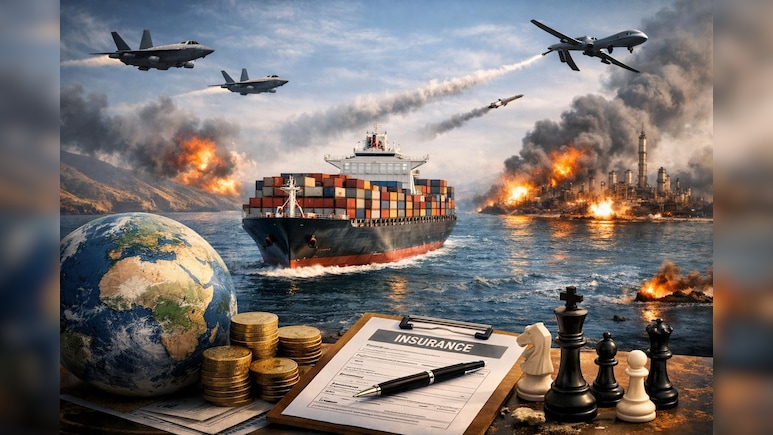
The Iran-Israel-USA war has touched different aspects almost every day. It began with geopolitical lessons on global chokepoints. In recent days, it has also covered religion and non-alignment policy. This explains how maritime insurance works and how several layers of that system reacted in the last couple of weeks.
Understanding Hull Insurance
Start with the basics. A shipowner sending a vessel on a voyage must consider risks such as ship damage, cargo loss, crew injuries, pollution and damage caused by the vessel. A charterer of that ship also needs insurance.
The two main types of marine insurance are hull insurance and Protection and Indemnity (P&I) insurance.
Also Read | Layoffs Are Rising In Tech, But These Skills Are Helping People Unlock Better Pay
Hull insurance protects the vessel. P&I insurance protects the shipowner against liabilities to third parties. It covers claims such as crew injury, oil spills or damage to port infrastructure.
There is also a structural difference. General insurers sell hull insurance. P&I clubs provide P&I cover. These are not-for-profit mutual associations owned by shipowners. Twelve such clubs form the International Group of P&I Clubs. They insure about 90% of global shipping traffic. Without P&I cover, ships cannot enter most ports.
Reinsurers form another layer. In hull insurance, standard reinsurance applies. In P&I, smaller claims are shared among the 12 clubs through pooling. Larger claims are covered through a Group Excess of Loss contract placed with specialist reinsurers such as Lloyd's of London.
Understanding War Risk In Marine Insurance
Standard covers do not include war risk. Shipowners must buy an add-on.
For hull insurance, the war-risk add-on covers physical damage from events such as missiles, drones, mines or terrorism. Insurers such as Lloyd's underwrite these covers. They typically charge 0.025% to 0.05% of hull value annually for general war risk. The Strait of Hormuz is listed as a high-risk zone, where premiums are higher and calculated per voyage.
For P&I, war-risk extensions cover third-party liabilities during conflict. These include charterers' liability, crew injury or death, cargo loss and offshore risks. Two changes apply. The cover becomes commercial and for-profit, and it sits outside the mutual pool. Each club must arrange reinsurance separately.
The final layer is retrocession and the insurance-linked securities market, where reinsurers spread risk further and raise capital through instruments such as catastrophe bonds. War risk is excluded from this layer, leaving reinsurers as the final backstop.
ALSO READ: Strait Of Hormuz Blockade: 3 Lakh Metric Tonnes LPG Stranded, Says Government
What Actually Changed During the Crisis
These structures explain recent changes. The core system did not collapse. Standard hull and P&I cover remained unchanged as they exclude war risk. The pressure emerged in war-risk add-ons and extensions.
Before the crisis, ships paid about 0.15% to 0.2% of vessel value per voyage to transit high-risk areas. After the conflict escalated, this rose to about 1% to 3% and required renewal every seven days.
Premiums rose as insurers faced the risk of multiple vessel losses at once, each valued at hundreds of millions of dollars, without a backstop such as catastrophe bonds. Reinsurers then faced higher capital requirements under rules such as Solvency II. Unable to meet these quickly, they issued 72-hour cancellation notices to P&I clubs.
As reinsurers withdrew, P&I clubs cancelled covers such as charterers' liability and crew extensions, as these sit outside the pooling system. They replaced them with buyback cover at higher prices, about $30,000 per week compared with $25,000 per year earlier. At these levels, premiums exceed voyage margins.
Higher premiums and cancelled extensions stem from the same issue: a small group of reinsurers carries the risk and withdraws when exposure rises. War risk can escalate quickly. If insurers do not reprice or cancel policies, losses can rise sharply. This is why short-notice cancellation clauses exist.
ALSO READ: Trump Reverses Stance On Hormuz, Says US Doesn't Need NATO Support
Insurance Still Exists; Yet Ships Don't Want to Sail
Shipowners can still obtain insurance. However, at current prices, it is often not viable to sail. The constraint is pricing rather than military closure.
If a ship secures war-risk cover, pays the premium and follows conditions, insurers will honour claims in case of attack, though complications may arise. Another factor is labour rules. The International Transport Workers' Federation and the Joint Negotiating Group have classified the Arabian Gulf, Gulf of Oman and Strait of Hormuz as a high-risk warlike operations area. Crew can refuse such voyages, affecting operations.
Risk perception also varies by country. Ships linked to countries such as India or China may face lower risk, while others face higher exposure, placing Iran in a gatekeeping position.
The Strait of Hormuz remains partially open. However, risks, crew safety concerns and high premiums have led many ships to avoid sailing.
How Are Chinese And Indian Ships Sailing
China set up a Hong Kong-based war-risk insurance pool in late 2025, backed by mainland insurers, and strengthened its reinsurance capacity. This allows Chinese vessels to bypass Western insurance networks. It also uses a shadow fleet moving Iranian oil, which operates with limited formal insurance.
India secured diplomatic safe passage for some vessels. However, GIC Re withdrew war-risk reinsurance for the region in early March. Indian ships that transited later did so without reinsurance backing.
Their arrangements likely included high-cost cover from London markets, limited or no formal insurance supported by assurances from Iran, or indirect sovereign backing through public insurers, with losses borne by the government.
ALSO READ: India Says Not Engaged In Bilateral Talks With US Amid Trump's Warship Deployment Appeal
Final Take
The crisis shows that when risks and uncertainty rise, insurance costs increase and shipping activity falls. The Strait has not closed physically but has become costly to use.
India and China have kept some traffic moving, but their methods highlight a shift. Focus has often been on systems such as SWIFT, IMF, World Bank and the dollar. This episode shows that insurance and reinsurance are also key constraints. Efforts to build alternatives may increase. Russia has proposed a BRICS-backed reinsurance system, while China is building its own capacity.
Creating an alternative will take time. Insurance depends on capital, legal systems, claims processes and global acceptance. India may need to strengthen its domestic capacity through GIC Re and expand gradually to support its strategic position.
Disclaimer: The views expressed in this article are solely those of the author and do not necessarily reflect the opinion of NDTV Profit or its affiliates. Readers are advised to conduct their own research or consult a qualified professional before making any investment or business decisions. NDTV Profit does not guarantee the accuracy, completeness, or reliability of the information presented in this article.
Essential Business Intelligence, Sharp Market Insights, Practical Personal Finance Advice, Daily Fuel, Gold and Silver Prices and Latest Stories — On NDTV Profit.