- Sensex, Nifty ended FY26 with its largest monthly drop since March 2020 amid US-Iran conflict
- Brent crude prices surged above $115 per barrel due to Middle East tensions impacting inflation
- Foreign investors withdrew over Rs 1.6 lakh crore in FY26, causing liquidity concerns for FY27
The Indian stock market closed fiscal 2025-26 (FY26) on a sour note after logging its biggest monthly slump since March 2020 amid intensifying US-Iran war that drove Brent crude oil prices above the $115 per barrel-mark. BSE benchmark Sensex settled at its lowest in two years while the NSE Nifty 50 dropped 2.14% to hit a nearly one-month low on March 30, 2026. Global cues led by the heightened Middle East geopolitical risk premium have stoked growth worries for the Indian economy.
D-Street opens for regular trading on April 1, however all trades will not be cleared on account of the settlement holiday due to the annual closing of banks. Notably, the domestic equity benchmarks begin the new fiscal 2026-27 (FY27) after shedding more than 11% in March due to the escalating US-Israel attacks on Iran which has toppled global financial markets for over a month.
ALSO READ: Stock Market Today: All You Need To Know Before Going Into Trade On April 1
Also Read | Layoffs Are Rising In Tech, But These Skills Are Helping People Unlock Better Pay
Nifty dropped 5.1% and Sensex fell 7.1% in FY26. The Indian stock market's volatility index India VIX, a gauge of market uncertainty, more than doubled to 27.89 in March, logging its biggest monthly jump in six years. Heading into FY27, analysts believe the Indian equity market will face several notable risks that could drive volatility and potential derating. From the Middle-East geopolitical tensions to foreign capital outflows, here are the top five triggers that may dictate Sensex, Nifty in FY27:
Outlook FY27: Top five triggers that dictate D-Street in 2026-27
1. Middle East geopolitical tensions
The most immediate concern is geopolitical escalation in the Middle East, particularly tensions involving Iran, Israel, and the US, which have already triggered sharp market weakness in March 2026. The war, which began in late February, has disrupted global supply routes, especially for crude oil and gas in Asia. ''The Goldilocks macro scenario which India had before the war has almost disappeared thanks to the war,'' said Dr. V K Vijayakumar, Chief Investment Strategist, Geojit Investments Ltd.
''Instead of high GDP growth, low inflation, moderate fiscal and current account deficits and expectations of higher corporate earnings growth in FY27, now we face prospects of lower GDP growth, higher inflation, higher fiscal and current account deficits and lower earnings growth for FY27. The market has largely discounted these negatives as reflected in the decline in the Nifty trailing PE ratio to about 19.9 times. This is fair but not yet cheap valuations,'' added Dr. V K Vijayakumar.
2. Brent crude oil prices
The US-Iran conflict has pushed Brent crude oil prices up about 60% in March, a record monthly jump. This becomes critical for the world's third-largest crude importer. Analysts believe any sustained disruption to oil supply routes like the Strait of Hormuz, a critical artery for over 20% of global oil supplies, could keep Brent crude elevated above $100 per barrel, feeding directly into higher input costs across the economy.
Closely linked to the risk of a prolonged crude oil spike and resulting imported inflation could bite through the margin compression in oil-import dependent sectors such as airlines, autos, chemicals, and paints, while adding to broader inflationary pressures that complicate fiscal and monetary management, according to Pranay Aggarwal, Director and CEO of Stoxkart.
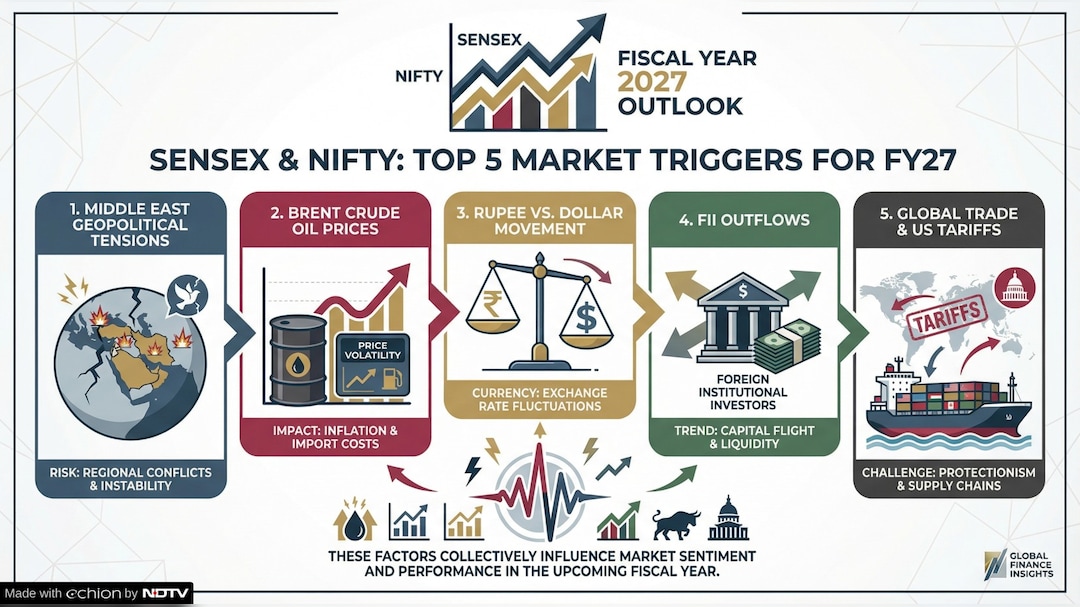
Top five triggers for Sensex, Nifty in FY27
Photo Credit: NDTV Profit/Echion
3. Global trade, tariff pressures
The India-US interim trade deal was signed in February, however, uncertainties around global trade and tariffs, including delays in sealing a favourable trade pact or fresh protectionist moves under broader "America First" policies, add a structural overhang for the Indian stock market in FY27. ''Markets have partially priced in moderate tariff scenarios, but worse outcomes could hit India's export-oriented sectors and disrupt the China+1 narrative that has supported manufacturing expectations,'' said Aggarwal of Stoxkart.
4. Foreign capital outflows
Foreign institutional investors withdrew more than Rs 1.6 lakh crore from Indian equities in FY26, however, a record Rs 8.5 lakh crore flow from domestic investors insulated the market. Persistent FII outflows represent a major headwind, with FIIs pulling out over Rs 97,000 crore in March 2026 alone-pushing year-to-date withdrawals past Rs 1.45 lakh crore.
A weaker rupee further erodes dollar-denominated returns and sustains the selling pressure, even as domestic institutional investors provide counterbalance. ''Without clearer triggers like an India-US trade resolution or a decisive global risk-on shift, these outflows could extend well into the first half of FY27, squeezing liquidity,'' said analysts at Stoxkart.
ALSO READ: FPIs Close March With Highest-Ever Outflows, Net Selling Crosses Rs 1.18 Lakh Crore
5. Rupee Vs Dollar
The Indian rupee fell to a record low of 95.21 in the previous session, marking the end of a rough financial year when trade frictions, geopolitics, and unfavourable capital flows pummelled the South Asian currency. The rupee had declined 11% in FY26, its steepest fall since 2011-12. The Reserve Bank of India's surprise cap on onshore forex positions gave the battered rupee a fleeting relief on Monday, but also left traders managing losses as they rushed to unwind arbitrage positions.
"The bottom line is that the RBI's cap does not change the underlying dynamics that fuelled pressure on the currency. The INR remains particularly vulnerable to an oil supply shock, while India's balance of payments position may deteriorate further, and capital and financial account pressures are increasing,'' said analysts at Barclays. Experts believe RBI's move could trigger potential losses for banks.
Essential Business Intelligence, Sharp Market Insights, Practical Personal Finance Advice, Daily Fuel, Gold and Silver Prices and Latest Stories — On NDTV Profit.