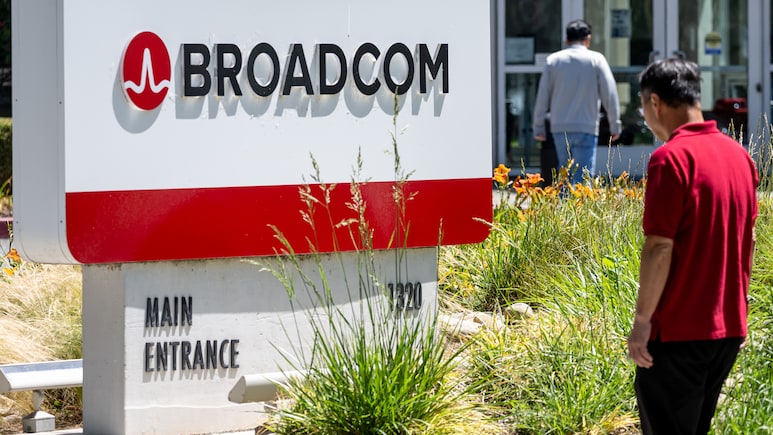
Broadcom Inc. shares plunged by the most in more than 16 months after the company's forecast for sales of its artificial intelligence chips disappointed investors.
AI semiconductor revenue will be $16 billion in the fiscal third quarter running through July, the company said in a statement Wednesday, falling well below analysts' expectations of $17.2 billion on average. Chief Executive Officer Hock Tan said Broadcom will sell $56 billion worth of AI chips in the fiscal year that ends in October, also falling short of estimates.
ALSO READ: No Verdict Via Algorithms: Supreme Court Releases Draft Regulations On AI Use In Courts
Also Read | Layoffs Are Rising In Tech, But These Skills Are Helping People Unlock Better Pay
Though the company is making headway in pivoting to AI customers, it's up against outsized investor expectations. Broadcom had added roughly $270 billion in market value over the five trading sessions before the earnings report, fueled by AI optimism.
Against that backdrop, the stock fell by as much as 15% on Thursday, marking the biggest intraday decline since January 2025. Shares were down 14% at $411.86 at 9:37 a.m. in New York. They're still up about 19% this year.
Broadcom has signed and expanded long-term deals with companies like Alphabet Inc.'s Google, Anthropic PBC and Meta Platforms Inc., but questions remain about how much revenue will be recognized in each quarter — as opposed to being accounted for in a multiyear backlog.
Total revenue in the period ending in July will be about $29.4 billion, Broadcom said. While analysts estimated $28.6 billion on average, some projections ranged billions of dollars higher.
In the fiscal second quarter that ended May 3, sales rose 48% to $22.2 billion, slightly below expectations. Earnings climbed to $2.44 a share, excluding some items. That compared with an estimate of $2.39.
AI semiconductor revenue was $10.8 billion, just above an average forecast of $10.7 billion. That category includes custom-built accelerators — the chips used to develop and run AI models — as well as networking semiconductors.
Tan has tied the company's fortunes to AI gear, betting on a rapid expansion of data centers and other infrastructure. While Nvidia remains the dominant maker of AI accelerators, Broadcom has positioned itself as a key alternative.
Broadcom also is taking a bigger role helping finance the purchase of chips.
Apollo Global Management Inc. and Blackstone Inc. are working on a roughly $36 billion debt financing deal to help Anthropic pay for its Google chips that Broadcom helped develop. Broadcom is backstopping payments on the largest portions of the transaction, people familiar with the matter have said. On a conference call with analysts after the results were released, Tan said the arrangement with Apollo and Blackstone will also help Anthropic's rival OpenAI with its AI computing demand.
Tan said the partnership will deploy more than 20 gigawatts of computing capacity through 2028.
ALSO READ: Ray Dalio's Big Warning: AI's Wealth Bubble Could Be Headed For A Reality Check
Broadcom has already begun delivering chips to OpenAI and is on track for production later this year. The chipmaker has a contract to deploy 1.3 gigawatts of capacity in 2027, Tan said on the call, part of an agreement announced last year with the AI company for 10 gigawatts by 2029.
The chipmaker will deploy 3 gigawatts of computing power for Meta through the end of 2028. An initial order of 1 gigawatt will begin delivery in the second half of next year, Tan said. The Meta deal includes both AI accelerators and networking chips.
(This story has not been edited by NDTV staff and is auto-generated from a syndicated feed.)
| Helplines | |
|---|---|
| Vandrevala Foundation for Mental Health | 9999666555 or help@vandrevalafoundation.com |
| TISS iCall | 022-25521111 (Monday-Saturday: 8 am to 10 pm) |
| (If you need support or know someone who does, please reach out to your nearest mental health specialist.) | |
Essential Business Intelligence, Sharp Market Insights, Practical Personal Finance Advice, Daily Fuel, Gold and Silver Prices and Latest Stories — On NDTV Profit.