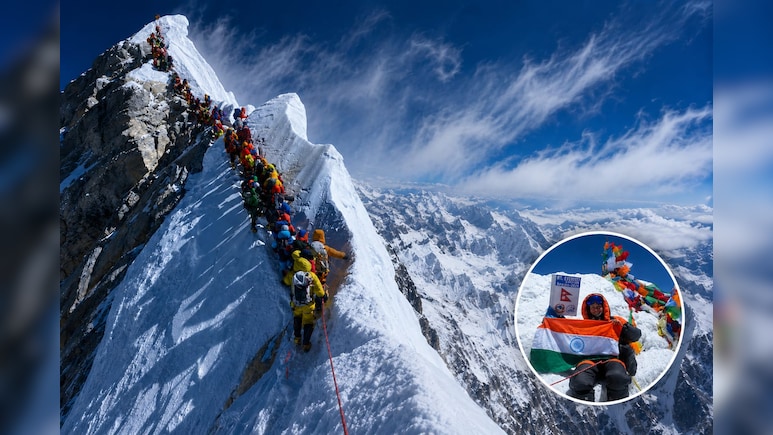
A few days ago, Saanika Shah stood on the summit of Mount Everest. I had the privilege of being part of her preparation journey and watching her get ready over the years. Seeing her achieve that dream was a proud moment, but it also brought back vivid memories of my own Everest expedition from the North Side through Tibet.
Like many people, I saw the photographs from the summit and the celebrations that followed. But unlike most, I also knew what lay behind those images — years of preparation, countless sacrifices, physical hardship, mental resilience and a financial commitment that few outside the mountaineering community fully appreciate.
Whenever people ask me about Everest, they usually want to know what it feels like to stand on top of the world. They ask about the cold, the altitude, the danger and the view from the summit.
Rarely do they ask a more practical question: What does it cost?
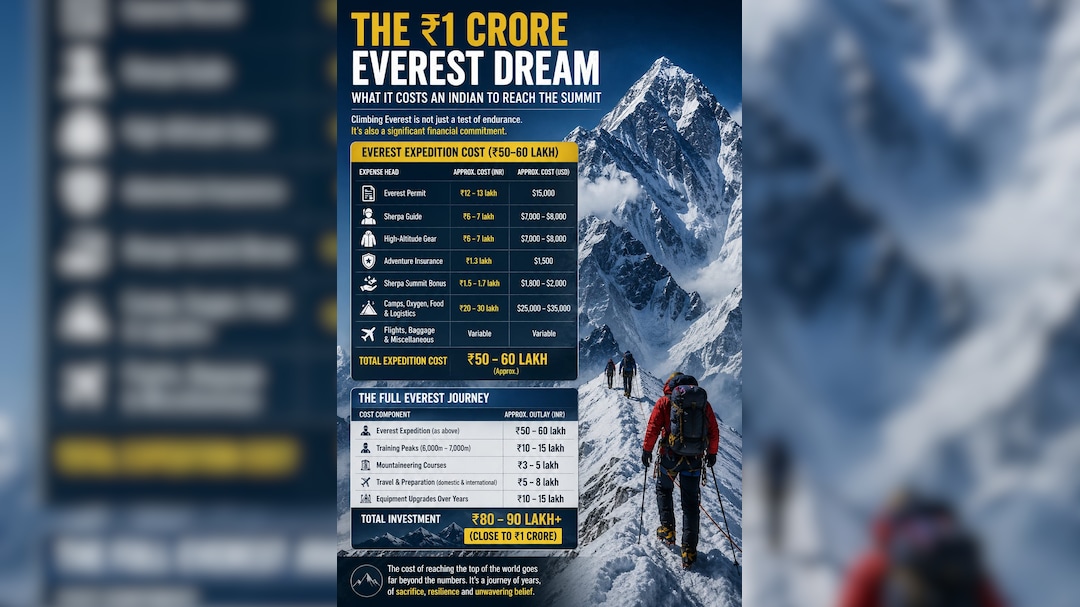
Most people have heard that climbing Everest costs around Rs 50 lakh to Rs 60 lakh. That figure is broadly accurate if you only count the expedition itself. But Everest is not a mountain you decide to climb overnight.
Long before a climber reaches Base Camp, there are years of preparation, training expeditions, mountaineering courses, travel, equipment upgrades and countless smaller expenses that quietly accumulate in the background. When I calculate everything I spent preparing for Everest — not just the expedition, but the entire journey leading up to it — the total investment comes remarkably close to Rs 1 crore.
That is the number most aspiring climbers should pay attention to.
Having gone through that journey myself, I wanted to break down where that money goes, why the costs are so high and why, for many Indians, raising the funds can be almost as challenging as reaching the summit itself.
Economics of summiting Mount Everest
Photo Credit: NDTV Profit
Breaking Down The Rs 1 Crore Everest Dream
The single largest expense is the Everest climbing permit, which today costs around Rs 12–13 lakh (roughly $15,000).
Beyond that, climbers typically spend another Rs 6–7 lakh ($7,000-$8,000) on an experienced Sherpa guide. Sherpas are far more than guides; they are the backbone of Himalayan mountaineering. They help carry loads, establish routes, manage logistics and often play a crucial role in keeping climbers safe in extreme conditions.
Equipment is another major expense. Everest requires specialised high-altitude gear designed to withstand temperatures that can plunge below minus 30 degrees Celsius. Down suits, technical mountaineering boots, oxygen systems, gloves, sleeping bags and other equipment can together cost another Rs 6–7 lakh ($7,000-$8,000).
Then come the expedition operators. These companies manage everything from transport and accommodation to food, oxygen cylinders, communications, rope fixing and camp infrastructure. Depending on the operator and level of support, these logistical expenses can easily run into Rs 20–30 lakh or more.
By the time a climber reaches Base Camp, a significant portion of the total expedition budget has already been spent.
ALSO READ: Two Indian Climbers Die While Descending From Mount Everest After Reaching Summit
The Expenses People Rarely Talk About
The headline number tells only part of the story.
High-altitude adventure insurance alone can cost around Rs 1.3 lakh ($1,500). Then there are flights, excess baggage charges, emergency reserves, additional oxygen requirements and recovery costs.
One expense that rarely gets discussed publicly is the summit bonus for Sherpas. It is customary for climbers who successfully reach the summit to tip their Sherpa guides separately. These bonuses typically range between Rs 1.5 lakh and Rs 1.7 lakh ($1,800-$2,000) and are an important gesture of gratitude towards the people who make these expeditions possible.
These hidden costs can add several lakh rupees to an expedition budget, often pushing the final bill well beyond what first-time climbers expect.
Everest Begins Long Before Everest
One of the biggest misconceptions about Everest is that it is a single expedition.
In reality, Everest is the culmination of years of preparation.
Before attempting Everest, I climbed multiple peaks above 6,000 and 7,000 metres. Every climb required travel, permits, logistics and specialised equipment. Training programmes, fitness preparation and technical mountaineering courses added further costs.
Equipment also needs regular upgrading. High-altitude gear wears out, technology evolves and experience teaches you what works and what does not. Many aspiring climbers underestimate how much these incremental expenses add up over time.
When I calculate everything I spent preparing for Everest over the years, the total investment comes close to Rs 1 crore.
That is why I often tell aspiring climbers that Everest is not a purchase. It is a long-term project.
Can The Average Indian Afford Everest?
For most Indians, the honest answer is no.
Mountaineering remains a niche sport. Unlike cricket, badminton or other mainstream disciplines, there is limited corporate sponsorship and relatively little institutional support available for climbers.
The ecosystem is improving, but funding remains one of the biggest barriers to entry. Many talented climbers never get the opportunity to attempt Everest simply because they cannot raise the required capital.
I understand this challenge personally.
Coming from a middle-class background, I did not have the resources to fund an Everest expedition outright. Around 50% of my expedition budget came through crowdfunding. More than 2,000 people contributed to the campaign, making it one of the most emotional and humbling aspects of my journey.
Another 30% came from years of personal savings. For the remaining 20%, I relied on loans from friends and family.
Without that collective support, my Everest dream would never have become reality.
More Than A Financial Return
From a purely economic perspective, Everest makes little sense.
There is no guaranteed financial reward waiting at the summit. No return on investment that can justify the money spent. In fact, most climbers spend years saving for an experience that lasts only a few weeks.
Yet I have never regretted the investment.
The value of Everest cannot be measured in monetary terms. The mountain teaches resilience, discipline, humility, patience and gratitude. It forces you to confront discomfort, uncertainty and fear in ways that ordinary life rarely does.
Standing on the summit is unforgettable, but the real reward comes from the person you become during the journey.
That is why, despite the rising costs and enormous sacrifices involved, people continue to dream about Everest. The economics rarely add up on paper. For most climbers, the decision is not driven by logic, convenience or financial returns.
More than a century ago, British mountaineer George Mallory was famously asked why he wanted to climb Everest.
His answer has become part of mountaineering folklore.
"Because it's there."
For anyone who has stood beneath the mountain and felt its pull, that answer still makes perfect sense.
And perhaps that is the real economics of Everest: no matter how expensive the journey becomes, there will always be people willing to pay the price to chase a dream that stands above all others.
ALSO READ: Cost Of Bringing Back Bodies From Mount Everest: Why Is It So Expensive To Retrieve Them?
Essential Business Intelligence, Sharp Market Insights, Practical Personal Finance Advice, Daily Fuel, Gold and Silver Prices and Latest Stories — On NDTV Profit.