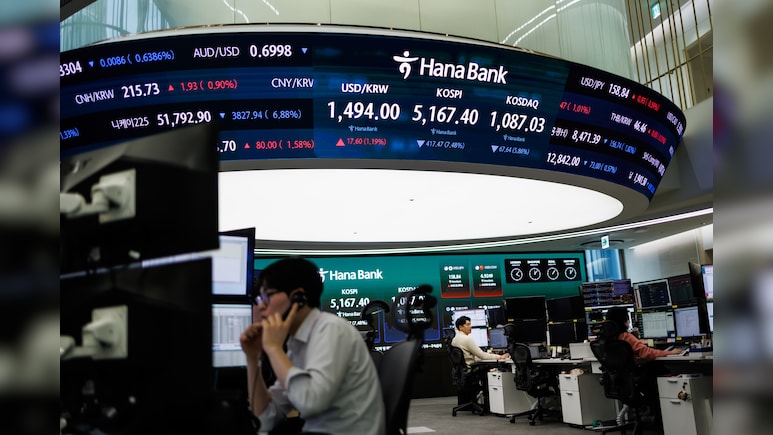
For fund managers in London, New York and Tokyo, a new ritual has emerged before trading gets underway: checking South Korean stocks.
Once a peripheral market for many global investors, Korea's $4 trillion equity market is offering an early read on risk appetite as AI-driven swings in Samsung Electronics Co. and SK Hynix Inc. ripple through global chip stocks.
The shift is reshaping investment routines. JPMorgan Asset Management's chief Asia market strategist gave a presentation on Korea to the firm's global team for the first time in his 14 years on the job. Japanese traders are adding the Kospi Index to their watch lists. “We are all Korean investors now,” said Hani Redha, a London-based portfolio manager at PineBridge Investments.
But the market's growing influence comes with a catch. The Kospi has become one of the world's most volatile major benchmarks, with leveraged trading amplifying swings. SK Hynix's recent US listing has extended Korea's influence into Wall Street. The result is the country's sentiment-driven trading increasingly setting the tone for global AI stocks around the clock.
Also Read | Layoffs Are Rising In Tech, But These Skills Are Helping People Unlock Better Pay
Korea may see another turbulent session when markets reopen following a long weekend. Global chip peers were sold off on Friday as a surprise breakthrough from a Chinese AI startup renewed doubts over massive capex investment.
Redha starts each day by checking Seoul for a read on the AI trade. Once the Korean market closes, his focus shifts to SK Hynix's American depositary receipts and Korea-focused exchange-traded funds in New York. “It's like almost 24-hour tracking,” he said.
That dynamic was on full display last week. A local selloff on Monday driven by fresh skepticism about future demand for AI triggered a near 9% drop in the Kospi, before the weakness spilled into Wall Street. SK Hynix's US-listed shares dropped 9.3%, dragging down other major chip stocks.
The tighter linkage is increasingly visible in the data. The 60-day correlation between the Kospi and the Nasdaq 100 has climbed to 0.46, near the highest level in two years and almost triple its five-year average of 0.16, according to data compiled by Bloomberg.
“Korea has effectively become part of the same volatility ecosystem as the Nasdaq and SOX, with SK Hynix, Samsung and the Kospi now functioning as a pre‑market read‑through on US AI and semiconductor risk,” said Ivan Feinseth, New York-based chief investment officer at Tigress Financial Partners. He added that the Asian country is no longer “a distant emerging-market side show.”
Korean stocks' influence appears even more pronounced when they suffer a downturn. The Nasdaq 100 Index's sensitivity to the Kospi during periods of Korean market weakness climbed to the highest since 1990 on July 7, according to Bloomberg-compiled data. A similar measure for the MSCI World Index has also risen to a four-year high earlier this month.
Correlation between the Kospi and Japan's Nikkei 225 has also surged. That's prompted Ortus Advisors' head of Japan equity strategy Andrew Jackson to add a chart of the Kospi for close monitoring earlier this year, a first for him in more than two decades.
Herald van der Linde, head of equity strategy for Asia Pacific at HSBC Holdings Plc, said Korea is discussed in “all meetings” nowadays. Over at JPMorgan Asset Management, its chief market strategist for Asia Pacific Tai Hui said “I think I've not presented to my global team on Korea until this year.”
Korea's influence, however, may shrink as the market rout continues. The Kospi Index has tumbled 25% since its June peak, resulting in a $1 trillion wipeout that threatens to weaken its global clout. Its chipmaker duo have both lost at least 30% of their value. The country's decision to temporarily halt new listings of single-stock leveraged exchange traded products may also help curb speculation and volatility.
Still, the benchmark remains up 62% for the year, among the world's best performers. Given the pivotal role of SK Hynix and Samsung Electronics in memory chip supply, the Korean market will likely remain the heartbeat of global AI investment in the foreseeable future.
“This is the new normal investors have to accept, as long as the AI rally continues,” said Chisa Kobayashi, Japan equity strategist at UBS SuMi TRUST Wealth Management. “The fact that markets are being driven by a relatively immature market with leverage-related swings, makes trading difficult because moves can deviate from fundamentals.”
(This story has not been edited by NDTV staff and is auto-generated from a syndicated feed.)
Essential Business Intelligence, Sharp Market Insights, Practical Personal Finance Advice, Daily Fuel, Gold and Silver Prices and Latest Stories — On NDTV Profit.