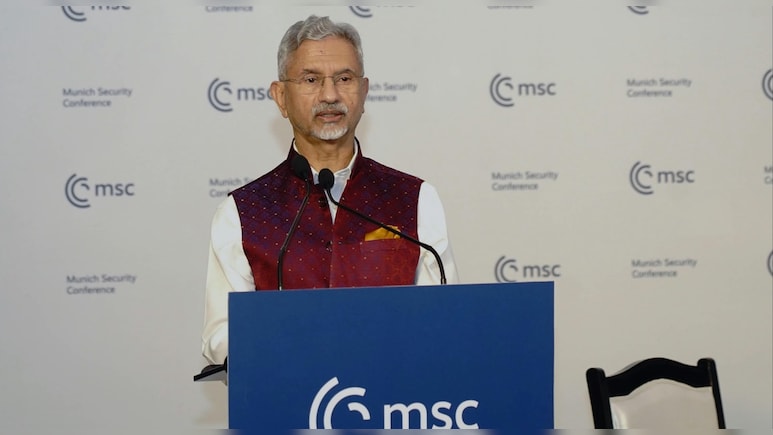
External Affairs Minister Subrahmanyam Jaishankar has said the United States has "deliberately become a lonelier power" as a changing US posture and the rise of China reshape the global order.
Speaking at the Munich Leaders Meeting in New Delhi, Jaishankar noted the current international landscape was being shaped by a "radical repositioning" of the US, the growing influence of China and the increasing self-reliance of emerging and middle powers.
"No one in the room would disagree with the fact that the landscape today is primarily marked by a radical repositioning of the United States,” Jaishankar said.
Also Read | Layoffs Are Rising In Tech, But These Skills Are Helping People Unlock Better Pay
#WATCH | Delhi: Speaking at the 62nd Munich Security Conference, External Affairs Minister Dr. S. Jaishankar says, "No one in the room would disagree with the fact that the landscape today is primarily marked by a radical repositioning of the United States. A repositioning which is a posture of choice and, in a way, it has deliberately become a lonelier power. The second feature of the landscape is, of course, the rise of China. China, which sees itself as a unique country that is in a way both its self-perception, in many ways, also the reality. And we are looking at very sharp competition. That competition today, not limited to these two countries, has led to a weaponization of any leverage that any country has. And that competition coexists with the complexity of interdependence."
— ANI (@ANI) October 4, 2026
He described the US shift as a “posture of choice”, saying Washington had, in a way, "deliberately become a lonelier power".
ALSO READ: Don't Join Russian Army Expecting A Govt Bailout Later: MEA Warns Indian Nationals
According to Jaishankar, the changing global order is also being driven by countries seeking to diversify their partnerships, reduce risks and become more self-reliant.
Emerging and middle powers are increasingly assessing their own interests and looking at what they can bring to the table while engaging with major powers.
China's Rise Another Key Feature
The second big feature of the changing international landscape is the rise of China, Jaishankar said.
He cited China's economic muscle, saying the country is responsible for about a third of global manufacturing and its economic capabilities are being translated into political power. "China, which sees itself as a unique country that is in a way both its self-perception, in many ways, also the reality," Jaishankar added.
He said the world was witnessing "very sharp competition" between the US and China. However, according to Jaishankar, the rivalry is no longer limited to the two countries. “That competition today, not limited to these two countries, has led to a weaponisation of any leverage that any country has,” he said.
At the same time, Jaishankar said the competition between major powers exists alongside the “complexity of interdependence”, reflecting the increasingly complicated nature of global economic and strategic relationships.
Emerging Powers Seek Greater Flexibility
Jaishankar said emerging and middle powers were also responding to the changing global environment by strengthening cooperation among themselves while maintaining relationships with both the US and China.
He cited initiatives such as the Quad, the India-Middle East-Europe Economic Corridor, the International North-South Transport Corridor and the Northern Sea Route as examples of such cooperation.
The External Affairs Minister's remarks come as countries reassess their partnerships and seek greater strategic flexibility amid intensifying competition between the world's major powers.
ALSO READ: US Visa Bond: 50 Countries Face Up To $20,000 Deposit On Washington Trip, India Exempted
Essential Business Intelligence, Sharp Market Insights, Practical Personal Finance Advice, Daily Fuel, Gold and Silver Prices and Latest Stories — On NDTV Profit.