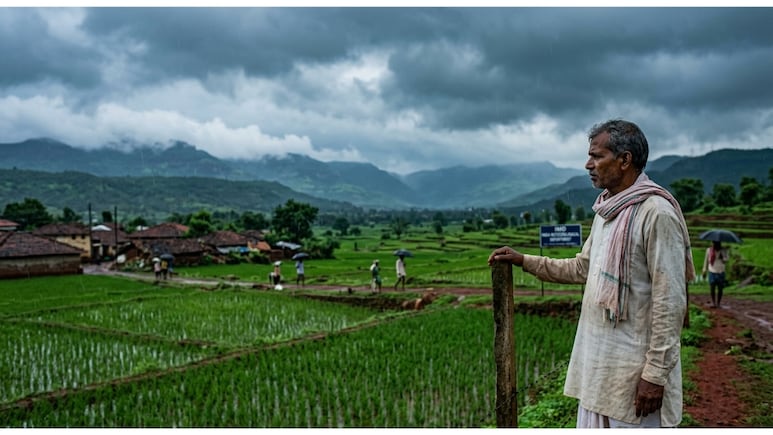
The India Meteorological Department (IMD) has predicted that the 2026 southwest monsoon rainfall (June to September) may be “below normal”.
According to the IMD, the rainfall may be at about 92% of the Long Period Average (LPA), with a ±5% margin. The LPA of the seasonal rainfall over the country as a whole, based on the period of 1971-2020, is 87 cm. The IMD defines 96-104% of LPA as normal.
In its update shared on Monday, the IMD said that the current weak La Nina–like conditions are shifting toward ENSO-neutral, with possible El Niño development during the monsoon. El Niño and La Niña are opposite phases of a natural climate cycle called ENSO. El Niño, the warmer phase, typically suppresses India's monsoon and brings weaker rainfall. Additionally, neutral Indian Ocean Dipole conditions may turn positive later in the season, the IMD said.
Also Read | Layoffs Are Rising In Tech, But These Skills Are Helping People Unlock Better Pay
ALSO READ: Weak Monsoon Ahead? IMD Flags El Nino Risk For 2026 Season, Expects 92% Rainfall
“The northern hemisphere snow cover extent during the last three months (January to March 2026) was slightly below normal. Winter and spring snow cover extent over the Northern Hemisphere, as well as Eurasia, has a general inverse relationship with the subsequent southwest monsoon seasonal rainfall over the country,” the weather agency said.
When Was The Last Time the Monsoon Was Below Normal?
The last time India saw below-normal rainfall during the Southwest Monsoon was in 2023. This followed even as the IMD had predicted a normal monsoon that year. In 2023, the rainfall over the country as a whole during the monsoon season was 94% of its LPA. Earlier, below-normal years included 2018 and 2017, when rainfall was about 91% and 95% of LPA, respectively. The years 2014 and 2015 were more serious, as both recorded deficient monsoons.
ALSO READ | Monsoon 2026 Forecast: IMD Vs Skymet — Below-Normal Rains Expected, Risks Rise For Agriculture
Monsoon In Last 5 Years
Between 2019 and 2024, India's southwest monsoon showed improvement. In 2019, only 3 meteorological subdivisions of the total 36 recorded deficient rainfall. This was significantly better compared to 2018, when 11 subdivisions were affected respectively. From 2020 to 2023, the pattern remained moderate, with 5–7 subdivisions facing rainfall deficits each year. In 2024, just 3 subdivisions were affected, the data showed.
In 2025, the rainfall over the country as a whole was 108% of its LPA, which is “above normal”. The three subdivisions, Arunachal Pradesh, Assam- Meghalaya, and Bihar, accounting for 9% of the total area, experienced deficient rainfall during the season.
2026 Monsoon Outlook By IMD
The weather office's prediction of a weaker monsoon in 2026 is the first such warning in 11 years. The forecast shows a 35% chance of deficient rain (below 90% of normal), 31% chance of below-normal rainfall (90–95%), 27% chance of normal rainfall (96–104%). There is only a 6% chance of above-normal rain this year, the IMD data showed.
This has implications for the Indian economy as about 51% of farmland depends on rain, producing nearly 40% of crops. Weak rainfall can reduce harvests and have broader implications, while India already struggles with the impact of global uncertainties such as the ongoing US-Iran war.
Essential Business Intelligence, Sharp Market Insights, Practical Personal Finance Advice, Daily Fuel, Gold and Silver Prices and Latest Stories — On NDTV Profit.