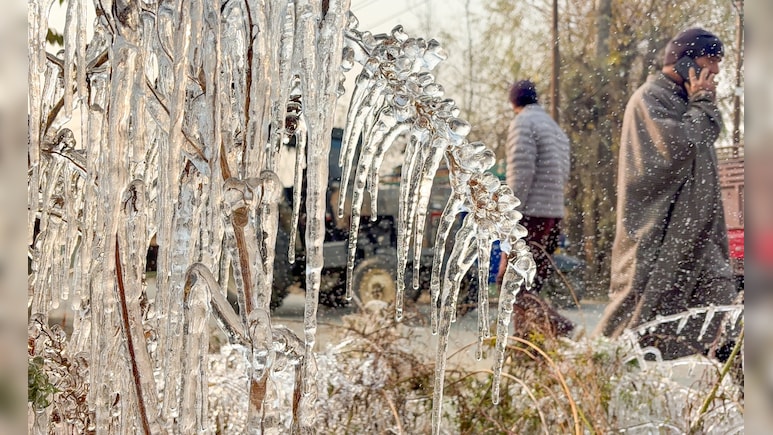
Kashmir continued to reel under an intensifying cold wave, with Srinagar recording its coldest night of the season as the minimum temperature settled at minus 2 degrees Celsius.
With the Valley witnessing sub-zero temperatures well ahead of Chilla-i-Kalan, the traditional 40-day period of intense winter beginning December 21, people have begun bracing for the harsh months ahead, reported NDTV.
As temperatures plunge, Kashmiris are turning to traditional winter essentials, including kangris and pherans, while demand for woollens, blankets, thermal wear and heaters picks up across markets.
Also Read | Layoffs Are Rising In Tech, But These Skills Are Helping People Unlock Better Pay
According to the Meteorological Department, Srinagar recorded a low of minus 2 degrees Celsius, while the mercury settled at minus 2.8 degrees in Pahalgam, minus 3.5 degrees in Qazigund, minus 1.5 degrees in Kupwara and minus 3 degrees in Konibal.
The intensifying cold has also prompted the government to announce winter vacations for schools across the Valley from November 30, as temperatures are expected to fall further in the coming weeks.
The prolonged spell of sub-zero temperatures has begun altering the Valley's landscape, with parts of lakes and streams in higher reaches showing signs of freezing. The process is expected to extend to other water bodies, including Dal Lake, as winter sets in.
For residents, however, the falling temperatures bring a familiar set of challenges. Frozen water pipes and taps frequently disrupt household water supplies during early morning hours, while prolonged sub-zero conditions make daily activities increasingly difficult.
The onset of winter also sets in motion a seasonal migration, with thousands of families moving to Jammu, Delhi and other relatively warmer parts of the country to avoid the Valley's harsh winter conditions.
For those staying back, preparations often begin well before Chilla-i-Kalan. Households arrange traditional kangris and hamams, stock up on winter clothing and install plastic coverings and heavy curtains on windows to prevent cold air from entering their homes.
The practice of storing large quantities of groceries and essential commodities ahead of winter, once common across the Valley because of frequent highway closures during heavy snowfall, has gradually declined with improved road connectivity. It nevertheless continues in remote and mountainous areas that remain vulnerable to prolonged disruptions.
The all-weather Srinagar-Jammu national highway and improved snow-clearance arrangements have considerably eased winter transportation challenges. However, electricity availability continues to be a major concern as heating requirements increase sharply during the coldest months.
ALSO READ | Delhi Weather: Temperature Drops To Single Digit, Air Quality Remains Severe
Officials said approximately 1,800 MW of electricity was being supplied to consumers in Kashmir, compared with around 1,300 MW during summer.
"Electricity demand rises sharply during winter. We have already augmented power supply to the Valley, but as temperatures fall further, demand increases significantly," a senior official said, according to NDTV.
The freezing of Dal Lake also presents a contrasting picture. While the phenomenon attracts tourists, it creates difficulties for people whose livelihoods depend on the water body. Shikarawalas are often seen breaking thin layers of ice every morning to clear navigation routes for their boats.
The MeT Department has predicted mainly dry weather until next week, with two Western Disturbances likely to affect Jammu and Kashmir between December 4 and 10, bringing snowfall to higher reaches and rain to the plains.
Essential Business Intelligence, Sharp Market Insights, Practical Personal Finance Advice, Daily Fuel, Gold and Silver Prices, Watch Business News Live and Latest Stories — On NDTV Profit.