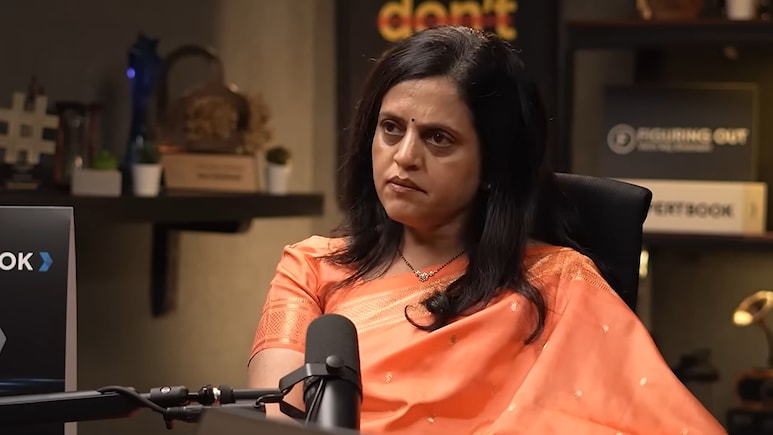
Mumbai's traffic congestion, potholes and large-scale infrastructure projects continue to dominate civic discussions as the city expands despite severe space constraints. Speaking on Raj Shamani's podcast, Brihanmumbai Municipal Corporation (BMC) Commissioner and Mumbai Metro Rail Corporation (MMRC) Managing Director Ashwini Bhide outlined the city's long-term strategy to address these persistent city challenges.
According to Bhide, Mumbai's traffic problem is rooted in its unique geography and rapid urbanisation. Surrounded by the sea on three sides and developed in a narrow linear pattern, the city has limited scope to widen roads or create additional surface transport infrastructure.
Frequent road excavations for water, sewage, gas and telecom utilities, along with the heavy dependence on suburban railways, have further increased pressure on the road network, resulting in round-the-clock congestion.
Also Read | Layoffs Are Rising In Tech, But These Skills Are Helping People Unlock Better Pay
She said the long-term solution lies in expanding Mumbai's metro network. A larger and better-connected metro system is expected to encourage commuters to shift from private vehicles to public transport, significantly easing traffic.
Once the under-construction metro corridors are connected over the next three to four years, the city is expected to witness a gradual reduction in road congestion. Looking ahead, Bhide said the metro network could carry between 90 lakh and one crore passengers every day by 2040, making public transport the preferred choice for daily travel.
Bhide also explained why Mumbai has opted for underground metro construction despite the high costs involved. With very little land available for surface expansion, underground corridors provide additional transport capacity without disturbing existing roads and buildings.
She noted that Mumbai Metro projects rank among the costliest urban transport projects in Asia, with construction expenses ranging between Rs 900 crore and Rs 1,000 crore per kilometre. Around 70% of the project cost goes towards civil construction, while the remaining 30% is spent on systems and technology. Tunnel construction alone costs nearly Rs 200-250 crore per kilometre, while metro stations can cost Rs 300-400 crore each.
Given Mumbai's dense urban environment, metro tunnelling requires advanced engineering techniques. Bhide said methods such as the New Austrian Tunnelling Method (NATM), along with detailed geological surveys and continuous structural monitoring, help ensure that heritage buildings, residential structures and underground utilities remain protected during construction.
Addressing the city's recurring pothole problem, Bhide said Mumbai's 2,050-kilometre road network contains a vast underground utility system that requires regular maintenance. Repeated digging weakens road surfaces, while cracks in bitumen roads allow rainwater to seep in during the monsoon, accelerating damage and making repairs difficult.
To provide a permanent solution, the BMC is replacing bitumen roads with concrete roads. Around 1,700 kilometres have already been concretised, while the remaining work is targeted for completion by March 2027. The civic body has allocated an estimated Rs 100 crore for pothole repairs, including Rs 40-50 crore for city roads and around ₹60 crore for the Eastern and Western Express Highways.
On manhole safety, Bhide said protective mesh covers, or "jaali" systems, have been installed to reduce the risk of accidents, particularly during the monsoon, while still allowing access for maintenance of underground utilities.
She also said Mumbai continues to strengthen its flood management system through pumping stations, IoT-enabled monitoring and disaster control infrastructure.
Briefly touching upon other civic issues, Bhide said slum redevelopment remains one of the city's most complex administrative challenges, while waste management has shifted towards scientific processing through bio-mining and waste-to-energy initiatives.
Essential Business Intelligence, Sharp Market Insights, Practical Personal Finance Advice, Daily Fuel, Gold and Silver Prices and Latest Stories — On NDTV Profit.