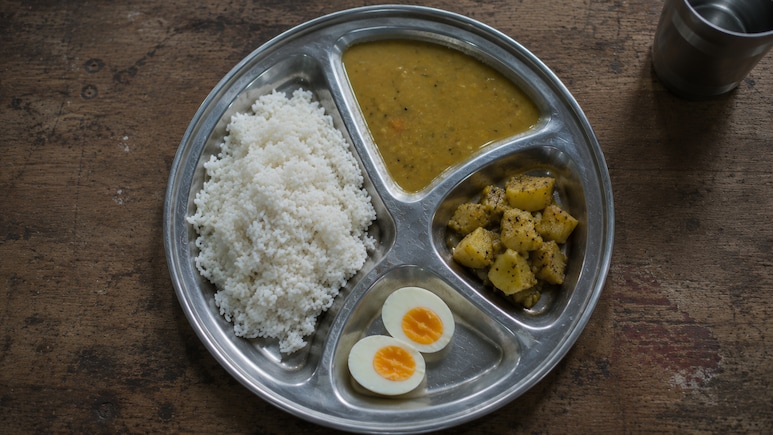
Once a week, a boiled egg landed on the plates of roughly one lakh children across Kolkata's primary and upper primary schools run by the government. It was one item in an otherwise standard meal of rice, dal and potato curry — but according to Debabrata Panti, headmaster of a primary school in Maheshtala, it was the item children showed up for. Attendance on egg days, they told The Federal, was reliably higher.
That egg is now likely to go. Following West Bengal's budget announcement on June 22, ISKCON's Annamitra Foundation is set to take over meal preparation across 1,800 schools in the Kolkata Municipal Corporation area. The organisation follows a sattvik diet that excludes eggs, onion and garlic.
ISKCON's Kolkata vice-president Radharamn Das, who has now been removed from the post and sent on "compulsory leave of absence", confirmed to the media earlier that the new menu would be vegetarian, with soya chunks, rajma, paneer, dal and pulses as the proposed protein sources. As of June 30, no official menu had been released. "Once the menu is finalised, we will make an official announcement," Das had posted on X before his removal.
ALSO READ: Amul Becomes India's First FMCG Company With Rs 1 Lakh Crore Turnover
What The Scheme Actually Promises
PM POSHAN runs on a clear nutritional mandate published on the Ministry of Education's own portal: 450 calories and 12 grams of protein per meal for primary school children. For upper primary students aged 11 to 14, the bar rises to 700 calories and 20 grams of protein. Under the National Food Security Act 2013, this is a legal entitlement.
The scheme's food norms specify what goes into that meal: 100 grams of rice, 20 grams of pulse, 50 grams of vegetables, 5 grams of oil for primary children; 150 grams of rice, 30 grams of pulse and 75 grams of vegetables for upper primary.
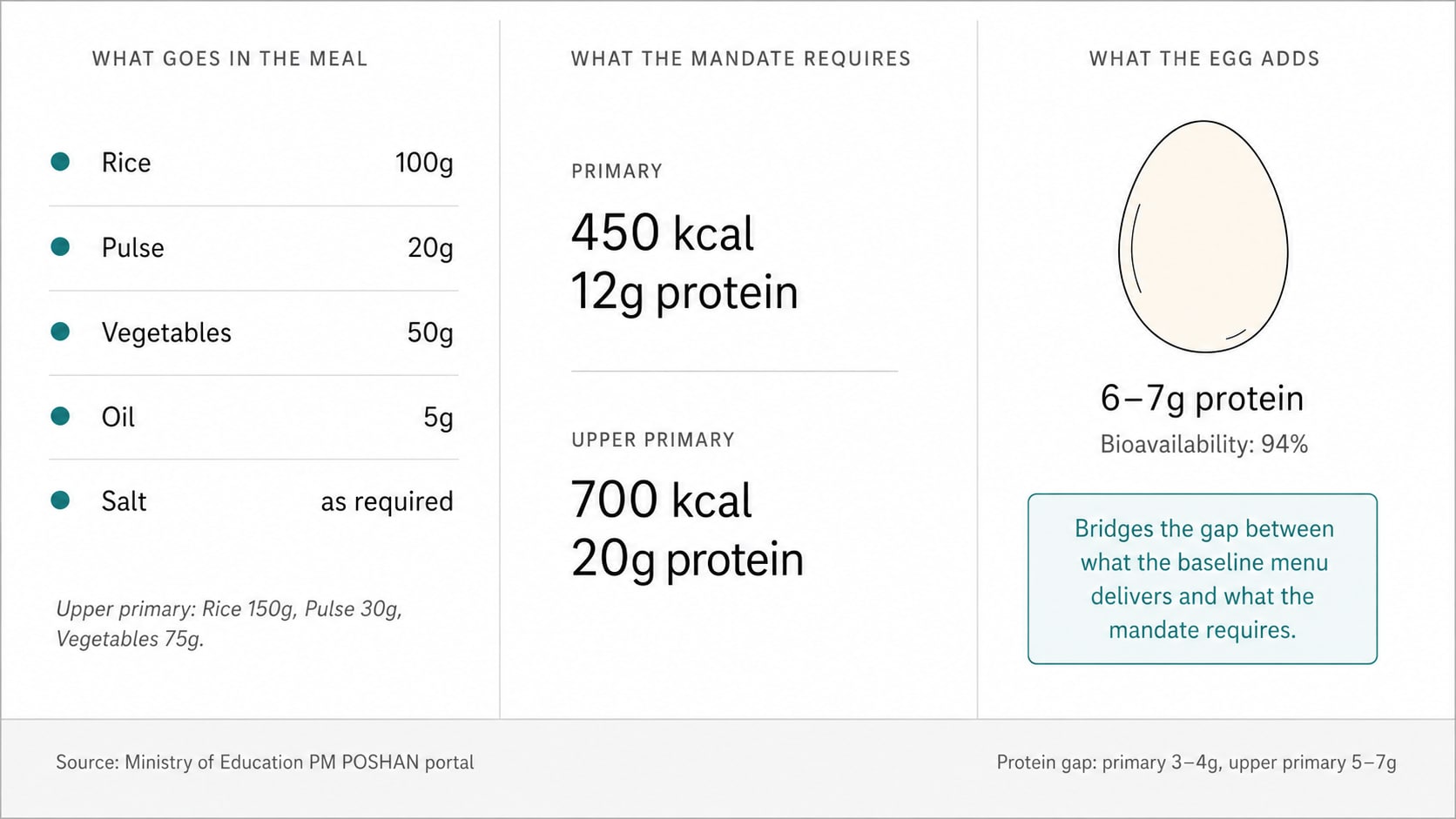
Dr Surya Deepthi, Senior Nutritionist, has run these numbers. According to her calculation, 150 grams of rice contributes roughly 10 to 11 grams of protein, 30 grams of pulses adds another 6 to 7 grams, and 75 grams of vegetables contributes 1 to 2 grams.
The Gap Between Planned And Delivered Nutrition
Dr Deepthi spent her career watching the distance between a menu on paper and a meal a child actually eats. She has worked for years as a Nutrition and Child Development Consultant with the Andhra Pradesh State Project Management Unit during a World Bank-supported maternal nutrition programme.
During the Andhra Pradesh programme, she says, field verification never stopped at checking whether food had been allocated. Her team tracked whether it was reaching the intended beneficiary, whether it was actually being consumed, and whether real nutritional outcomes followed. That experience, she says, fundamentally changed how she evaluates public nutrition programmes — and she believes the same scrutiny needs to apply to PM POSHAN.
Her point is that the more useful question is not whether a menu contains 20 grams of protein on paper, but whether every child consistently receives, consumes and absorbs that protein. Serving size variability, cooking practices, protein quality, school attendance, plate waste and procurement gaps all stand between the prescribed menu and what a child's body actually gets.
ALSO READ: Not Just Milk: The Two Stocks Powering India's Rs 1-Lakh-Crore Protein Boom
Stated Protein vs Absorbed Protein
The amount of protein a food contains and the amount a child's body can actually use are different numbers — a distinction nutrition science increasingly measures through metrics like the Protein Digestibility-Corrected Amino Acid Score (PDCAAS) and the newer Digestible Indispensable Amino Acid Score (DIAAS), both of which assess not just digestibility but whether a food supplies the full set of essential amino acids the body needs.
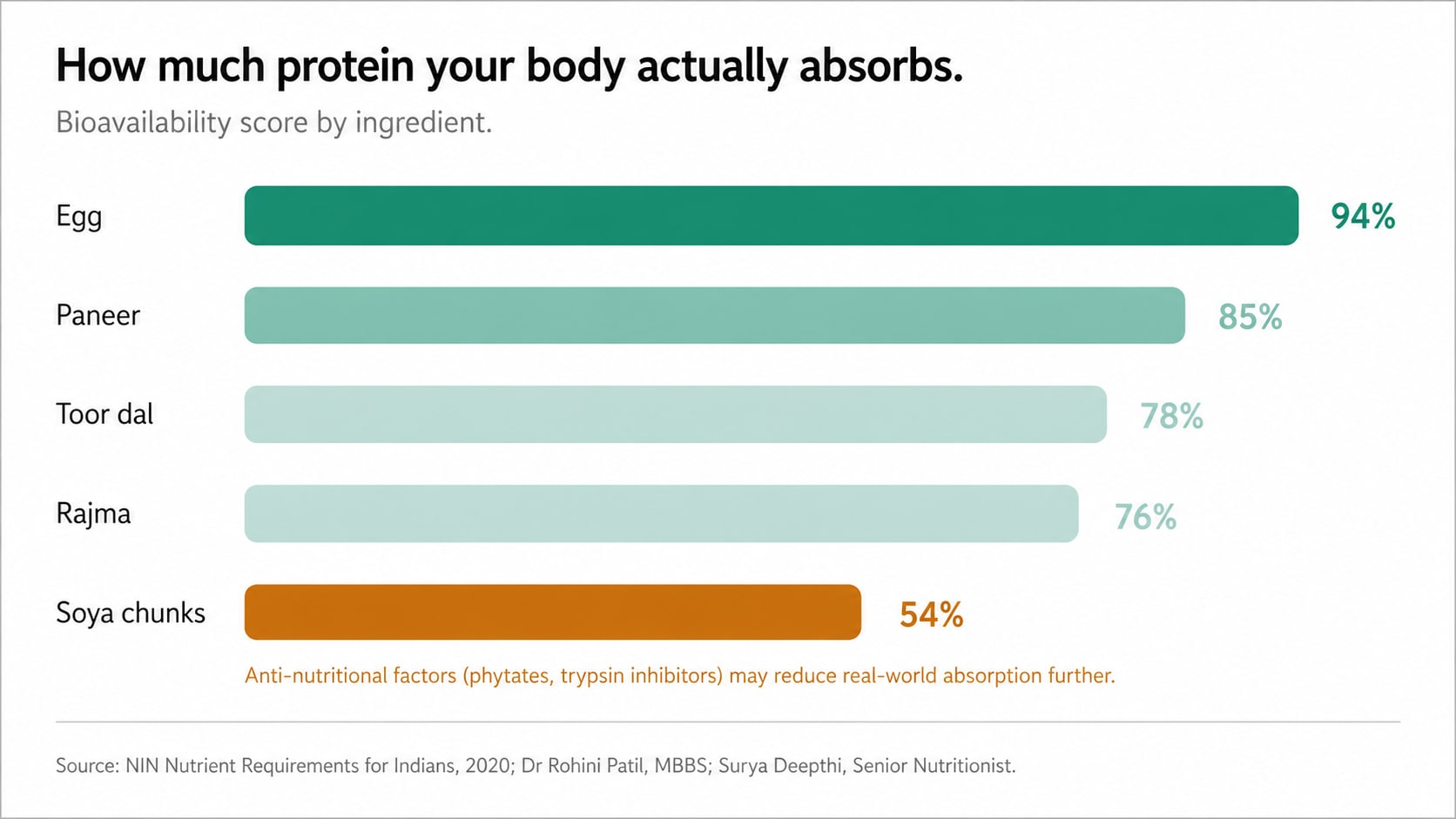
Animal-source proteins — eggs and dairy — tend to score highest on these scales because they're highly digestible and contain all nine essential amino acids in proportions close to human requirements. Plant proteins remain indispensable in Indian diets, Dr Deepthi notes, but their digestibility and amino acid profiles vary, which is precisely why India's traditional cereal-pulse combinations have always mattered nutritionally.
Dr Rohini Patil, MBBS and nutritionist, frames the concept simply,"Protein on the label tells you how much protein is present. Bioavailability tells you how much of that protein the body can actually digest and use. Eggs have one of the highest protein bioavailability scores, followed by soy and dairy, while pulses are nutritious but generally have lower digestibility." The National Institute of Nutrition's published data puts egg protein bioavailability at 94%, soya at 54%, and Bengal gram — the base of most Indian dal — at 76%.
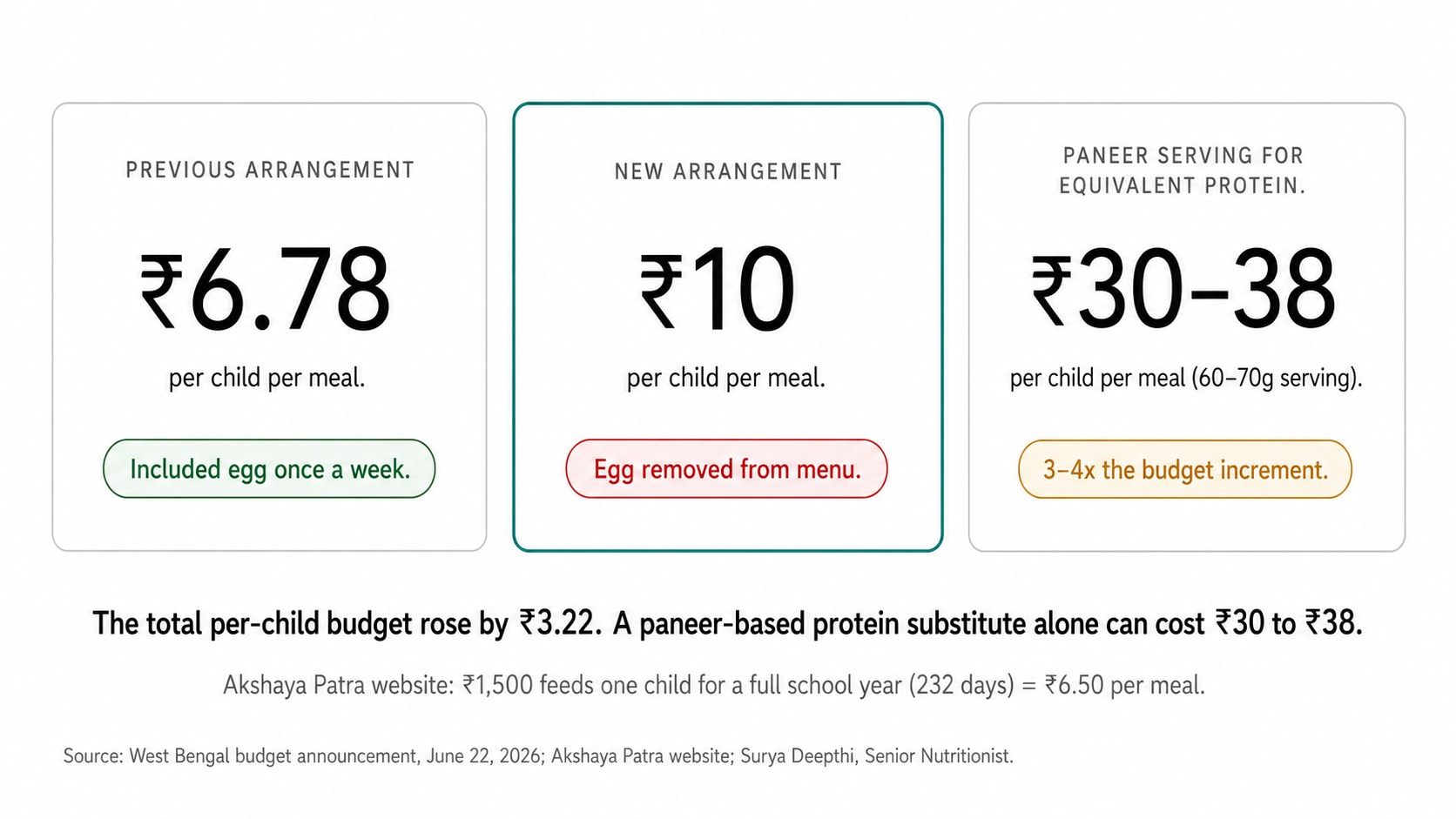
Using published PDCAAS data and current Indian retail prices, soya chunks work out to roughly Rs 6 to Rs 8 per 10 grams of usable protein — the cheapest option on the table. Rajma and toor dal sit at Rs 9 to Rs 12. Egg comes in at Rs 7 to Rs 8. Paneer, despite scoring as a complete, highly digestible milk protein, is the most expensive by a wide margin: Rs 30 to Rs 38 per 10 grams of usable protein.
In his YouTube video A Universe in a Shell: The Science of Eggs, food scientist and author Krish Ashok walks through why the egg occupies a category of its own among affordable Indian foods — a source of complete protein, fat-soluble vitamins and essential amino acids that, gram for gram, outperforms most alternatives available to the average household.
During her time on the Andhra Pradesh programme, Deepthi says, no single food carried the weight of the intervention — eggs, milk, chikki, iron-folic acid supplementation and nutrition counselling were combined deliberately, each addressing a different gap.
The Micronutrient Gap
Protein is only one part of what the egg was contributing. Multiple nutritionists point to a second, quieter layer of loss.
"Eggs cannot truly be replaced by any other single food," says Dr Aakanksha Arya, dietician at Ganga Ram Hospital. "They are an excellent source of high-quality protein and also provide Vitamin B12, Vitamin D, essential amino acids, and healthy fats." Deepthi's list runs longer still — choline, selenium, iodine and riboflavin, alongside protein and the vitamins already named, each playing a distinct role in brain development, nerve function and immunity.
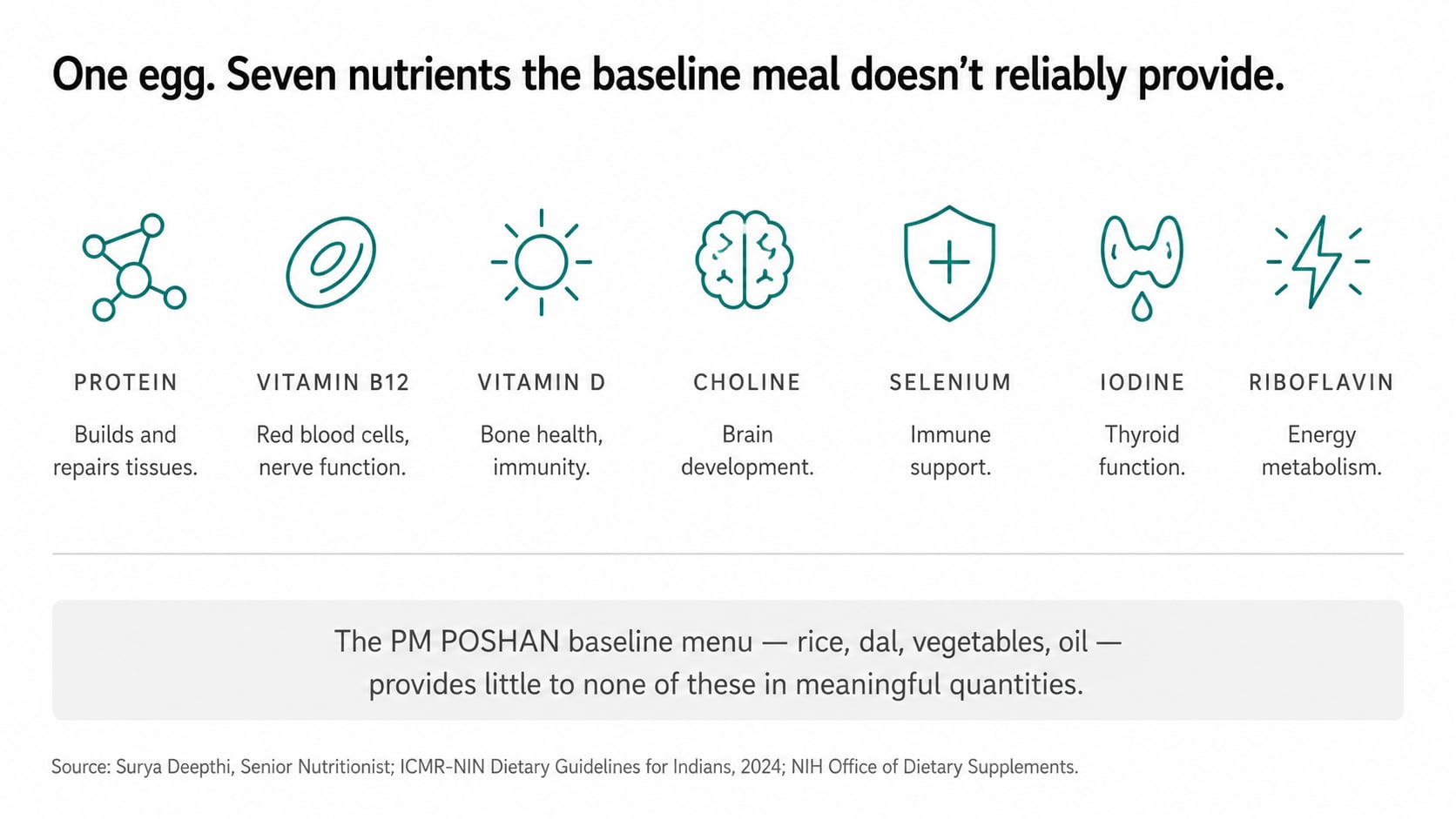
Well-planned vegetarian diets can meet nutritional needs, Dr Deepthi says, but they typically require consistent dairy intake, fortification or supplementation to secure adequate B12 — and for children from households where dietary diversity outside the school meal isn't guaranteed, that becomes a public health consideration rather than a personal dietary choice.
Deficiency in school-age children, she notes, often shows up first as fatigue, poor concentration, irritability and memory difficulty — symptoms easily mistaken for behavioural or academic problems rather than a nutrient gap.
ISKCON has said its menus will be prepared in consultation with empanelled dietitians and will meet nutritional requirements. Das had told Business Standard earlier that the organisation already serves 12 lakh students daily across 21 cities in eight states, following nutrition norms prescribed by respective state governments.
ALSO READ: India's Food Safety Problem Is About Everything — From Laws to Trust | The Reason Why
Ideal Diets And Public Policy
It's true, Dr Deepthi says, that a thoughtfully planned vegetarian diet can meet a child's full nutritional requirements — the science supports that. But years inside government nutrition programmes taught her a second, harder truth: public policy isn't designed for the ideal household. It's designed for the child whose family can't reliably afford milk, for whom the school meal may be the most nutritious thing they eat all day.
Her suggested test for any version of the menu, vegetarian or not, is simple: can the programme guarantee that every child, regardless of where they live or what their family can afford, consistently receives adequate protein, B12, iron and other essential nutrients? If yes, it's working. If not, the programme should be open to strengthening — through eggs, dairy, soy or any scientifically validated alternative. "Public nutrition should always be guided by evidence, not ideology," she says.
What The National Data Says
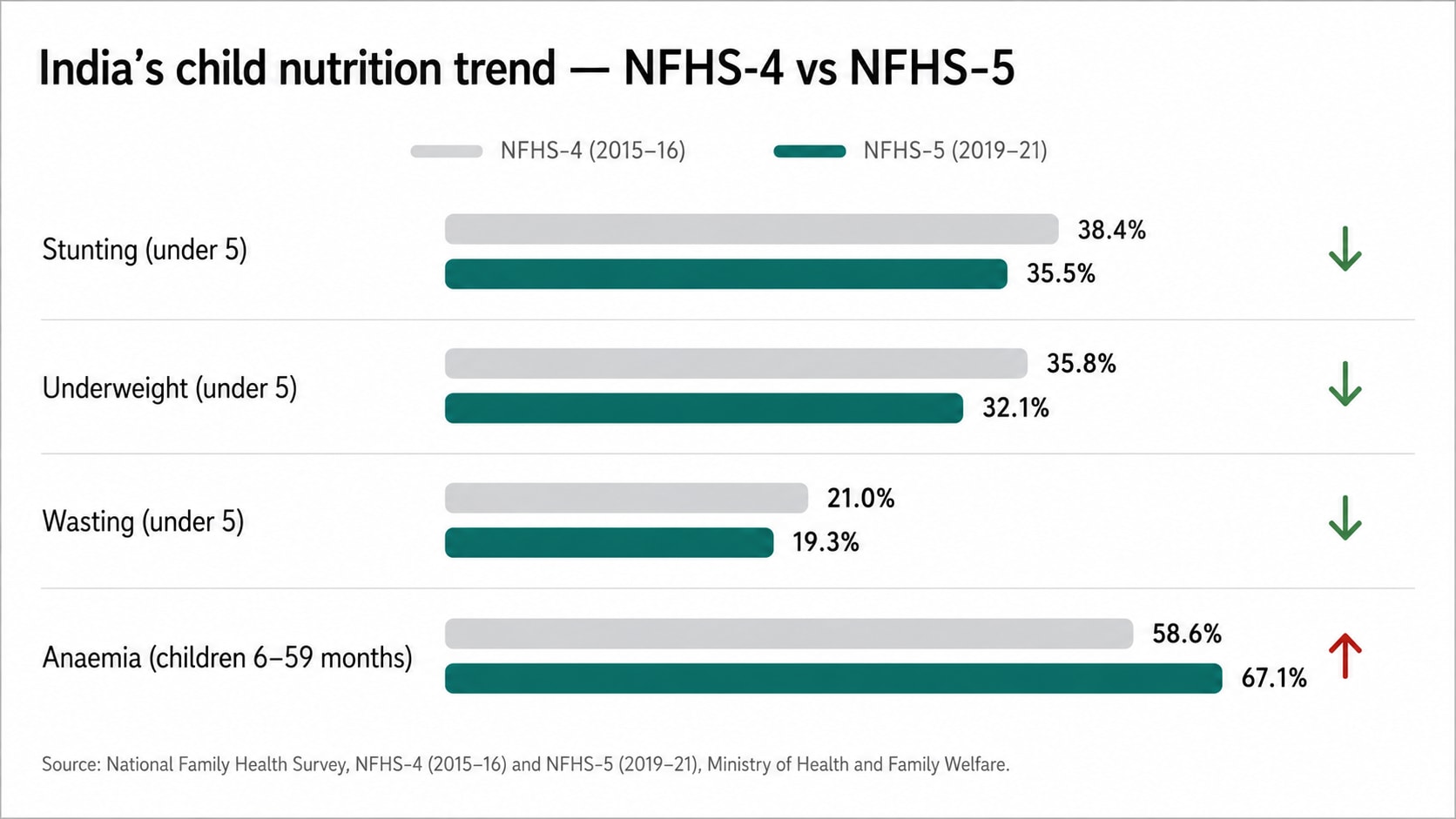
Comparing NFHS-4 (2015–16) to NFHS-5 (2019–21), stunting among children under five fell from 38.4 percent to 35.5 percent, underweight prevalence dropped from 35.8 percent to 32.1 percent, and wasting eased from 21.0 percent to 19.3 percent. Anaemia moved the other way — from 58.6 percent to 67.1 percent among children aged 6 to 59 months, and from 53.1 percent to 57.0 percent among women aged 15 to 49.
One in three Indian children under five remains stunted, even after a decade of improvement. Since Tamil Nadu first put an egg on a government school plate in 1989, the midday meal has been one of the few direct mechanisms the Indian state has had for reaching the children most at risk — not by feeding them more, but, increasingly, by feeding them better.
Essential Business Intelligence, Sharp Market Insights, Practical Personal Finance Advice, Daily Fuel, Gold and Silver Prices and Latest Stories — On NDTV Profit.