I have written at great length on China in this column over the last few months. Much of it was positive — manufacturing and supply chain stealth, technological advancements, and rising geopolitical weightage. But all this doesn't mean that everything is hunky dory there. It's time to take off the veil and analyse its economy more deeply.
Low-Consumption Economy
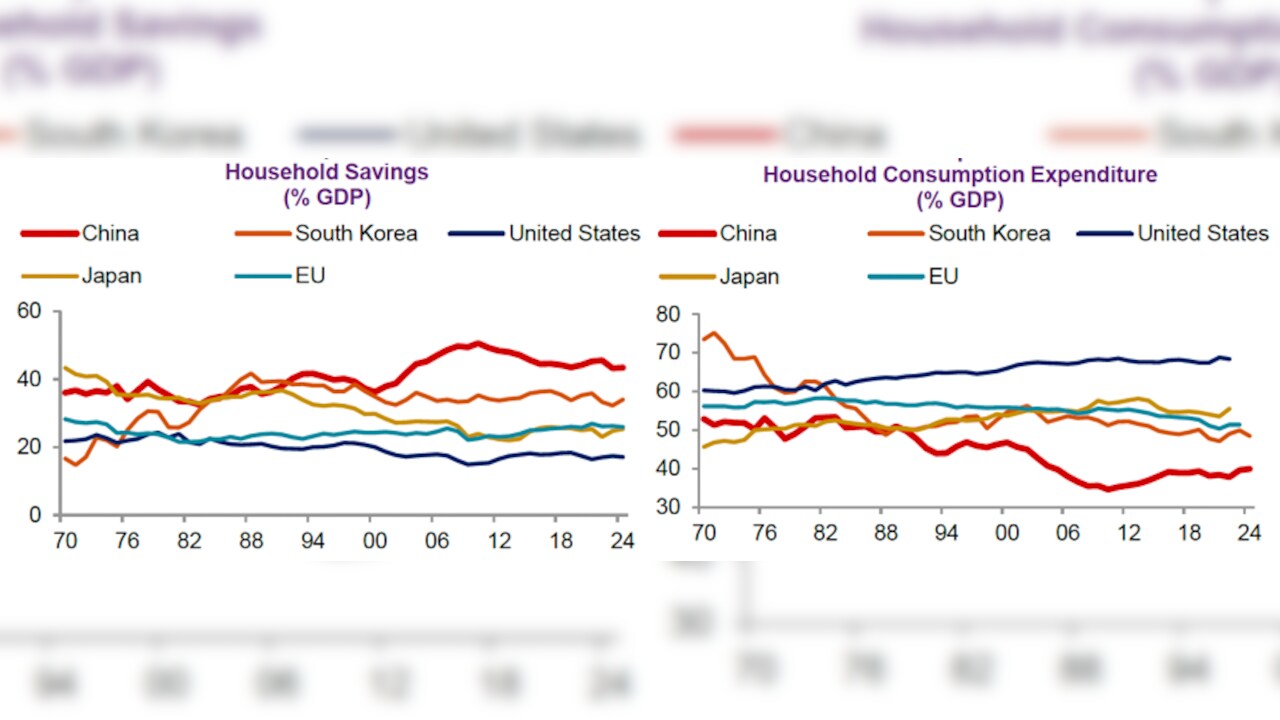
China is not a consumer economy from a statistical angle. Private consumption, the amount that the Chinese spend on personal use, is around 40% of its GDP, lower than India's 55% and the US's 68%. Forty years ago, it was over 50%, but it kept declining.
On the other hand, it spends disproportionately higher on infrastructure and factory construction compared to India (33%) and the US (18%).
It's All Planned
The spending pattern isn't by chance. It was deliberate. The government has channelled the resources through subsidies, loans, grants, energy, and industrial policy towards the supply side of the economy.
Across the last four Five-Year Plans, the main strategy has been to move up the manufacturing value chain, strengthen industrial capacity, and reduce dependence on foreign technology.
The 12th Plan (2011-15) focused on building strategic industries and upgrading traditional manufacturing; the 13th (2016-20) kickstarted the mission of Made in China 2025 along with supply-side reforms. The 14th Plan (2021-25) prioritised technological self-reliance and high-quality manufacturing, particularly in semiconductors, EVs, batteries, and digital infrastructure. Now, the 15th Plan (2026-30) focuses on using AI, advanced manufacturing, and strategic technologies to build "new quality productive forces."
These plans also mention boosting domestic consumption through higher incomes, stronger social safety nets, urbanisation, and expanded public services. But most analysts argue that these haven't worked that well compared to the industrial policies. It seems that the state isn't serious about it.
Dual Economy
That's why Alicia García Herrero, Chief Economist - Asia Pacific, Natixis, characterises China as a dual economy where, on one side, we see world-class developments in EVs, batteries, solar, and AI, while the other side faces wage compression, property sector losses, and weak consumption.
In her latest China Leadership Monitor article, she argues that China's growth model depends on a large pool of low-cost household savings. Because capital controls restrict people from moving money abroad, those savings remain in the domestic system, where banks and the government channel them into investment.
That model is now breaking down.
Sources: Natixis, World Bank, China Leadership Monitor & Swapnil Karkare
Corporate Involution
China's industrial development model rests on government support in the form of subsidies, cheaper loans, etc. That has led to surpluses in many sectors, from steel to electric vehicles.
With weaker domestic demand, saturated global markets with Chinese goods and rising trade barriers, especially with the US, Chinese firms don't have an option but to grow revenues within China itself. That means all companies are vying for higher market share from one another, leading to price crashes. Many commentators have termed it 'involution', which means economic stagnation despite more efforts.
Take electric vehicles. The price war began in 2023, so much so that last year, the regulators warned EV makers to resist aggressive discounts while introducing a few measures to curb it.
China's producer prices and corporate profitability in the industrial sector have been declining since 2022. In 2025, finally, the sector registered profit (0.6% YoY) for the first time in four years.
The process doesn't stop here. The country is seeing a rapid increase in 'zombie firms', companies that cannot generate enough revenue to cover their interest costs. Their share has doubled in the last few years (~6% in 2018 to 12% in 2024) and is now double the global average too. In green technologies, the share is slowly approaching one-third of total firms.
In a dynamic market-based economy, such firms come and go in cycles. But in China, such firms keep surviving because the local governments keep supporting them. According to Alicia, the career trajectories of officials depend on local employment and industrial growth figures, and so they keep such firms afloat. When unproductive firms rise, it also impacts productive firms.
Hollowed-Out Domestic Demand
As involution impacts profitability, it also impacts one of the most significant line items in any company's statement of profit and loss: salaries and wages. Fierce competition and receding margins mean workers must take a hit. Reducing headcounts, limiting hiring, and not hiking wages have been a common theme across many sectors. AI and automation have accelerated this process.
Average private sector wage growth in cities has plunged from above 8% YoY in pre-COVID years to below 1% YoY in 2025. Further, the youth urban unemployment rate is close to 17% in 2025, up 2 percentage points in two years.
Traditionally, Chinese families invested around 60-70% of their assets in real estate. Post Evergrande's collapse in 2021, property prices and sales have continued to fall.
With shrinking wealth and wages, consumers have become more cautious about spending. This is despite several measures to boost consumption, such as trade-in subsidies, consumption vouchers, EV incentives, housing support, and expanded social benefits to encourage spending. That keeps on reflecting in the retail sales data, which in April grew by 0.2% YoY, a 40-month low.
Final Take
Decades of investment- and export-led growth have left China with world-beating capacity in autos, solar panels, electronics, and machinery. At the same time, it has become a country where household wealth has shrunk, and consumers are spending less. This is increasingly looking like a structural problem rather than a temporary slowdown. Meanwhile, foreign markets are becoming less willing to absorb Chinese goods as trade tensions and protectionist policies rise.
Rising geopolitical issues, stretched current account deficits, and inflationary pressures around the globe mean that time alone is unlikely to solve China's problems. The longer Beijing delays reforms that raise household incomes and strengthen domestic demand, the harder it may become to escape the current cycle of weak consumption, overcapacity, and rising trade tensions.
Disclaimer: The views expressed in this article are solely those of the author and do not necessarily reflect the opinion of NDTV Profit or its affiliates. Readers are advised to conduct their own research or consult a qualified professional before making any investment or business decisions. NDTV Profit does not guarantee the accuracy, completeness, or reliability of the information presented in this article.
ALSO READ: Geoeconomics Was Always The Rule. We Just Forgot | The Reason Why
Essential Business Intelligence, Sharp Market Insights, Practical Personal Finance Advice, Daily Fuel, Gold and Silver Prices and Latest Stories — On NDTV Profit.