In the '80s, Texas Instruments Global Chairman Mark Shephard was looking to expand the company's R&D and engineering capabilities. During this period, he noticed that many of the company's brightest engineers were Indians. Dr G. Mohan, a senior leader in the company, then suggested that instead of hiring Indians in the US, it would be better to hire them in India. Later, it became the first MNC to set up an offshore development and outsourcing centre in India. And the rest is history.
But today, Indian IT companies are facing heat due to AI. They are laying off thousands of employees. Citrini Research warns that AI can destroy their business models, too. This has a direct impact on India's macroeconomic stability, which relies heavily on software services.
GCC Was India's Value-Addition Bet
At a macro level, there was always an understanding that the cost advantage would eventually fade. The larger goal, therefore, was to create enough value for clients such that even after losing the cost angle, firms would still retain Indian IT companies. That helped India transition from a simple BPO cluster to a global capability centre (GCCs) hub. It's like how global manufacturing firms continue operating in China despite rising costs and geopolitical issues. GCCs, therefore, became India's big value-addition bet.
Also Read | Layoffs Are Rising In Tech, But These Skills Are Helping People Unlock Better Pay
But with AI, things could change. Lalit Ahuja, founder of ANSR, a firm that helps companies set GCCs in India, said that hiring is down by 30-50%. He also said that some firms are scaling back from an ambitious hiring plan of 5,000 employees to about 2,000. If GCCs shift toward fewer but more skilled roles, export revenues can continue to grow while employment elasticities fall. This is a wake-up call.
ALSO READ | Small Businesses Thrive In Some States, Struggle In Others | The Reason Why
Diversification in Services Exports
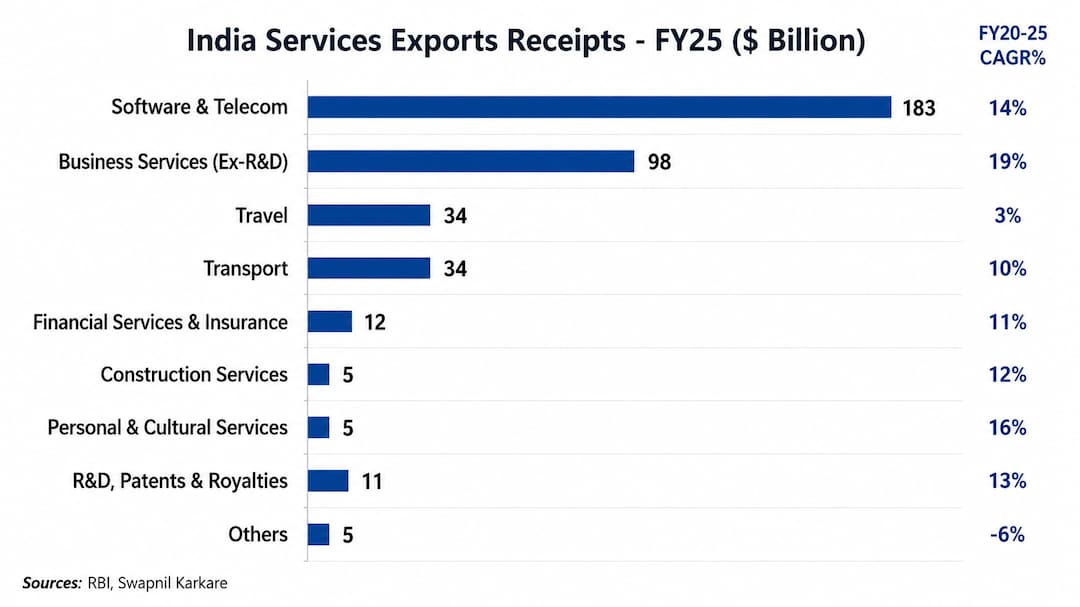
That brings us to an important point. We rely too much on software services for our exports. Software and business consulting services account for nearly three-quarters of all export receipts, according to RBI, both built on the same labour arbitrage foundation.
The best way to climb the value chain is by intensifying R&D, but India's progress in R&D has been sluggish. India earns more from freight charges on exports than from all its intellectual property combined. That means it's not easy to pull it off.
Then, coming to business services. India has deliberately kept foreign legal and accounting firms under tight restrictions, largely to protect domestic professionals and build indigenous firms. But this protection also comes with trade-offs. It limits India's ability to become a global hub for legal, accounting, arbitration, and high-end advisory services. Countries like the UK and Singapore earn substantial export revenues through such sectors.
Financial services also show a worrying story. GIFT City was conceived to capture cross-border flows, but a decade on, it has not moved the needle. Similarly, foreign tourist footfall in India is also declining, limiting our dollar-earning opportunities.
As a result, India's services exports remain heavily concentrated in IT, ITES, and generic business services rather than higher-value professional and advisory exports.
Tapping on Blurring Lines of Manufacturing & Services
One of the better ways to ensure sustainable export earnings is tapping the blurring lines between manufacturing and services. Today, apart from physical products, companies gain even from the software, data, subscriptions, and services wrapped around them. Machines are connected through Internet of Things (IoT) systems. It generates data which can be used for predictive maintenance, automation, and customer lock-in.
Examples like John Deere show how a tractor maker can evolve into a data and precision-agriculture platform through connected devices and analytics. Similarly, Xiaomi and other Chinese EV firms like XPeng and NIO increasingly operate as software-first businesses. In such models, technology plays an important part in driving innovation and billing in the long run.
For India, this creates an opportunity for domestic manufacturing and software firms to come together. Indian companies can sell products, software and even services together. This might be a bit far-fetched, but it doesn't need unrealistic
changes in government policies or structural reforms. This can happen between global corporates and educational institutions.
ALSO READ | Don't Panic At 100/$: Arvind Panagariya Urges RBI To Let Rupee Depreciate
Final Take
For the services export story to remain sustainable in the long run, India will need broader reforms - deeper AI adoption, stronger education and skilling systems, higher R&D intensity, domestic ownership of IP, and a more diversified export base beyond traditional software services.
Economist Ajay Shah writes that India should not become overly pessimistic about the future of its IT, ITES, and GCC ecosystem. However, he argues the industry's capital allocation model must change. For years, many firms returned cash to shareholders instead of reinvesting in R&D. In an AI-driven world, that may no longer be enough.
There is also an important historical parallel here. In the early 2000s, NASSCOM spent years countering political backlash against outsourcing in the US by highlighting the broader economic and social value created through global delivery networks. It was an effort to build political and business support around India's outsourcing model.
Today, the challenge is different, but the need for coordinated effort may be even greater. As AI reshapes global services, India may again need a broader coalition between industry, government, educational institutions, and global firms, along with doubling down on innovation to ensure that the country remains central to the next phase of the global technology and services economy.
Disclaimer: The views expressed in this article are solely those of the author and do not necessarily reflect the opinion of NDTV Profit or its affiliates. Readers are advised to conduct their own research or consult a qualified professional before making any investment or business decisions. NDTV Profit does not guarantee the accuracy, completeness, or reliability of the information presented in this article.
Essential Business Intelligence, Sharp Market Insights, Practical Personal Finance Advice, Daily Fuel, Gold and Silver Prices and Latest Stories — On NDTV Profit.