In my previous article, I analysed the 2025 Annual Survey of Unincorporated Sector Enterprises (ASUSE). The data showed that Indian unincorporated businesses generate an average gross value added (GVA) of about Rs 1.56 lakh per worker annually. But there is a sharp productivity divide within the informal economy itself.
Own-account enterprises (OAEs) - the sole proprietors - generate around Rs 1.16 lakh per worker, while hired worker enterprises (HWEs) - firms that hire workers - generate nearly Rs 2.3 lakh. In simple terms, once firms begin hiring workers and operating at a larger scale, labour productivity almost doubles.
In this piece, we look at how these productivity patterns vary across states.
Also Read | Layoffs Are Rising In Tech, But These Skills Are Helping People Unlock Better Pay
Wages and Productivity Go Hand in Hand
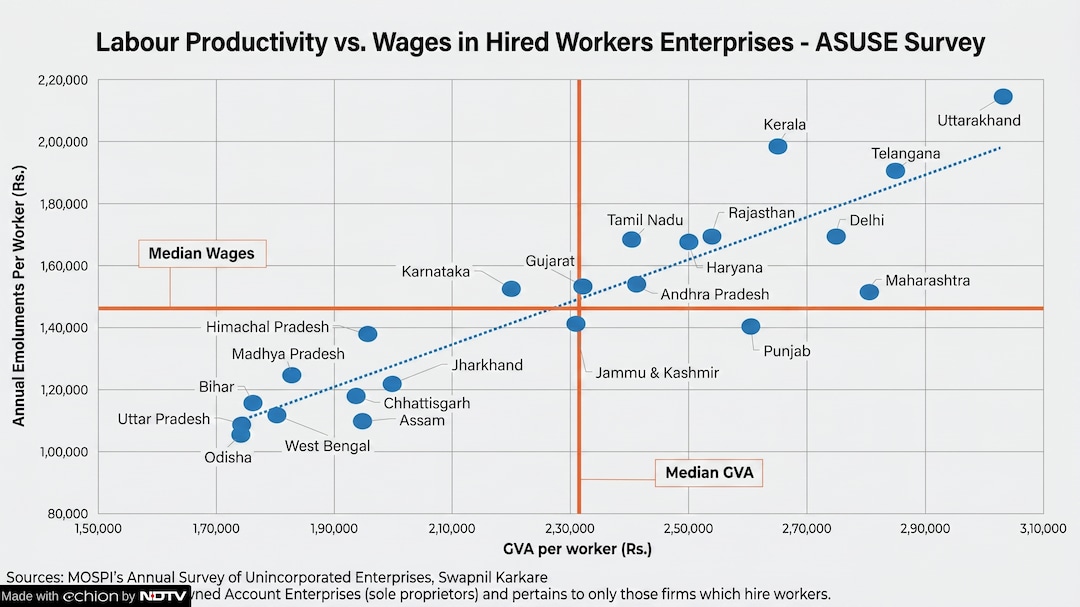
One of the clearest observations from the ASUSE data is that wages and productivity are directly related to each other. It may sound obvious, but it matters. If India wants better wages, it also needs more productive small businesses.
The relationship is visible across states. Uttarakhand, Telangana, Kerala, Maharashtra, and Delhi are among the most productive economies in the country, and workers in those states even earn more than the national average. At the other end, states like Uttar Pradesh, Odisha, Bihar, and West Bengal remain stuck in the low-productivity, low-wage category.
Who Gets the Productivity Gains?
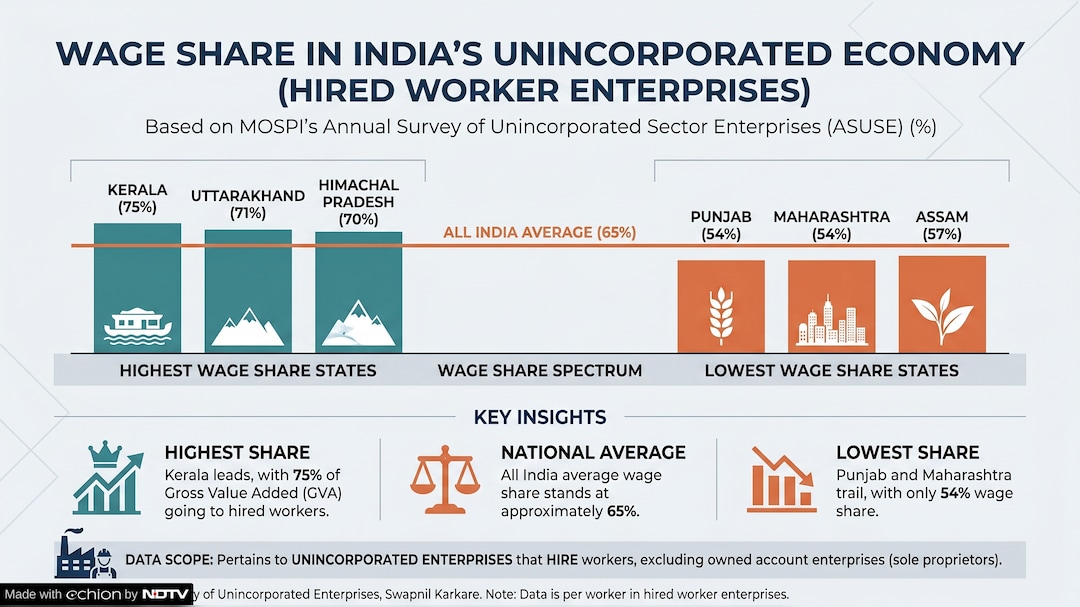
The report reveals that some states share productivity gains more with workers, while other states pocket those. At the all-India level, workers in HWEs receive roughly 65% of the GVA as wages.
Kerala's wage share is 75%, the highest among major states. However, the biggest anomalies are Maharashtra and Punjab, among the lowest in India. They generate one of the highest outputs per worker, but their workers end up taking home much less than the average.
Formal-Informal Wage Gap
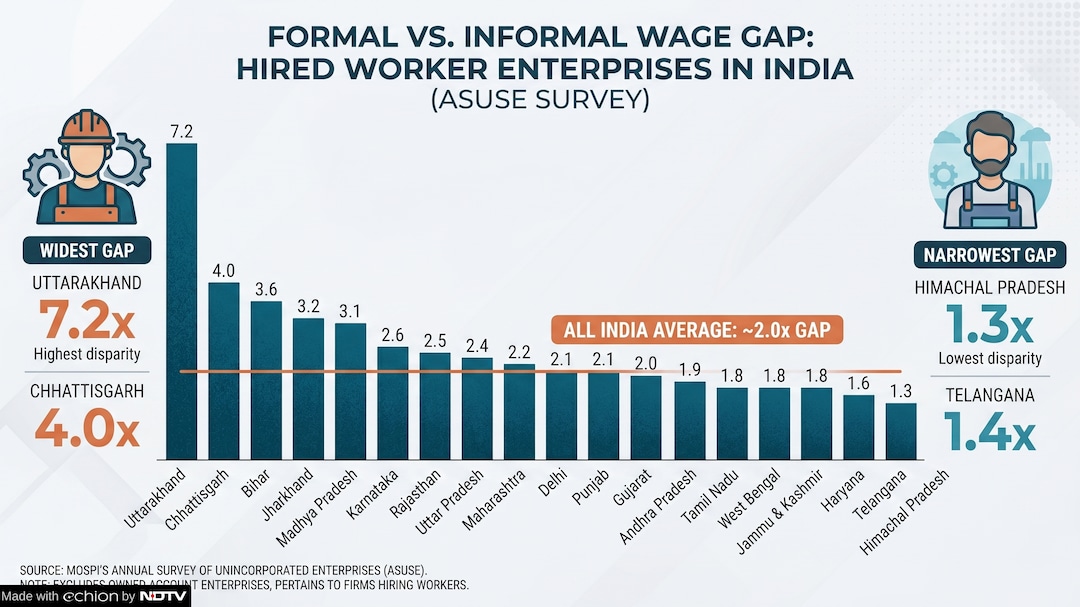
The third layer of the analysis is the formal-informal wage gap. On average, workers in formal employment get twice the wages compared to those in informal setups. Uttarakhand, Chhattisgarh and Bihar have the highest gap, while Himachal Pradesh, Telangana and Haryana have the lowest gaps.
Once these three things - productivity, wage share, and formal-informal wage gaps - are read together, very different state-level stories begin to emerge.
Kerala and Telangana: High Productivity, High Wages
Kerala is probably the strongest overall performer in the dataset. Workers in Kerala's HWEs generate around Rs 2.65 lakh in GVA per worker annually, while annual wages are close to ₹1.98 lakh.
Even more importantly, Kerala's formal-informal wage gap is relatively low at around 1.8 times. That means informal workers are not dramatically underpaid compared to formal workers. Kerala combines high productivity with a relatively broad wage distribution.
Telangana tells a slightly different but equally interesting story. Its productivity is among the highest in India at nearly Rs 2.85 lakh per worker, while annual wages are around Rs 1.9 lakh. But the biggest standout is the formal-informal wage gap. At around 1.4 times, Telangana has the lowest gap among major states.
Uttarakhand: High Productivity, But a Huge Divide
Uttarakhand looks extremely successful at first glance. It has the highest productivity among major states at over Rs 3 lakh per worker annually, and wages are also among the highest at over Rs 2.14 lakh.
But much of it is driven by formal employment. The state has the largest formal-informal wage gap in India. A formal worker there earns more than seven times what an informal worker earns.
Uttar Pradesh, Odisha and West Bengal: Large Economies, Low Productivity
At the other end are states like Uttar Pradesh, Odisha, and West Bengal, where productivity remains below the all-India average even after firms scale from OAEs to HWEs.
Uttar Pradesh has the largest number of informal enterprises in India and contributes significantly to overall output. Yet productivity per worker remains low. One likely reason is the very high share of tiny OAEs with limited capital, technology, or division of labour.
Odisha performs even worse on some indicators. Productivity and wages are both low, but workers also receive one of the smallest shares of the value created.
West Bengal shows a slightly different pattern. Productivity and wages remain below average, but the formal-informal wage gap is relatively moderate.
These trends suggest that many businesses in these states remain trapped in low-productivity, survival-oriented activities rather than growth-oriented expansion. Limited capital, weak market linkages, and low technology adoption restrict their ability to hire more workers, scale operations, or improve productivity. Over time, that also keeps wages low.
Final Take
The biggest takeaway from the ASUSE data is simple. India does not have one informal economy. Different states face completely different bottlenecks. Some need higher productivity. Some need better wage transmission. Some need businesses to scale beyond tiny own-account enterprises. And some need to reduce the huge divide between formal and informal workers.
Disclaimer: The views expressed in this article are solely those of the author and do not necessarily reflect the opinion of NDTV Profit or its affiliates. Readers are advised to conduct their own research or consult a qualified professional before making any investment or business decisions. NDTV Profit does not guarantee the accuracy, completeness, or reliability of the information presented in this article.
ALSO READ: India's Productivity Journey Is More Complicated Than We Think | The Reason Why
Essential Business Intelligence, Sharp Market Insights, Practical Personal Finance Advice, Daily Fuel, Gold and Silver Prices and Latest Stories — On NDTV Profit.