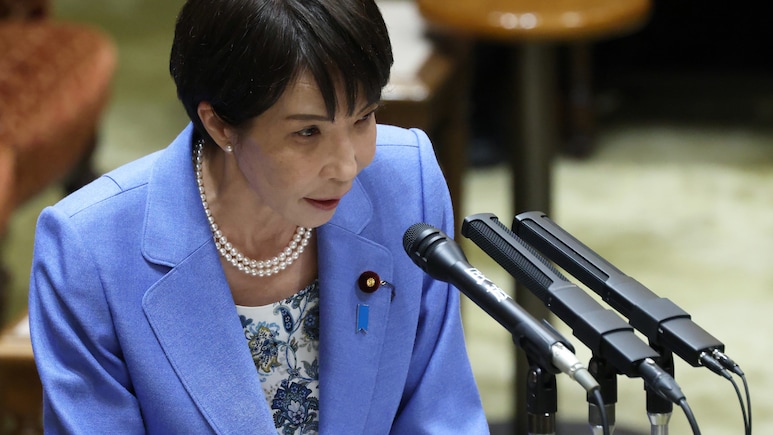
Japanese Prime Minister Sanae Takaichi said she has called on the finance ministry to compile an extra budget in response to rising commodity prices driven by the ongoing Middle East conflict, backtracking after repeatedly insisting such a measure wasn't necessary.
“I asked Finance Minister Katayama last week to consider ways of funding including compiling a supplementary budget,” Takaichi said at a ruling coalition meeting held on Monday.
For weeks, Takaichi and Finance Minister Satsuki Katayama have denied the need for additional funds or fresh bond issuance. But Monday's announcement has been seen as almost inevitable given rising oil prices and the depletion of funds to pay for relief measures.
The planned supplementary budget is expected to fund emergency relief measures rather than provide economic stimulus, Bloomberg News reported earlier. To finance part of its supplementary budget, the government is likely to issue fresh debt, Reuters reported on Monday, citing an unnamed government official.
Speaking separately on Monday, Hirofumi Yoshimura — co-leader of Japan's Ishin party, which maintains a coalition with Takaichi — said the scale of the extra budget hasn't been decided yet.
It's a turnabout for Takaichi, who campaigned on promises that the government wouldn't borrow more to fund spending. She had to similarly adjust earlier this year, when she insisted that the budget for the new fiscal year would pass in time for its start date. But due to delays from the election that solidified her party's power, the budget was passed a week after Takaichi's self-imposed deadline.
The call for an extra budget comes amid renewed concerns over the nation's fiscal sustainability. Yields on long-term Japanese government bonds have climbed to multi-decade highs, with a Kyodo report last week on the possibility of an supplementary budget bumping up yields. The 30-year yield rose to the highest since the tenor's debut in 1999 last week, while 20- and 40-year yields also touched the highest levels in decades.
As recently as Friday, Katayama reiterated that the government saw no immediate need for an extra budget, attributing the recent rise in yields partly to global market trends. The opposition Democratic Party for the People submitted a proposal Friday calling for a ¥3 trillion ($18.9 billion) supplementary budget.
Japan typically finances such spending through higher-than-expected tax revenue, unused budget funds or additional bond issuance. With the current fiscal year having only just started, it remains unclear how much extra tax revenue or unused funds are available, making further debt issuance increasingly likely — especially if the budget exceeds the DPP's ¥3 trillion proposal.
Takaichi also said Monday she's planning to reinstate energy subsidies from July to September, confirming media reports. She asked the ruling bloc to ensure those subsidies will lead to lower household energy bills compared to last year, adding that she doesn't expect energy prices to rise this month or next.
Takaichi's government has yet to finalise plans for temporary food tax cuts, raising further questions about how the measure would be financed. Planned increases in defense spending are also adding to the fiscal strain on her administration.
The government has been subsidising gasoline prices to cap them at ¥170 per liter, using reserve funds to finance the program. Those funds will likely run out by June 29 under a baseline scenario in which the government continues subsidies of around ¥42.6 per liter, according to a report last week by Takahide Kiuchi, executive economist at Nomura Research Institute.
International entities including the Organisation for Economic Co-operation and Development and the Asian Development Bank have recently urged Japan to limit reliance on extra budgets, citing the need to preserve fiscal buffers.
ALSO READ: Nifty Down Over 1%, Sensex Slumps 950 Points — Three Reasons Why Markets Are Crashing Today
(This story has not been edited by NDTV staff and is auto-generated from a syndicated feed.)
Essential Business Intelligence, Sharp Market Insights, Practical Personal Finance Advice, Daily Fuel, Gold and Silver Prices and Latest Stories — On NDTV Profit.