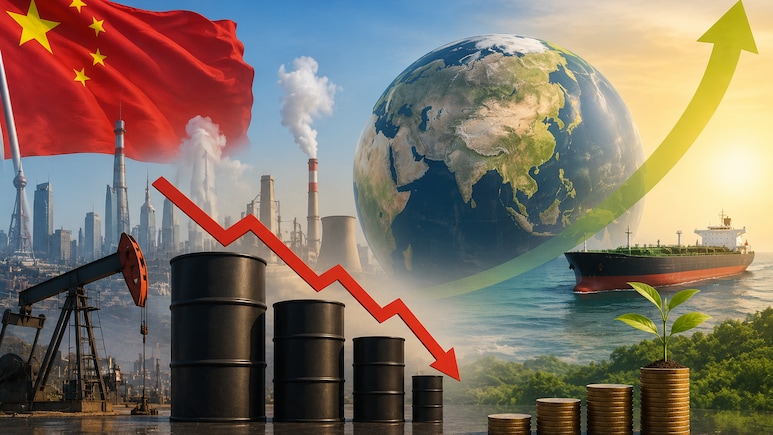
- China cut crude imports by 3 million barrels daily amid the Iran war, easing global price shocks
- Brent crude prices stayed below $100 despite Strait of Hormuz closure fears of $150-$200 per barrel
- Chinese consumers shifted to EVs and trains, reducing gasoline and short-haul flight demand
China's sharp reduction in crude oil imports during the Iran war has played a significant role in keeping global oil prices from spiralling out of control, helping cushion the world economy from a potentially devastating shock, the Wall Street Journal reported.
When the US and Israel attacked Iran and the Strait of Hormuz was effectively closed, analysts had warned a prolonged closure could push oil prices to between $150 and $200 a barrel, likely triggering a global recession.
Instead, with the strait's chokehold now into its fourth month, the Brent crude benchmark has stayed below $100 a barrel.
The Missing Three Million Barrels
China's crude imports fell to 7.8 million barrels a day in May, down from around 11 million barrels a day in recent years — a drop of roughly three million barrels daily, equivalent to the combined oil consumption of Italy and France, according to WSJ.
Remarkably, the decline has occurred with little visible disruption to everyday life in China, with tourists still travelling, factories still running and store shelves well stocked.
EVs, Trains Replace Cars And Planes
Chinese consumers have shifted from gasoline-powered cars to electric vehicles and from short-haul flights to high-speed rail. During the May Day holiday period, air passenger traffic fell 5.7% year-on-year while rail traffic rose 4.6%, according to China's Ministry of Transport.
EV charging volume on highways surged 53% during the same period, the National Energy Administration said.
ALSO READ: China's Exports Jump 19.4% In May From A Year Earlier, Despite Iran War
Refiners Cut Back
Chinese refiners have also significantly reduced operations. By May, refinery run rates had dropped by 10% points, with steam cracker run rates falling 7% points, according to Argus Media, cited by WSJ.
Beijing had also stockpiled large quantities of cheap Russian and Iranian oil before the war, giving it reserves analysts estimate at between one billion and 1.4 billion barrels.
ALSO READ: US Inflation Soars To Three-Year High As Iran War Pushes Up Energy Prices
How Long Can It Last
The resilience may not last indefinitely. China is running short of ethylene and other petrochemical feedstocks, and producer prices rose 3.9% in May, WSJ reported.
Vortexa analyst Emma Li told the paper that even if inventory drawdowns accelerated to over one million barrels a day, China's commercial reserves alone could sustain another six months — but traders are watching closely to see whether Beijing returns to spot crude purchases in the weeks ahead.
Essential Business Intelligence, Sharp Market Insights, Practical Personal Finance Advice, Daily Fuel, Gold and Silver Prices and Latest Stories — On NDTV Profit.