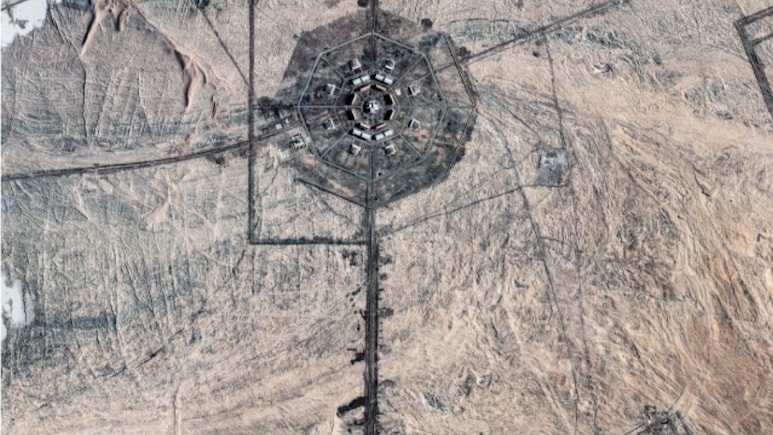
China is building an extensive military infrastructure network in its remote northwestern desert that security analysts say is aimed at safeguarding Beijing's nuclear arsenal from a potential first strike by the United States, according to a Reuters investigation based on satellite imagery.
The images reveal more than 80 concrete launch pads, fortified bunkers and communications facilities spread across eastern Xinjiang near the Hami nuclear silo field, home to some of China's longest-range intercontinental ballistic missiles (ICBMs).
Analysts told Reuters the network appears designed to strengthen China's second-strike capability, the ability to retaliate with nuclear weapons even after absorbing an enemy attack.
Also Read | Layoffs Are Rising In Tech, But These Skills Are Helping People Unlock Better Pay
“We can see this infrastructure is being built on a grand scale, covering thousands of square kilometers of desert beyond the silo fields,” said Alexander Neill, adjunct fellow at Hawaii-based Pacific Forum.
ALSO READ: China Supports 'Active Mediation' By Pakistan Between US, Iran: FM Wang Yi
Depending on its final capabilities, he added, “we're looking at a very considerable enhancement and diversification of China's strategic nuclear deterrent.”
Satellite imagery reviewed by Reuters also showed two octagon-shaped military complexes southwest of the Hami silo field. The installations contain housing blocks, large vehicle facilities, airfields, railheads and heavily fortified storage areas. Recent images from April and May showed military vehicle movements, temporary structures and what analysts described as camouflaged launch positions near the northern octagon.
Three security analysts assessed that some of the launch pads could support mobile missile launchers, air-defense batteries and electronic warfare systems. Others suggested the underground conduits linking the sites may contain fiber-optic communication networks.
Hans Kristensen, director of the Nuclear Information Project at the Federation of American Scientists, said the scale of construction was unprecedented. “I've never seen anything quite like it,” he told Reuters. “It's an extraordinary effort.”
The developments come as China accelerates the modernisation of its nuclear forces under President Xi Jinping. According to the Pentagon's latest assessment, China is on course to field 1,000 nuclear warheads by 2030, despite a recent slowdown in warhead production.
ALSO READ: Even Non-Chinese Trade Depends on China | The Reason Why
China maintains a “no first use” nuclear policy, though some Western diplomats and analysts believe Beijing could use nuclear coercion in a conflict involving Taiwan.
Reuters reported that the vast defensive network sets China apart from the US and Russia, both of which rely more heavily on silo numbers and hardened structures rather than expansive missile-defense systems to preserve deterrence.
Essential Business Intelligence, Sharp Market Insights, Practical Personal Finance Advice, Daily Fuel, Gold and Silver Prices and Latest Stories — On NDTV Profit.