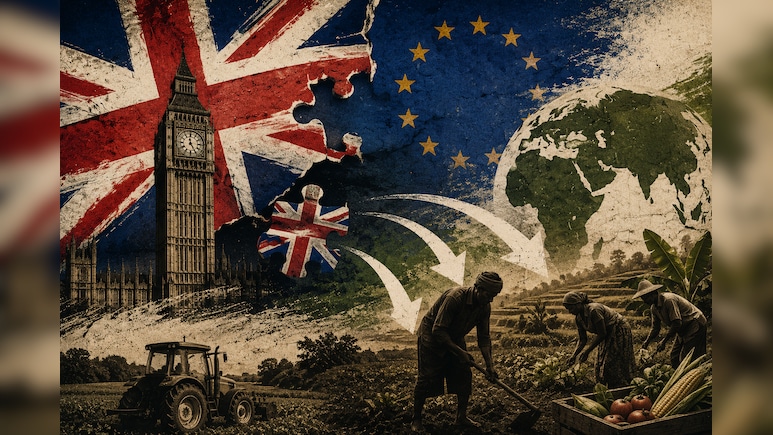
June 2026 marks ten years since the Brexit referendum, when the United Kingdom (UK) voted to leave the European Union (EU). Much attention has focused on its political and economic fallout. A less-noticed consequence is that the UK had to revise its commitments at the World Trade Organization (WTO), including the level of farm support it can provide and the tariffs it can impose on agricultural imports.
The UK's post-Brexit agricultural commitments, therefore, highlight a fundamental contradiction in the multilateral trading system: flexibility is accommodated when it serves developed countries, yet comparable policy space sought by developing countries, including India, for food security and the livelihoods of millions of small farmers remains contested.
Currency Issue and Agricultural Commitments
WTO agricultural commitments define a country's policy space by setting limits on farm subsidies, capping import tariffs, and determining when governments can shield domestic producers from import surges. The tighter these commitments, the narrower the room for policy intervention.
Also Read | Layoffs Are Rising In Tech, But These Skills Are Helping People Unlock Better Pay
Before Brexit, the UK operated under the EU's WTO commitments, which were denominated in Euros (€). Leaving the EU meant that the UK had to build its own WTO schedule in Pounds (£). The new schedule was built in two steps. It first carved out its share of the EU's agricultural commitments, which were based on 1986-88 data and denominated in Euros (€). It then converted those commitments into Pounds (£).
The real story lies in how that conversion was done. Rather than using the 1986-88 exchange rate, the UK chose the average Pound-Euro exchange rate for 2015-19, arguing that it better reflected current economic realities. By then, the Pound had weakened significantly against the Euro, moving from £0.67 per Euro in 1986-88 to £0.84 per Euro in 2015-19, a depreciation of nearly 25 percent. This seemingly minor technical adjustment gave the UK significantly more room to support and protect its farm sector under the WTO Agreement on Agriculture.
Impact of Exchange Rate
This single technical choice had four major consequences. First, the adjustment gave the UK nearly £1 billion in additional room to support its farmers. In effect, it expanded the UK's ability to subsidise agriculture. Most developing countries, including India, enjoy no such flexibility and continue to operate under far tighter constraints.
Second, the change made it easier for the UK government to support its farmers through price support programmes. Because of the revised exchange rate, the fixed external reference prices used to calculate farm subsidies increased by almost 25 percent. In simple terms, this meant the government could provide more support to farmers before reaching WTO limits, a valuable cushion during low prices or market distress.
Third, Brexit quietly strengthened the UK's trade defences. For about one-third of agricultural products, those subject to specific duties rather than percentage tariffs, the UK can now impose higher import duties. For rice, the bound tariff rises from £142 to £177 per tonne, representing a 25 percent advantage. Put simply, the UK now has more room to raise the wall against cheap imports when it wants to protect its farmers.
Lastly, WTO rules give some countries, including the UK, an emergency safety valve known as the Special Safeguard (SSG). It allows governments to temporarily raise import duties above their normal limits when there is a sudden surge of imports or when world prices collapse and threaten domestic farmers. The trigger for using this mechanism depends on a reference price. By adopting the more recent exchange rate, the UK ended up with a higher trigger price, giving it even greater flexibility to protect its farmers when markets become turbulent.
Taken together, these technical changes quietly expanded the UK's policy space in agriculture. Not surprisingly, several WTO members, including India, New Zealand, Brazil, Paraguay and Canada, have raised concerns over the use of the more recent exchange rate. The issue remains unresolved, with India continuing consultations with the UK.
Lessons for the Global South
But this debate is about more than exchange rates. It reveals a deeper imbalance in how flexibility operates within the WTO, and the paradox is striking.
The UK has argued that using a more recent exchange rate is justified because it reflects current economic realities. Yet, when developing countries have sought to update WTO agricultural rules that still rely on benchmark prices fixed nearly 40 years ago, progress has been elusive.
Take India, for example. Under current WTO rules, any minimum support price for wheat above about ₹3.5 per kilogram is counted as a trade-distorting subsidy, even though market prices have changed dramatically since the late 1980s. If current realities matter for developed countries, why should the same principle be denied to the Global South?
The UK case shows that in trade negotiations, technical details are never just technical. Small adjustments can reshape policy space and make international rules even more uneven. Unless these issues are addressed, the imbalances that emerged during the Uruguay Round may simply be reproduced, once again leaving developing countries at a disadvantage.
The larger lesson is simple: policy space matters. Even if the UK does not use these additional flexibilities today, retaining them preserves room to act when circumstances change. At its core, this is not just about current farm subsidies; it is about keeping policy options open for the future.
If preserving policy flexibility is considered prudent for developed countries, it should not be treated as a privilege when sought by developing countries. The real challenge for the WTO is ensuring that flexibility is available fairly, not selectively.
The piece has been written by Prof. Sachin Kumar Sharma and Paavni Mathur. Prof. Sharma is Director General, and Paavni Mathur is Consultant at RIS, New Delhi.
Essential Business Intelligence, Sharp Market Insights, Practical Personal Finance Advice, Daily Fuel, Gold and Silver Prices and Latest Stories — On NDTV Profit.