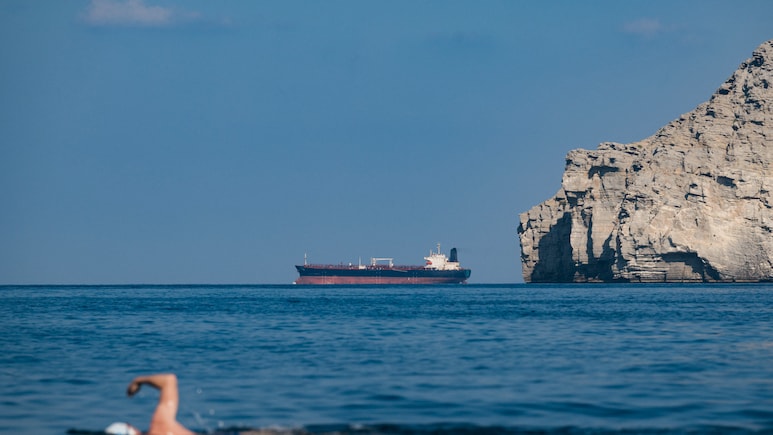
British endurance swimmer Lewis Pugh has drawn attention to the devastating impact of the US-Iran war on marine life in the Strait of Hormuz after completing a three-day swim through the region. The 56-year-old risked his life to highlight the environmental damage caused by attacks on commercial vessels and the threat to the region's fragile marine ecosystem.
Pugh, who serves as the United Nations Environment Programme's Patron of the Oceans, shared photographs and videos from his swim on social media on Saturday. He also urged those involved in the conflict to stop the fighting, reopen the strategic waterway and clean up the pollution caused by attacks on ships.
In a series of posts on X, Pugh described witnessing explosions and attacks on commercial shipping during his journey. "I have just completed a three-day swim through the Strait of Hormuz. I went there to bring attention to the devastating environmental cost of war," he wrote in his first post.
Also Read | Layoffs Are Rising In Tech, But These Skills Are Helping People Unlock Better Pay
I have just completed a three-day swim through the Strait of Hormuz. I went there to bring attention to the devastating environmental cost of war. Associated Press has published the first account of the swim. Please read it, and help share it. https://t.co/qfxN1qLPZ3 Photos: Kelvin Trautman / Lewis Pugh Foundation #HormuzSwim
— Lewis Pugh (@LewisPugh) November 21, 2026
He covered a total distance of 15 kilometres (9.3 miles), starting from Oman's Musandam Peninsula and swimming around part of the Cape of Hormuz. Iran lies on the other side of the strait, which is approximately 39 kilometres wide at its narrowest point.
ALSO READ: The Ukraine War Just Spilled Into The Gulf Of Finland-With A Burning Russian Ship
Sharing a video of his journey, Pugh revealed that an oil tanker was struck just a few kilometres away, barely 30 minutes after he began swimming. "Just 30 minutes after I began swimming, an oil tanker was struck a few kilometres away. The explosions rocked the sea around me. Over the following days, I witnessed further attacks on commercial shipping and saw vessels engulfed in flames," he wrote.
He further highlighted how the conflict's environmental consequences could extend far beyond the immediate destruction caused by the attacks.
I have just completed a three-day swim through the Strait of Hormuz to draw attention to the devastating environmental consequences of war. Just 30 minutes after I began swimming, an oil tanker was struck a few kilometres away. The explosions rocked the sea around me. Over the following days, I witnessed further attacks on commercial shipping and saw vessels engulfed in flames. War causes immense human suffering. Lives are lost, families are torn apart, and homes are destroyed. But there is another casualty that receives far too little attention: nature itself. The Strait of Hormuz is one of the most beautiful places I have ever visited. Towering mountains rise above spectacular fjords. There are coral reefs and mangrove forests, and waters home to dolphins, sea turtles and dugongs. It is one of the great natural wonders of the world. Yet this extraordinary place is now caught in the middle of a war. Oil tankers, gas carriers and other merchant ships are being attacked. The environmental consequences will last for decades. My message is simple: Stop the fighting. Open the Strait. Clean up the pollution. Please help share this message. #HormuzSwim
— Lewis Pugh (@LewisPugh) November 21, 2026
"War causes immense human suffering. Lives are lost, families are torn apart, and homes are destroyed. But there is another casualty that receives far too little attention: nature itself," Pugh said.
Describing the Strait of Hormuz as one of the most beautiful places he had ever visited, the swimmer pointed to its coral reefs, mangrove forests and diverse marine life, including dolphins, sea turtles and dugongs.
However, he warned that repeated attacks on oil tankers, gas carriers and other merchant vessels could have long-lasting consequences for the region's ecosystem. "The environmental consequences will last for decades," he said.
Concluding his message, Pugh called for an end to the conflict and urgent action to address the environmental damage.
"My message is simple: Stop the fighting. Open the Strait. Clean up the pollution. Please help share this message," he concluded.
ALSO READ: Iran Claims Missile Strike On US F-16 Over Gulf: What CENTCOM Fact-Check Shows
Essential Business Intelligence, Sharp Market Insights, Practical Personal Finance Advice, Daily Fuel, Gold and Silver Prices, Watch Business News Live and Latest Stories — On NDTV Profit.