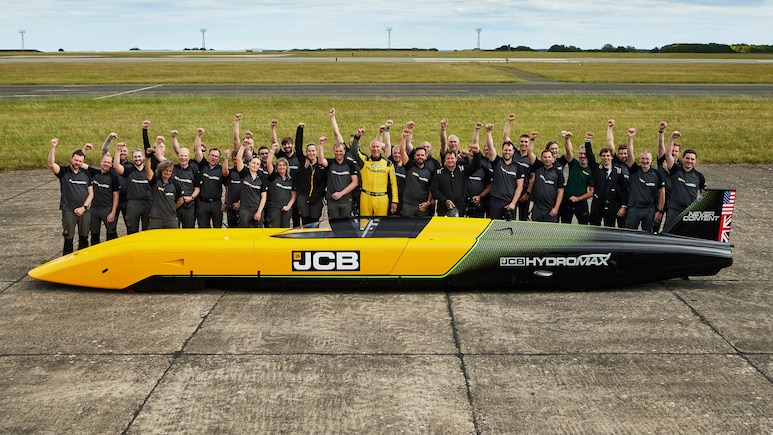
On Utah's Bonneville Salt Flats, the hydrogen-powered JCB Hydromax achieved an average speed of 406.320 mph (653.9 kmph), setting a temporary FIA global land speed record.
Wing Commander Andy Green OBE, who had previously set JCB's diesel land speed record with the Dieselmax, piloted the British-built streamliner, according to a report by NDTV.

-
 India's Market Leaders To Decode The New Samvat At NDTV Profit Ignite In Mumbai On Oct 28
 -
 NDTV Profit IGNITE Diwali 2026: Top Market Veterans Decode Wealth Creation
 -
 The Week Ahead: Earnings Season, Fed Policy Verdict And Crude Oil In Focus
 -
 Silver Is Now Down From Rs 4.2 Lakh To Rs 1.9 Lakh: Where It Goes From Here
 -
 NDTV Ignite, The Trillion-Dollar Trajectory: India's Road to 2030
As per FIA regulations, the 32-foot Hydromax made two runs in opposite directions within one hour. It clocked 400.623 mph (644 kmph) on its first run and 412.135 mph (663 kmph) on the return run. The overall average for the flying kilometre was 406.320 mph.
Also Read | Layoffs Are Rising In Tech, But These Skills Are Helping People Unlock Better Pay
Another record in the history books 🏁
— FIA (@fia) August 11, 2026
The JCB Hydromax has claimed a new FIA hydrogen land speed record, recording a flying start speed of 406.320 mph / 653.909 kph at the Bonneville Salt Flats.
Click below to discover how the record was set, verified and officially recognised…
The verdict is still subject to final ratification by the FIA's Land Speed Records Commission. If confirmed, it will beat the hydrogen internal-combustion record of 185.5 mph (298 kmph) set by the BMW H2R in 2004.
The Hydromax also beat JCB's own diesel record of 350.092mph (563kmph) set by Green in the Dieselmax at Bonneville in 2006.
The latest run also set a new hydrogen fuel-cell record, beating the previous record of 303 mph (486 kmph), meaning the Hydromax is the fastest hydrogen-powered vehicle recorded, according to JCB's judgement.
The Hydromax uses hydrogen in internal-combustion engines, unlike a fuel-cell vehicle. It is powered by a pair of production-based hydrogen engines developed from units designed for JCB construction equipment
The engines generate about 1,600 horsepower when combined. According to JCB, they are built on the same hydrogen combustion technology as its construction machinery program, which is a component of the company's $100 million investment in the development of hydrogen engines.
Instead of using hydrogen to create power by a fuel cell, the engines burn pressurised hydrogen with air. Although the system's larger environmental impact relies on how the hydrogen is created, JCB claims that the technology emits no carbon dioxide at the vehicle's exhaust.
Essential Business Intelligence, Sharp Market Insights, Practical Personal Finance Advice, Daily Fuel, Gold and Silver Prices and Latest Stories — On NDTV Profit.