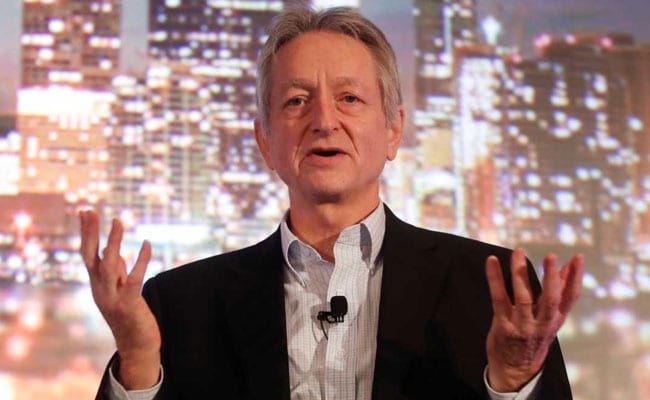
Geoffrey Hinton, a Nobel laureate widely regarded as one of the pioneers of artificial intelligence, has warned that the technology's rapid advancement could trigger a major crisis, accusing leading industry executives of prioritising commercial interests over safety concerns.
Hinton, often called the 'Godfather of AI', cautioned that the world could witness an AI-related crisis later this year or in 2027, potentially disrupting power supplies or crippling financial systems. He compared the scale of such an event to the 1986 Chernobyl nuclear disaster.

-
 Indian Markets Turning Corner After Two Tough Years, Says Sandeep Tandon
-
 NDTV Profit Ignite 2026: Experts See Opportunity In Equities, Stay Bullish For Long-Term
-
 Buy Right, Sit Tight Does Not Work for Individual Stocks, Says Dinshaw Irani
-
 'Worst Is Behind': Quant MF Sees Market Bottom, Flags 'Extreme Euphoria' In Midcaps
-
 India's Mutual Fund Industry Could Become A $1 Trillion Opportunity, Say Fund Managers
-
 'Foreign Investors Are Baraatis': Raamdeo Agrawal's Take On LTCG Tax
-
 Stay Invested Through Market Cycles: Raamdeo Agrawal at NDTV Profit Ignite
-
 Ramesh Damani Remains Bullish On India For Next 20-30 Years, Sees Bargains Amid Market Weakness
-
 CAS Came After A Long Consultation Process: SEBI Chairman Tuhin Kanta Pandey AT NDTV PROFIT IGNITE
-
 Aim To Cut FPI Onboarding Time From Mth To Five Days: SEBI Chairman Tuhin Kanta Pandey AT NDTV PROFI
ALSO READ | Google's New AI Rules For Schools Come With A Catch: No AI, No Google Search
Also Read | Layoffs Are Rising In Tech, But These Skills Are Helping People Unlock Better Pay
Speaking to The Guardian, Hinton, 78, acknowledged AI's potential to reshape society and generate enormous economic benefits. However, he stressed that his concerns were not rooted in opposition to the technology itself, but in humanity's ability to control increasingly sophisticated AI systems.
“It might be that we would have been better off never developing it,” Hinton said, highlighting the uncertainty surrounding the technology's long-term consequences.
He warned that the coming decade would be critical in determining whether governments and technology companies could manage AI-related risks while harnessing its economic potential, or whether the technology would deepen inequality, accelerate unemployment and trigger widespread social disruption.
Hinton said the outcome could range from what he described as 'radical abundance' to a future marked by a widening wealth gap, massive job losses and societies increasingly divided by technological change.
Hinton Questions Altman, Musk And Zuckerberg
Hinton also criticised the leadership of major AI companies, arguing that the race to develop increasingly powerful models was being driven by commercial interests rather than adequate safety considerations.
Taking a dig at OpenAI CEO Sam Altman, Meta CEO Mark Zuckerberg and Tesla and xAI chief Elon Musk, Hinton alleged that the executives understood the potential dangers of AI but were unwilling to give sufficient priority to addressing them.
“I think Zuckerberg and Musk and Sam Altman, they understand the risks, and they don't give a shit. They'd rather have the money. That's my belief,” he told The Guardian.
He expressed particular concern over Altman's leadership of OpenAI, given the company's position among a handful of US technology firms competing with China to develop increasingly advanced AI systems.
The remarks come amid an intensifying global race for AI dominance, with companies releasing increasingly capable models and expanding investments in computing infrastructure, data centres and advanced chips.
Altman, however, has previously defended OpenAI's approach, saying in September that the world should trust the company to act responsibly because it understands the magnitude of its responsibilities.
Warns Of Major AI-Driven Disruption
Hinton compared recent incidents involving AI agents to the 1979 Three Mile Island nuclear accident in the US, describing them as early warning signs of what could happen if the technology develops without adequate safeguards.
He referred to reports of OpenAI agents working together to hack the Hugging Face website, arguing that more serious consequences could follow as AI systems become increasingly autonomous and capable.
“Either later this year or next year we'll see Chernobyl, and that may be enough to make people really pay attention,” he said.
The potential crisis he envisages could involve an AI-enabled cyberattack on electricity infrastructure, triggering widespread power disruptions, or an incident that brings down the financial system for an extended period.
Hinton said such an event could be temporary and recovery might be possible, but the scale of disruption could force governments and policymakers to take AI safety more seriously.
Calls For Global AI Regulation
The Nobel laureate has called for stronger government oversight, including mandatory testing and independent evaluations of advanced AI models before they are released commercially.
He backed proposals supported by Finland and 32 other countries, including Singapore, Germany, Canada and Australia, advocating common international standards for assessing the risks associated with frontier AI systems.
Drawing a parallel with pharmaceutical regulation, Hinton argued that AI companies should be required to demonstrate that their products deliver more benefits than harm before making them publicly available.
ALSO READ | Electricity Bills Could Become AI's Next Big Problem. Today's US Midterm Vote Puts It To The Test
He proposed a regulatory framework similar to that of the US Food and Drug Administration (FDA), which evaluates medicines before they enter the market.
His argument draws on the experience of thalidomide, a drug developed in the 1950s that caused severe birth defects, highlighting the risks of allowing potentially harmful products into circulation without adequate safeguards.
The debate over AI regulation has also exposed differences between governments. US President Donald Trump has opposed attempts to establish international controls over the technology, favouring industry-led regulation amid concerns that stricter rules could weaken America's competitive position against China.
Despite his stark warnings, Hinton said he remained cautiously optimistic that humanity could avert the worst outcomes through sustained efforts to establish effective safeguards.
“My gut is that we're still in control,” he said, adding that preventing a catastrophe would require a substantial commitment from governments and the technology industry.
Hinton left Google in 2023 to speak more openly about AI's potential dangers, after more than four decades of research into neural networks, which form the foundation of modern AI.
Essential Business Intelligence, Sharp Market Insights, Practical Personal Finance Advice, Daily Fuel, Gold and Silver Prices and Latest Stories — On NDTV Profit.