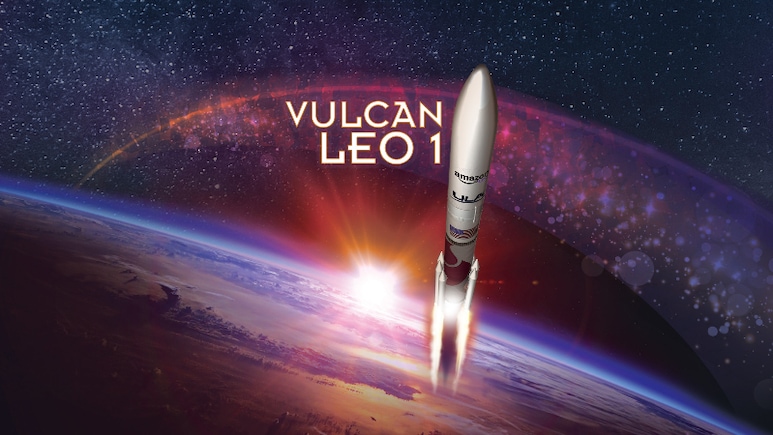
United Launch Alliance's (ULA) Vulcan rocket was lost following an in-flight anomaly approximately 10 minutes after launch, failing to deliver 40 Amazon Leo broadband satellites into orbit. The rocket launched from Space Launch Complex 41 at Cape Canaveral, Florida, but the mission ended unsuccessfully after the vehicle encountered an unidentified technical problem.
The incident represents a major setback for Amazon's satellite internet expansion and a significant challenge for ULA, the joint venture between Boeing and Lockheed Martin. The deployment of the now-lost satellites was a major step in Amazon's planned low-Earth-orbit (LEO) constellation, designed to compete with Elon Musk's Starlink network.
ULA Acknowledges Failure, Launches Investigation
Confirming the incident, ULA poste on X,"Based on data received by our Launch Director, we confirm that the Vulcan vehicle launched from Space Launch Complex 41 suffered an anomaly 10 minutes into the flight and failed to deliver the Amazon mission to orbit."
Also Read | Layoffs Are Rising In Tech, But These Skills Are Helping People Unlock Better Pay
The company acknowledged that it had not yet established the cause of the failure, as the incident had only recently occurred and investigators were still awaiting detailed flight data.
ULA added, "ULA exists to provide assured access to space for our nation and for the customers who depend on us. That purpose is why we take on some of the hardest missions in spaceflight, and why we hold ourselves to the standard of mission success. Today, we did not meet that standard."
Based on data received by our Launch Director, we confirm that the Vulcan vehicle launched from Space Launch Complex 41 suffered an anomaly 10 minutes into the flight and failed to deliver the Amazon mission to orbit. Every flight generates data, and every flight teaches us something. Since the anomaly just occurred, we don't have any specific data yet to understand what occurred today. ULA exists to provide assured access to space for our nation and for the customers who depend on us. That purpose is why we take on some of the hardest missions in spaceflight, and why we hold ourselves to the standard of mission success. Today, we did not meet that standard. We will work closely with our customer and other appropriate organizations to find the cause, determine the appropriate corrective action, and return to flight as quickly as possible. ULA is committed to full transparency with our customers, and they will have visibility into the investigation process, which utilizes rigorous methodology and corrective action. We will provide further updates when new information becomes available.
— ULA (@ulalaunch) November 15, 2026
Major Blow to Amazon's Satellite Internet Programme
The failure threatens to disrupt Amazon's ambitious plan to deploy a constellation of 3,232 satellites to provide global broadband connectivity. The company has contracted ULA for 38 launches, with Vulcan expected to carry a substantial portion of its first-generation satellite network. Amazon has already deployed approximately 400 satellites since April 2025 and aims to establish Amazon Leo as a competitor to Starlink.
ALSO READ: TRAI's New Satcom Framework: What it Means for Starlink, Jio Satcom and OneWeb
Amazon is also relying on Blue Origin's New Glenn and Europe's Ariane 6 rockets for future deployments. Arianespace is scheduled to launch another 36 Amazon satellites from French Guiana, while Blue Origin is expected to support subsequent missions.
Essential Business Intelligence, Sharp Market Insights, Practical Personal Finance Advice, Daily Fuel, Gold and Silver Prices and Latest Stories — On NDTV Profit.