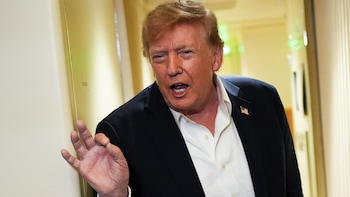
US President Donald Trump said the Iran war with Iran is nearing its end but warned of intensified strikes in the coming weeks, signalling a mix of military escalation and continued diplomatic efforts. In a televised address to US citizens from the White House, Trump said US operations are close to achieving their objectives, even as he set a two- to three-week window for either a deal or further attacks. According to D-Street experts, market sentiments have again turned negative after Trump's latest comments.
''While Trump's comments suggested a potential escalation of military operations, he also indicated that diplomatic discussions are ongoing. The conflicting statements raised concerns over the uncertainty of a swift resolution and fears of further damage to energy infrastructure,'' said Jigar Trivedi, Senior Research Analyst at Indusind Securities.
ALSO READ: Trump Speech Highlights: Iran War 'Near End' But US To Hit 'Extremely Hard' In Coming Weeks
Also Read | Layoffs Are Rising In Tech, But These Skills Are Helping People Unlock Better Pay
Trump struck a defiant tone on energy and global markets, insisting the US will not bear the burden of reopening the Strait of Hormuz and arguing that American strength has forced Iran into a weakened position after a month-long conflict. The conflict, which began on Feb. 28 with US and Israeli strikes on Iran, has entered its second month and continues to disrupt global energy markets and supply routes.
What does Trump's address mean for the Indian stock market?
"With President Trump's declaration " we are going to hit Iran extremely hard in the next two to three weeks, " market sentiments have again turned negative. Brent crude spiked around 5% to $105 and the US 10-year bond yield again firmed up to 4.36% negatively impacting gold and silver prices, though marginally,'' said Dr. VK Vijayakumar, Chief Investment Strategist, Geojit Investments Ltd.
Meanwhile, foreign institutional investors (FIIs) started the new financial year on a negative footing, continuing as net sellers by divesting equities worth Rs 8,331 crore on April 1, 2026. On the other hand, domestic institutional investors (DIIs) helped counterbalance the outflows to some extent, investing more than Rs 7,000 crore in equities in yesterday's session.
The high crude price, the widening trade deficit, the fear of declining remittances and sustained selling by foreign investors are acting cumulatively to put high pressure on the rupee which continues to decline despite RBI's decisions on restrictions on dollar futures deals, according to analysts.
ALSO READ: Stock To Buy: HSBC Bets On This Auto Components Supplier For 35% Upside
''Trump's statement that "we will finish the job in two to three weeks" cannot be taken at face value since the president has been notoriously inconsistent in all his views. He can change his position anytime. The March auto numbers reflect great resilience in the sector, and this has the potential to keep auto stocks relatively strong even in an otherwise weak market,'' said Dr. VK Vijayakumar.
After Trump's address, the Indian equity benchmarks opened lower on Thursday, resuming declines after a one-day breather as the US warned of intensified military action against Iran in the coming weeks. The BSE Sensex dropped as much as 2.1%, or 1,525 points, to 71,608.48 and the NSE Nifty 50 fell as much as 2.1% to 22,209 in early trade.
What should investors place bets now?
''Amid ongoing geopolitical issues, traders should remain more vigilant near crucial demand and supply zones and look for a clear break from either zone before entering new trades,'' said Kamlesh Jain, Technical Derivatives Analyst, Choice Equity Broking Private Ltd. Despite the constructive tone, markets may remain sensitive to the sudden reversals in the evolving geopolitical landscape going forward, according to Geojit Investments Ltd. Technically, Nifty's immediate support for the index is placed in the 22,250-22,300 range, while resistance is observed between 22,700 and 22,750 levels.
Essential Business Intelligence, Sharp Market Insights, Practical Personal Finance Advice, Daily Fuel, Gold and Silver Prices and Latest Stories — On NDTV Profit.