- Quant funds use mathematical models and algorithms for investment decisions, minimising human bias
- Nippon Indian Quant Fund was India's first quant fund; many others like SBI and Axis followed
- Quant models consider ratios, volatility, technical indicators, market cap, and macroeconomic data
To make investing devoid of human behaviour, mutual fund houses have, over the years, introduced quant funds. Note that we are not referring to schemes offered by Quant Mutual Fund, but rather to those that follow complex quantitative models or algorithms.
The oldest quant fund in India is Nippon Indian Quant Fund, originally launched as Reliance Quant Fund (before Nippon Life Insurance officially completed its takeover of Reliance Mutual Fund). After that, several other mutual fund houses, SBI, DSP, Tata, ICICI Prudential, Axis, and others, have introduced their respective quant funds. Cumulatively, these funds, classified as thematic funds, manage a significant AUM. So, let's understand in detail what these funds are.
What Are Quant Funds?
Intersection of Math and Investing
Quant-based funds, unlike other active funds, rely on complex mathematical and statistical models with automated algorithms and rules applied to make investment decisions. This applies to asset allocation, stock/security selection, as well as determining the entry and exits. This investment approach is devoid of human behaviour and biases.
Also Read | Layoffs Are Rising In Tech, But These Skills Are Helping People Unlock Better Pay
It is a quasi-passive, quasi-active investment strategy in which a fund manager is involved, but investment decisions are predominantly guided by a set of rules incorporated into the quantitative model or algorithm.
In this age of technology, fund houses are using artificial intelligence and machine learning to incorporate rules and restrictions that account for various factors.
Typically, the factors include:
Fundamental investment ratios such as price-to-earnings (PE), price-to-book (PB), price-to-sales (PS), price-to-earnings growth (PEG), return on equity, dividend yield, return on capital employed, debt-to-equity, interest coverage ratio, current ratio, quick ratio, working capital ratio, and trend analysis of operating profit, operating margin, cash flows, etc.
- Measures of volatility such as the VIX, stock beta, standard deviation, etc.
- Technical and momentum indicators such as the Relative Strength Index (RSI), Moving Averages (MAs), Convergences/Divergences, 52-week highs and lows, etc.
- Market cap to analyse the size: largecap, midcap, smallcap, etc.
- Institutional activity to assess FPI and/or DII buying and selling in the respective stock
- Size of the orderbook to understand future earning potential
- Sector prospects to identify high-growth and low-growth sectors, and set sector caps
- Macroeconomic indicators, index level rules, interest rate cycle, etc.
Moreover, rebalancing of the portfolio happens at regular intervals based on the metrics of the model.
So, multiple factors are incorporated into the quant model using an objective-driven approach, leaving no room for judgment calls or biases. The fund management team's role is only to establish the quant model, make parameter changes (if needed), and/or rebalance.
Another plus point of quant-based investing is that even if a fund manager/s is no longer part of the team, you don't have to worry about the scheme's performance as long as the quant-based model, alongside the investment processes and systems at the fund house, is strong.
As regards the cost of investing, since the performance of quant funds largely depends on the efficiency of their quantitative or algorithm-based models, they typically charge lower expense ratios than traditional equity mutual funds, where the fund manager plays an active role.
Have Quant Funds Delivered on Returns?
The table below shows that not all quant funds have delivered alpha, i.e., outperformed the market. Hence, prudent selection matters.
Take, for example, the DSP Quant Fund (launched in July 2019) and Axis Quant Fund (launched in July 2021). These funds have underperformed across short- and long-term periods relative to the category average and the broader BSE 500 - Total Return Index (TRI).
While DSP Quant Fund has exposed investors to relatively low risk (as indicated by the standard deviation of 11.74) compared to the category average, the risk-adjusted returns (as reflected by the Sharpe ratio of 0.64) are nothing to vie for.
In the case of Axis Quant Fund, while it has taken high risk (standard deviation of 13.63), it hasn't justified it much in terms of the risk-adjusted returns (Sharpe ratio of 0.78).
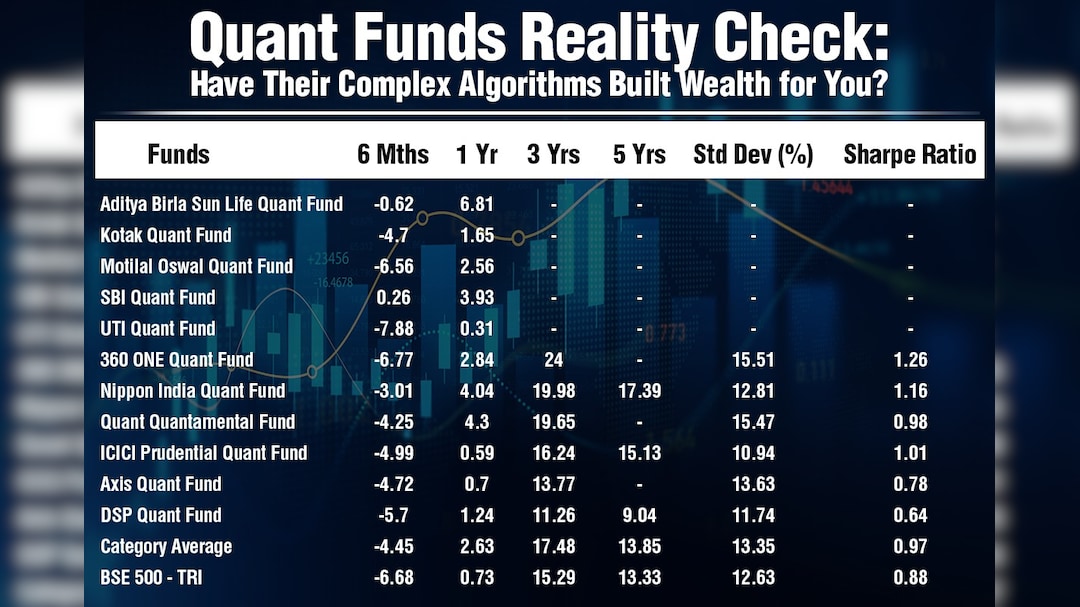
Only certain funds, such as 360 ONE Quant Fund, Nippon India Quant Quantamental Fund, have delivered appealing returns. Moreover, they have justified the risk taken through higher risk-adjusted returns (as indicated by their Sharpe ratios).
The point is that quant funds do not guarantee market-beating returns. Quant models are based on historical data points, which may or may not repeat in the future. Also, much depends on how efficient, agile, and adaptive the quantitative model or the algorithm is to the market scenario.
At times, the time lag in adapting to new developments also delays the fund manager's actions and ultimately impacts returns.
Also, if the fund is underweight to certain sectors that have actually been performing, then too the returns of quant-based funds could lag. For example, in 2025, many quantitative models were underweight on financial services (banks) and overweight on energy and commodities. Since banks performed well during this period, the algorithms missed a major market rally.
Besides, there are chances that the quantitative model might miss out on qualitative data such as management quality, internal processes, and other intangible and non-quantifiable assets. In comparison, the fund managers of an actively managed scheme, through their expertise, research, experience, and instincts, are better able to capture such nuances.
Currently, only those schemes with a longer performance track record have exhibited a compounded average growth rate for investors and justified the risk taken.
What Should Investors Do?
As AI and ML are still in the evolution stage, and quantitative models are yet to be refined to perfection, it would be imprudent to get carried away with quant-based funds. Only a small portion of the satellite part of your mutual fund portfolio can include one of the best-performing quant funds. And therein as well, you need a long-term time horizon, because quant-based models may take time to realise their full potential.
Invest sensibly.
Disclaimer: The views expressed in this article are solely those of the author and do not necessarily reflect the opinion of NDTV Profit or its affiliates. Readers are advised to conduct their own research or consult a qualified professional before making any investment or business decisions. NDTV Profit does not guarantee the accuracy, completeness, or reliability of the information presented in this article.
ALSO READ: How To Structure Mutual Fund Withdrawals In A Volatile Market
Essential Business Intelligence, Sharp Market Insights, Practical Personal Finance Advice, Daily Fuel, Gold and Silver Prices and Latest Stories — On NDTV Profit.