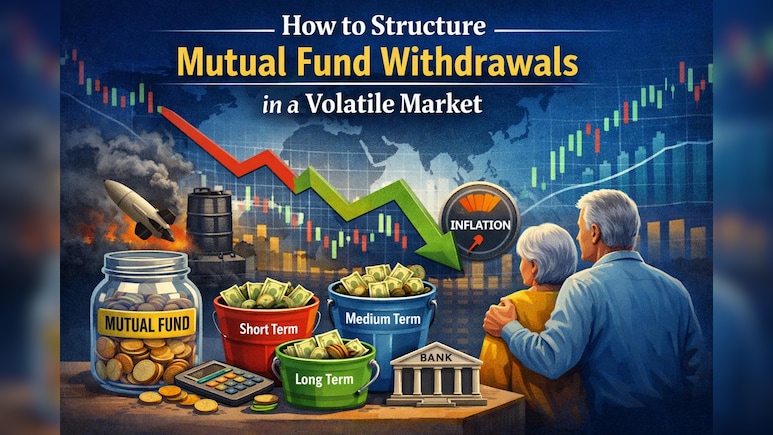
The Indian equity market has seen higher volatility amid the war in West Asia. India's VIX has risen to 20%, reflecting investor concern.
Those considering withdrawals are concerned about a fall in investment value, while others face losses. Those nearing retirement are assessing the impact on their retirement corpus.
Inflation concerns linked to the energy crisis and supply chain disruptions have added to the situation.
Also Read | Layoffs Are Rising In Tech, But These Skills Are Helping People Unlock Better Pay
The question is how to approach withdrawals or redemptions from mutual funds in such periods.
Withdrawals from mutual funds, in full or in part, should be considered only when:
- The financial goal has been met
- You are less than three years from the financial goal
- The mutual fund scheme is underperforming
- There is a change in the scheme's fundamental attributes or investment objective that does not align with your needs
- There is a better investment alternative
- There is a need for portfolio rebalancing
- You need the money
If none of these conditions is met, the exit may be driven by panic due to a fall in portfolio value.
If there are valid reasons to withdraw, a structured approach is required.
ALSO READ: IDCW Vs Growth: Which Mutual Fund Option Should You Choose And How To Switch Between The Two
The Bucketing Strategy
Assess when you need the money by dividing it into three buckets:
- You need the money in less than three years - Shift from equity mutual funds to debt fund categories such as banking and PSU debt funds, corporate bond funds, dynamic bond funds, short-duration debt funds with high-quality papers, and liquid funds. Bank fixed deposits may also be considered with an appropriate tenure. These options reduce exposure to volatility and are suitable when risk tolerance is low or retirement is near.
When the goal is close, redeem and hold the amount in a savings account for the financial goal.
- You need the money in the next three to five years - This is a medium-term period where some risk can be taken. Avoid withdrawing the entire corpus from equity funds. Review the types of equity funds held. If the portfolio includes small-cap, mid-cap, and sector or thematic funds, consider reducing exposure and shifting to large-cap funds, balanced funds, balanced advantage funds, suitable debt funds, and bank fixed deposits. Senior citizens may consider the Senior Citizens Savings Scheme, which offers an interest rate of 8.2% per year, compounded annually. This approach helps limit downside risk in volatile conditions.
- You need the money after five years - If the investment horizon exceeds five years and the portfolio holds suitable equity mutual fund schemes, continue to hold flexi-cap funds, value funds and large-cap funds. For longer horizons, consider mid-cap and small-cap funds with an investment horizon of seven to eight years or more.
Historical trends show that the Indian equity market has recovered from periods of uncertainty, geopolitical tensions and conflict after short-term declines. This was seen during the COVID-19 pandemic, the Russia-Ukraine war, the Middle East tensions of 2023-2024 and Operation Sindoor. Market declines were followed by recovery over time.
As the time horizon approaches, gradually shift from equity funds to debt funds and bank fixed deposits. Redeem when required and hold funds in a savings account for the financial goal.
A bucketing approach supports structured decision-making and avoids unplanned exits that may affect financial goals.
How To Withdraw Money For Retirement Needs
If investments are in suitable mutual fund schemes and performance is stable, a systematic withdrawal plan is an option instead of the IDCW option.
IDCW payouts depend on the fund manager's decision and are not guaranteed.
The SWP facility allows withdrawal of fixed amounts at regular intervals such as monthly, quarterly or annually. Investors can set the withdrawal rate and amount.
This process supports cash flow without full liquidation of investments, while the remaining corpus continues to generate returns. Only a portion of units is redeemed for each withdrawal, and the rest remain invested.
This enables rupee-cost averaging. More units are redeemed in a falling market and fewer in a rising market. The remaining corpus continues to grow.
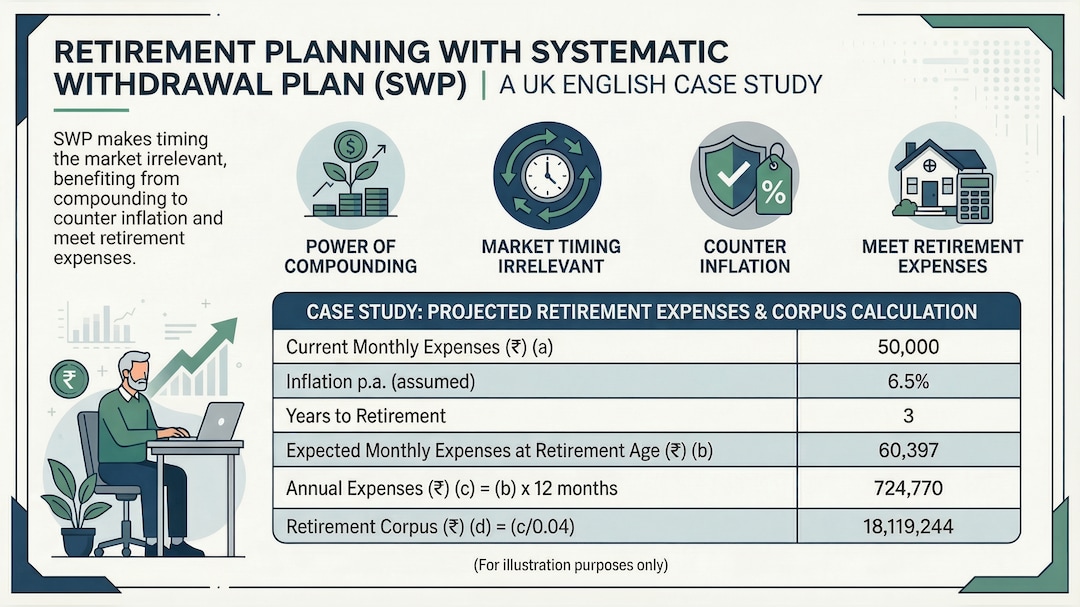
SWP reduces the need to time the market and allows the corpus to benefit from compounding while supporting regular withdrawals.
Case Study
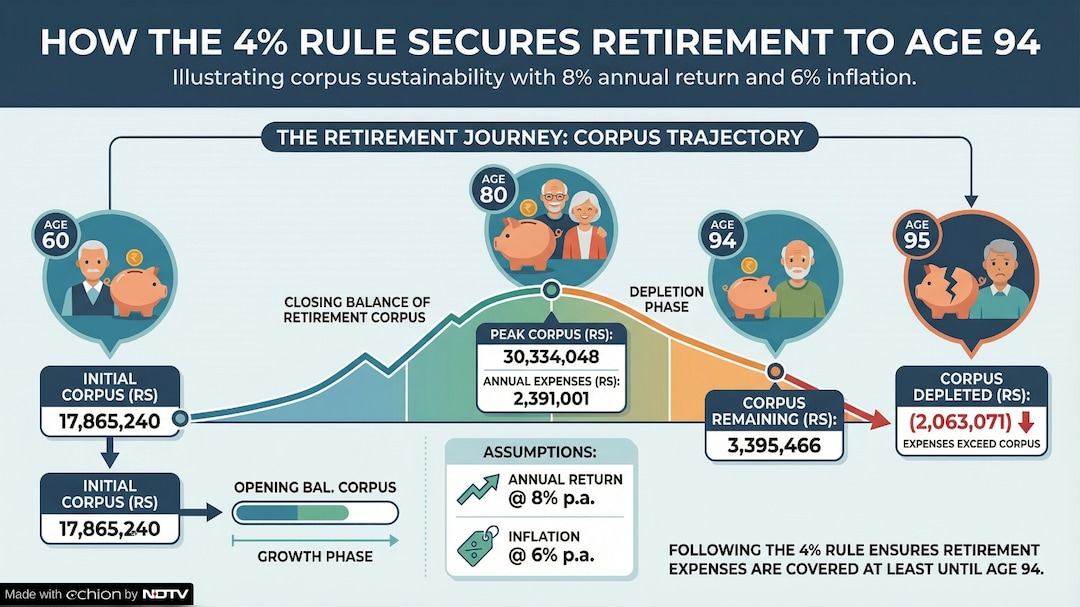
Assume an investor has built a corpus of Rs 1.80 crore in equity funds. Current monthly expenses are Rs 50,000. After three years, at retirement age 60, expenses are expected to be about Rs 60,397, assuming inflation of 6.5% per year.
Using the 4% rule, the corpus can support expenses until about age 94, assuming an annual return of 8%.
SWPs are subject to short-term capital gains tax at 20% or long-term capital gains tax at 12.5% on gains exceeding Rs 1.25 lakh, as applicable. IDCW payouts are taxed as per the investor's income tax slab.
SWP provides control over cash flows and supports a structured withdrawal approach.
To Conclude
When redeeming or withdrawing from mutual funds, a structured approach helps manage outcomes. Avoid unplanned exits that may affect financial goals.
ALSO READ: How A PPF Account Can Be Opened In A Minor Child's Name To Plan For Financial Goals
Disclaimer: The views expressed in this article are solely those of the author and do not necessarily reflect the opinion of NDTV Profit or its affiliates. Readers are advised to conduct their own research or consult a qualified professional before making any investment or business decisions. NDTV Profit does not guarantee the accuracy, completeness, or reliability of the information presented in this article.
Essential Business Intelligence, Sharp Market Insights, Practical Personal Finance Advice, Daily Fuel, Gold and Silver Prices and Latest Stories — On NDTV Profit.