- Shares of Indian Oil, BPCL, and HPCL fell over 2% amid US-Iran tensions and rising crude prices
- US airstrikes on Iran and sanctions revival sparked fears of Middle East supply disruptions
- Brent crude rose nearly 3% above $76 per barrel; WTI surpassed $72 per barrel on conflict news
Shares of India's state-run oil marketing companies (OMCs) Indian Oil Corp Ltd, Bharat Petroleum Corp Ltd, and Hindustan Petroleum Corp Ltd, tumbled in early trade on Wednesday, July 8, amid a surge in global crude oil prices on the ongoing geopolitical tensions between US and Iran. The US military launched airstrikes against Iran and reimposed crude sales sanctions, raising fears their fragile truce was unravelling and Middle East supplies could be disrupted again.
Shares of IOCL, BPCL, and HPCL opened nearly 2% lower each and extended losses to shed by 4% trade in red amid a broader bearish sentiment across the domestic frontline indices. On the NSE, shares of HPCL las traded 3.67% lower at Rs 391.05, IOC traded 2.12% lower at Rs 139.17, and BPCL shares were last down 3.47% lower at Rs 303.05 apiece on the NSE. The NSE Nifty 50 fell as much as 0.69% to 24,229. The BSE Sensex fell as much as 0.73% or 569 points to 77,611.91.
Also Read | Layoffs Are Rising In Tech, But These Skills Are Helping People Unlock Better Pay
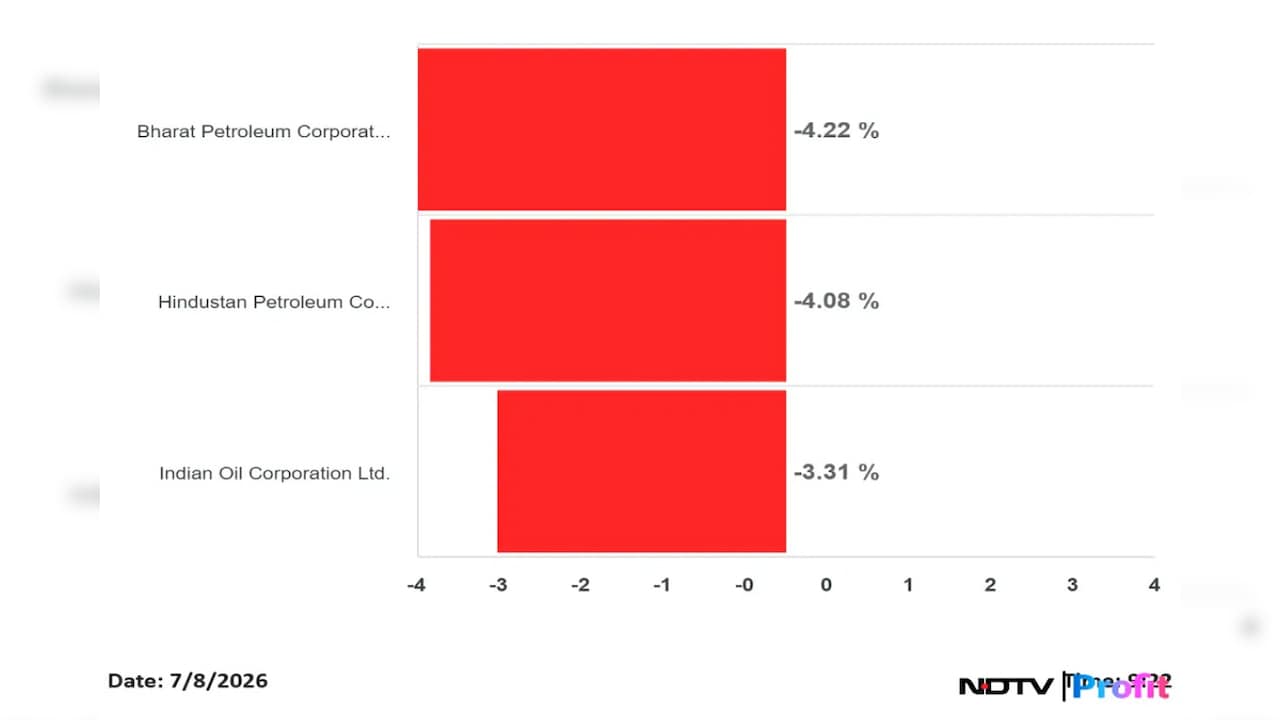
OMC stocks fall amid surge in Brent crude
Crude oil prices spike 3% amid renewed US-Iran tensions
Oil prices surged on Wednesday after the US launched military strikes against Iran, escalating tensions in the Middle East and raising fresh concerns over disruptions to global energy supplies. Brent crude climbed 2.8% to trade above $76 a barrel, while US benchmark West Texas Intermediate (WTI) rose above $72 per barrel. Both benchmarks rose about 3% on Tuesday after the US revoked the general licence authorising the sale of Iranian crude following the Iranian attacks.
The move came after the US said it had carried out "powerful strikes" against Iranian targets in response to a series of attacks on commercial vessels in the Strait of Hormuz, one of the world's busiest energy shipping routes. According to Iranian media, explosions were reported on an island near the strait, while Tehran vowed to respond.
Both benchmarks rose about 3% on Tuesday after the US revoked the general licence authorising the sale of Iranian crude following the Iranian attacks. Iran is asserting its control of the Strait and has ordered ships to use a route closer to its coast rather than one nearer to Oman, which also borders the waterway. The US insists the waterway must remain free to all as it was before the conflict started.
ALSO READ: 'Breach Of Commitment, MoU Violation': Iran Warns Of Consequences As US Revokes Oil Sanctions Waiver
The latest escalation also saw the US Treasury revoke a sanctions waiver that had allowed Iran to continue limited oil exports under last month's interim peace agreement. The decision tightens restrictions on Iranian crude sales once again. The renewed conflict has stoked fears over oil supply disruptions. The Strait of Hormuz handles one-fifth of global oil trade, making any military conflict in the region a major concern for energy markets.
Essential Business Intelligence, Sharp Market Insights, Practical Personal Finance Advice, Daily Fuel, Gold and Silver Prices and Latest Stories — On NDTV Profit.