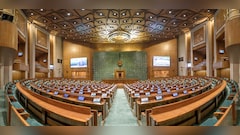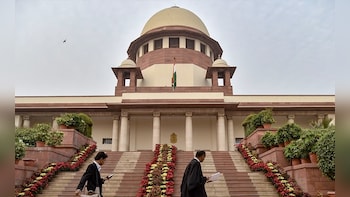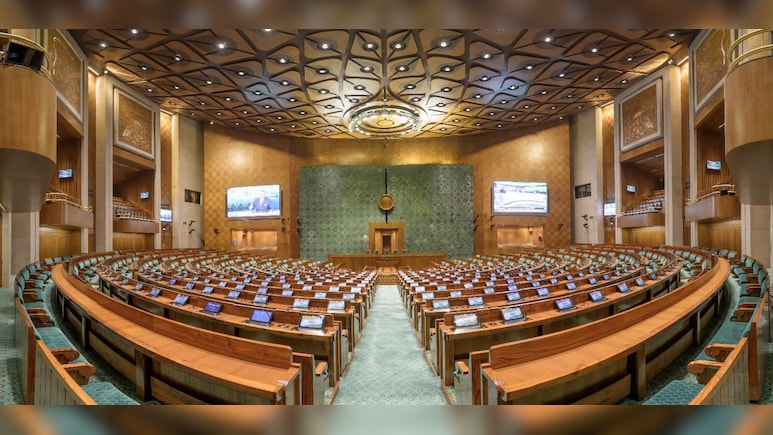
The Lok Sabha is scheduled to consider three key bills on Monday, setting the stage for a major legislative push on women's reservation and delimitation.
The proposed legislations seek to operationalise the 33 per cent quota for women in Parliament and state assemblies, alongside provisions for restructuring seat allocation and redrawing constituency boundaries.
ALSO READ : Lok Sabha Could Grow To 850 Seats: Why Stalin Is Now Calling Delimitation A Win For The South
Also Read | Layoffs Are Rising In Tech, But These Skills Are Helping People Unlock Better Pay
As per the Lok Sabha's List of Business released on Saturday, Law Minister Arjun Ram Meghwal is scheduled to move the Constitution (132nd Amendment) Bill, 2026, and the Delimitation (Second) Bill, 2026, for consideration and passage. Home Minister Amit Shah will move the Union Territories Laws (Amendment) Second Bill, 2026.
The three bills form part of the government's legislative push to operationalise women's reservation across legislative bodies, including the Lok Sabha, state assemblies and the three Union Territories with legislatures — Delhi, Jammu and Kashmir, and Puducherry.
What Does The Constitution Amendment Bill Propose?
At the heart of the proposed legislative exercise is the Constitution (132nd Amendment) Bill, 2026, which seeks to pave the way for 33 per cent reservation for women in Parliament and state legislative assemblies through the necessary constitutional amendments.
The women's reservation law provides for 33 per cent reservation for women in the Lok Sabha and state legislative assemblies. Its implementation is linked to the delimitation exercise and the related constitutional and legislative changes.
What Is The Delimitation Bill About?
The proposed Delimitation (Second) Bill, 2026, provides for restructuring the allocation of seats and redrawing constituency boundaries, alongside facilitating the rollout of the 33 per cent reservation for women in legislative bodies.
The exercise entails redrawing the boundaries of Lok Sabha and assembly constituencies and revising the distribution of seats in accordance with constitutional provisions. The proposed changes could reshape the strength and representational structure of elected legislatures.
What Do The Union Territories Amendments Cover?
The Union Territories Laws (Amendment) Second Bill, 2026, seeks to amend three existing laws — the Government of Union Territories Act, 1963, the Government of National Capital Territory of Delhi Act, 1991, and the Jammu and Kashmir Reorganisation Act, 2019.
The amendments are intended to extend the women's reservation framework to Delhi, Jammu and Kashmir and Puducherry, which have elected legislative assemblies.
Why Are Two Earlier Bills Being Withdrawn?
The government's agenda also provides for withdrawing the original Delimitation Bill, 2026, and the Union Territories Laws (Amendment) Bill, 2026, both introduced in the Lok Sabha on April 16. Revised versions of the two legislations will subsequently be introduced.
Meghwal will also move a motion seeking suspension of the application of the proviso to Rule 66 of the Lok Sabha Rules, insofar as it concerns the consideration and passage of the two bills that are dependent on the Constitution amendment.
All three revised bills are listed to be taken up together for consideration and passage on Monday.
Essential Business Intelligence, Sharp Market Insights, Practical Personal Finance Advice, Daily Fuel, Gold and Silver Prices, Watch Business News Live and Latest Stories — On NDTV Profit.