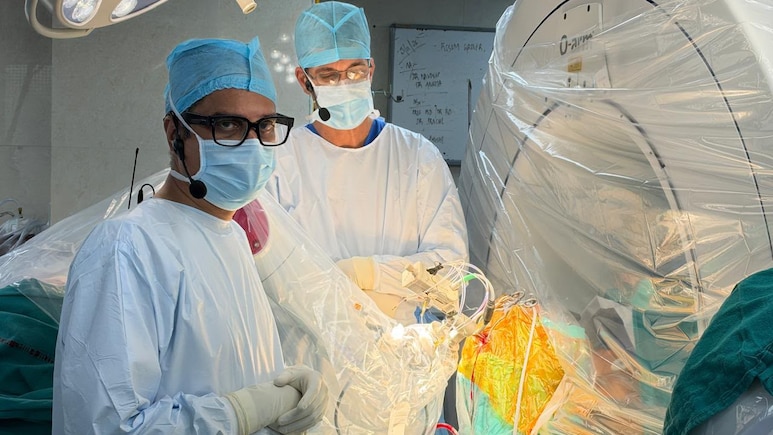
- Doctors at AIIMS New Delhi performed India's first robotic-guided deep brain stimulation procedure
- The surgery was done in collaboration with Tel Aviv University experts and AIIMS neurology teams
- DBS involves implanting electrodes in the brain to deliver electrical impulses altering brain activity
Doctors at the All India Institute of Medical Sciences (AIIMS), New Delhi, have performed the country's first robotic-guided deep brain stimulation (DBS) procedure for a patient with Parkinson's disease.
The procedure was done in collaboration with Tel Aviv University in Israel, AIIMS said in a post on X.
It was carried out by Prof P Sarat Chandra and Prof Ido Straus of Tel Aviv University, along with Prof Ela Varsi and Prof Manjari Tripathi. Teams from the hospital's neurosurgery and neurology departments were also involved.
Also Read | Layoffs Are Rising In Tech, But These Skills Are Helping People Unlock Better Pay
ALSO READ | Toxic Air Toll: Pollution-Linked Health Insurance Claims Jump 4.3x In Three Years, Delhi Tops List
DBS requires electrodes to be placed at very specific points in the brain. The robotic system helps doctors position these electrodes precisely, the hospital said, adding that this helps people living with Parkinson's.
AIIMS described the procedure as a milestone and congratulated the team.
How DBS Works
In deep brain stimulation, electrodes are implanted in certain parts of the brain. They deliver electrical impulses that alter brain activity. These impulses can also act on the cells and chemicals in the brain that are linked to some medical conditions.
ALSO READ | RTI Data Reveals Exodus Of Resident Doctor From AIIMS, JIPMER Over 36-Hour Work Schedule
The impulses are regulated by a small device, similar to a pacemaker, which sits under the skin in the upper chest. A wire running beneath the skin connects it to the electrodes in the brain.
India's first robotic-guided deep brain stimulation (DBS) for Parkinson's disease was performed at AIIMS, New Delhi, in collaboration with Tel Aviv University, Israel. The procedure was carried out by Prof. P. Sarat Chandra, together with Prof. Ido Straus of Tel Aviv University, and Prof. Ela Varsi and Prof. Manjari Tripathi, along with teams from the Departments of Neurosurgery and Neurology. Robotic guidance supports precise placement of the stimulation electrodes in the brain, helping people living with Parkinson's disease. We congratulate the entire team on this milestone. #ParkinsonsDisease #DeepBrainStimulation #RoboticSurgery #Neurosurgery #Neurology #AIIMSNewDelhi
— AIIMS, New Delhi ???????? (@aiims_newdelhi) November 28, 2026
Besides Parkinson's, the treatment is commonly used for essential tremor and for dystonia, a group of conditions in which muscles contract involuntarily, such as Meige syndrome. Doctors also use it for epilepsy, for obsessive-compulsive disorder and for Tourette syndrome, which causes repetitive movements and sounds.
Its use in several other conditions is still being studied. These include chorea, which involves quick movements that look like exaggerated fidgeting and is seen in Huntington's disease, as well as long-lasting pain, cluster headaches, dementia, depression, addiction and obesity.
ALSO READ | AIIMS INI CET 2026 Result Declared; 34,236 Candidates Qualify, Check PDF at aiimsexams.ac.in
AIIMS did not share details about the patient.
Essential Business Intelligence, Sharp Market Insights, Practical Personal Finance Advice, Daily Fuel, Gold and Silver Prices, Watch Business News Live and Latest Stories — On NDTV Profit.