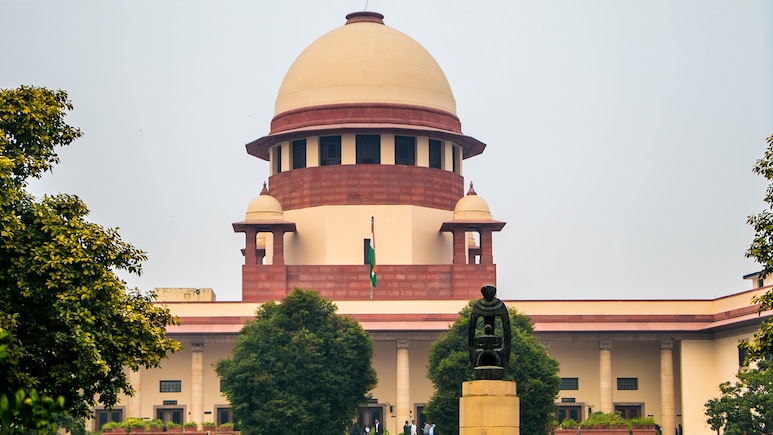
The Supreme Court has sought responses from the Centre, the Election Commission of India (ECI) and the Law Commission of India on a public interest litigation (PIL) that wants to stop elected representatives from using strategic resignations to escape disqualification under the anti-defection law.
A Bench of Chief Justice of India Surya Kant and Justices Joymalya Bagchi and V Mohana issued notices on Monday, including to the Ministries of Law and Justice and Parliamentary Affairs, on the petition filed by A Sethu.
As per reports, the plea is concerned with legislators who resign when disqualification proceedings under the Tenth Schedule of the Constitution are pending or expected. It argues that this lets them avoid the consequences of defection and influence the numerical strength of legislative assemblies. The petition was filed through advocates R Satish Kumar and Jatin, and Senior Advocate A Sirajudeen appeared for the petitioner.
Also Read | Layoffs Are Rising In Tech, But These Skills Are Helping People Unlock Better Pay
ALSO READ: 'Stop Behaving Like Bahubali': SC Rebukes Bihar Judge, Questions His Legal Understanding
Interestingly, the court has tagged the matter with another petition, K Suthan v. Union of India. That petition raises the question of recovering election expenditure from a candidate who wins on one party's ticket, resigns and then contests again for another party.
The petitioner argues that legislators often resign before the Speaker or Chairman can decide the allegations against them. Combined with delays in deciding disqualification petitions, this could enable political realignments and affect the survival of elected governments. The plea says resignation and disqualification fall under separate constitutional provisions, so stepping down after an alleged act of defection should not automatically end pending proceedings. It relies on the Supreme Court's ruling in Shrimanth Balasaheb Patil v. Hon'ble Speaker, Karnataka Legislative Assembly, which held that resignation alone does not make a disqualification proceeding infructuous.
The petition, as reported, states, "A resignation process that can be used to postpone, and then to avoid, the consequences of defection, coupled with the absence of any enforced time-limit for deciding disqualification petitions, impairs the integrity of the electoral mandate".
It also points out that delayed decisions can lose their meaning if the assembly's term ends, a by-election is held, or the government falls or survives before the disqualification question is settled.
The petition seeks a series of changes. It asks the Union government to consider a statutory deadline, ordinarily capped at three months, for deciding disqualification petitions, with exceptions only for recorded reasons. It relies on Keisham Meghachandra Singh v. Hon'ble Speaker, Manipur Legislative Assembly, which indicated a three-month period. It also questions the role of Speakers and Chairpersons as adjudicators, citing their political ties and dependence on the House, and urges the Centre and the Law Commission to examine an independent, permanent tribunal.
ALSO READ: Only BS-VI Vehicles In Delhi? Supreme Court's Big Remark Amid Pollution Crisis
Interestingly, the plea also asks for a bar on rewarding such resignations. It seeks a declaration that legislators who resign while facing, or likely to face, disqualification proceedings should not be appointed ministers or given remunerative political posts until the matter is decided in their favour or they win re-election. The plea links this to Articles 75(1B), 164(1B) and 361B. It additionally asks for public disclosure of resignation letters, notices, replies, hearing dates and orders, subject to necessary redactions.
On hung assemblies, the petitioner wants a declaration that a claim of majority must be proved on the floor of a duly constituted House, after members take their oaths under Article 188. Letters of support or shows of strength outside the legislature should not be accepted instead, the plea says.
The petitioner also cites Kihoto Hollohan v. Zachillhu, Subhash Desai v. Principal Secretary, Governor of Maharashtra and Padi Kaushik Reddy v. State of Telangana. However, according to the plea, representations sent earlier to the President, Prime Minister, Union Law Minister, Lok Sabha Speaker, Rajya Sabha Chairperson, Chief Election Commissioner and Law Commission brought no substantive response.
Essential Business Intelligence, Sharp Market Insights, Practical Personal Finance Advice, Daily Fuel, Gold and Silver Prices, Watch Business News Live and Latest Stories — On NDTV Profit.