The Cauvery water dispute has been haunting the states of Karnataka and Tamil Nadu since the 19th century and both states have repeatedly accused the other of reneging on several arguments.
The Dispute Starts Pre-Independence
The dispute started in 1892 when the Madras Presidency (under the British Raj) sought to restrain the princely State of Mysore from building irrigation dams, saying it would impede the flow of water from 15 rivers, including the Cauvery. The Madras Presidency and Mysore entered into agreements in in 1892 and then in 1924, regarding the distribution of the water from the Cauvery. The 1924 pact would be valid for 50 years. Some clarifications were made to that agreement in 1929, which divided water from the river between the key southern states as follows:
- 75% with Tamil Nadu and Puducherry
- 23% to Karnataka
- Remaining to go to Kerala
The Post-Independence Timeline
After independence, and after the reorganisation of states in 1956, Karnataka and Tamil Nadu got embroiled in further disputes regarding the former's plan to build more four reservoirs across four tributaries of the Cauvery. From 1959 continuing throughout the 60s, Tamil Nadu opposed Karnataka's plan.
Historically, Karnataka had fewer irrigation systems than Tamil Nadu and played catch up for most of the 20th century, and contended that the agreements were heavily skewed in favour of Tamil Nadu.
In 1971, Tamil Nadu filed a case in the Supreme Court to resolve the water dispute between the two states but that was withdrawn in 1971.
In 1974, the 1924 agreement lapsed. The Karnataka government said the agreement was heavily skewed against it since the then Madras Presidency was controlled by the British and the state of Mysore was administered by the king. Tamil Nadu argued that it was heavily dependent on the existing pattern of usage and that any change would have an adverse effect on the livelihood of millions of farmers in the state.
In 1986, Tamil Nadu approached the Centre and asked for a tribunal to be set up.
In 1990, the Supreme Court directed the Centre to set up the tribunal, acting on a write petition filed by a Tamil Nadu organisation on the Cauvery water dispute.
In 1991, the Central government set up the Cauvery Water Dispute Tribunal on the Supreme Court's order. Later in the year, the CWDT awarded interim relief to Tamil Nadu, directing Karnataka to release water to its neighboring state. However, Karnataka refused to comply. Tensions escalated between the two states after the 1991 interim order.
In the same year, Karnataka passed ordinances nullifying the tribunal's interim order. The Supreme Court struck down that ordinance, thereby upholding the tribunal's awards. In response, then Karnataka Chief Minister S Bangarappa declared a bandh in the state.
In 1998, the Centre constituted the Cauvery River Authority to implement the interim award of the Cauvery Water Dispute Tribunal.
In 2002, Cauvery River Authority chaired by then Prime Minister AB Vajpayee, directed Karnataka to release 9,000 cusecs (0.8 thousand million cubic feet) of Cauvery water to Tamil Nadu. Unhappy with the move, Tamil Nadu decided to move the Supreme Court. In the same year, a farmer jumped into the Kabini Reservoir resulting in a fatality. Talks between the two states continued without any result.
In 2005, Karnataka refused to release Cauvery water to Tamil Nadu.
In 2007, the tribunal gave its final verdict upholding the original agreement between Madras and Mysore in 1982 and 1924 valid, resulting in widespread protests and a state-wide bandh in Karnataka.
Then Tamil Nadu Chief Minister J Jayalalithaa went on a fast, demanding publication of the final award of the tribunal in the Centre's official gazette.
In 2010, Cauvery river rose owing to good rainfall in the catchment areas in Kodagu district and the Stanley reservoir, the lifeline of the Cauvery delta, touched the full reservoir level.
In 2012, Jayalalithaa sought a meeting of the Cauvery River Authority in May. In September, then Prime Minister Manmohan Singh directed Karnataka to release 9,000 cusecs of Cauvery water into Tamil Nadu. Chief Ministers of both the states called the PM's direction unacceptable. Supreme Court slammed both states for not complying with the directive.
In 2013, Centre notified the final award of the tribunal between sharing of Cauvery water between Karnataka, Tamil Nadu, Kerala and Puducherry. Tamil Nadu moved the Supreme Court seeking Rs 2,480 crore in damages from Karnataka for not following the orders of the tribunal.
In September, 2016, Supreme Court directed Karnataka to release 15,000 cusecs of water into Tamil Nadu per day for the next 10 days to save certain crops in Tamil Nadu. While Karnataka began to release water into Tamil Nadu as per the judgement for a few days, it finally succumbed to public protests and filed a plea with Supreme Court. The court issued a strict warning to the public of both the states and reduced the amount to 12,000 cusecs.
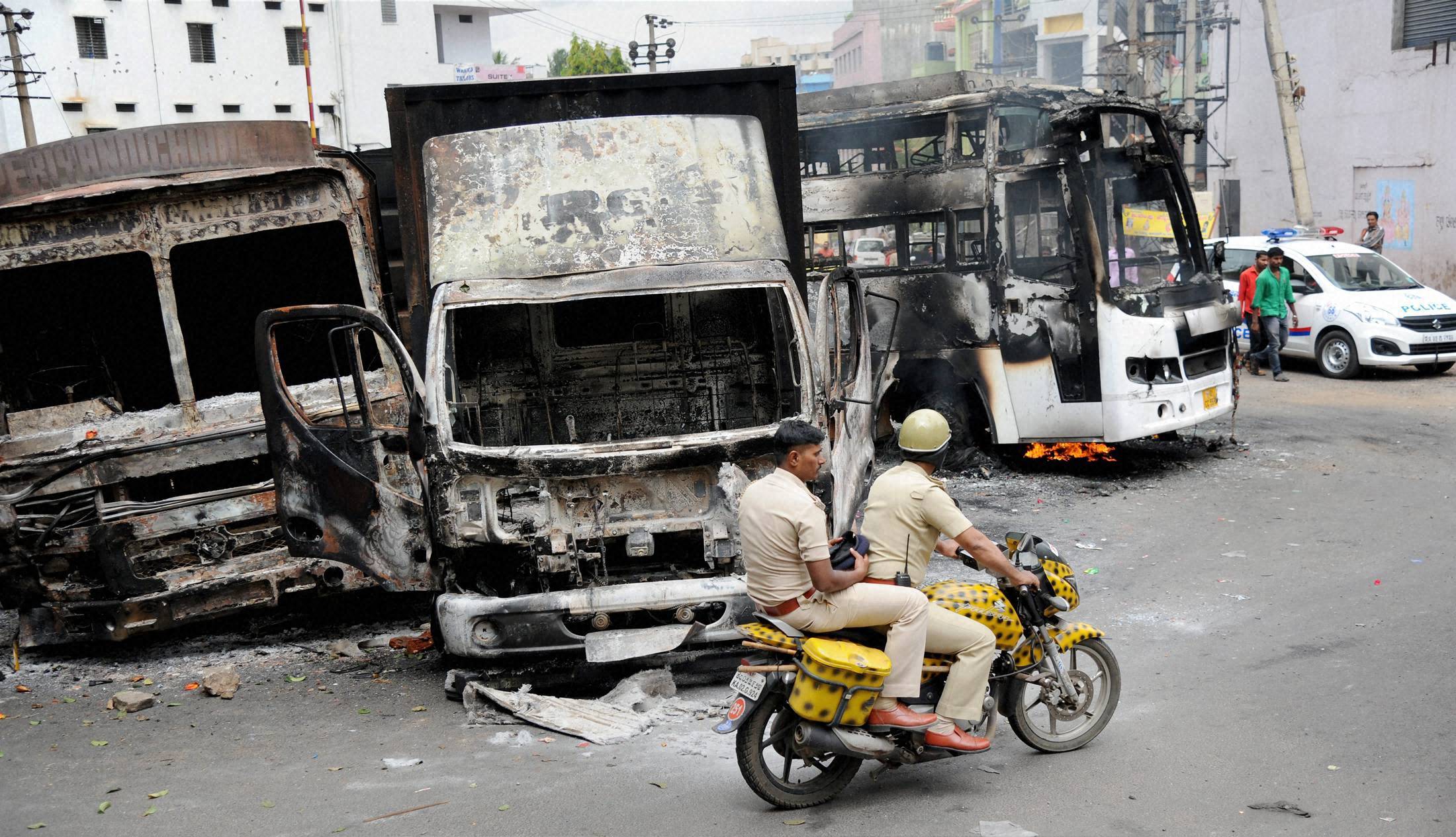
One person died and four were injured in police firing. Mobs attack businesses with Tamil names. A curfew was imposed in seven police station limits of Bengaluru. The violence virtually paralysed the Bengaluru-Mysuru highway.
Prohibitory orders under Section 144 were imposed in Bengaluru and Mysuru, areas around four reservoirs in the Cauvery basin, and Pandavapura in Mandya district.
Also Read:
Cauvery Issue: Modi Expresses ‘Personal Pain' Over Dispute
Cauvery Row: Karnataka Government Warns Of Stringent Action Against Vandalism
Essential Business Intelligence, Continuous LIVE TV, Sharp Market Insights, Practical Personal Finance Advice and Latest Stories — On NDTV Profit.